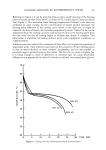
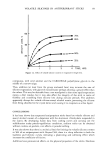
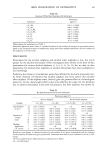
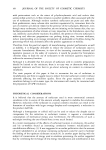
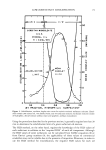
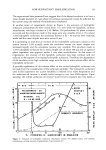
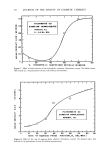
LOW-SURFACTANT EMULSIFICATION 175 The experimental data presented here suggest that if the desired emulsion is to have a mean droplet diameter of 2/•m about 3% sorbitan monolaurate would be sufficient for the system using the method of emulsification employed. In another series of experiments shown in Figure 5, the amounts of hydrophilic surfactant, polysorbate-20, were varied from 1 to 3.5% while the lipophilic, sorbitan monolaurate, was kept constant at 2.5%. Below 1.5% polysorbate-20, phase inversion occurred and the emulsions made in this range were very unstable. From 1.75 to about 2.25% hydrophilic surfactant, the emulsions formed at R = 40 ml/min were relatively stable and the mean droplet sizes were around 2/•m. It is interesting to note that an increase of the hydrophilic surfactant content in this system beyond 2.25% actually made the emulsions worse the mean droplet size increased rapidly and the emulsions became very unstable. The emulsion made at 3.25% hydrophilic surfactant had a mean droplet size of about 300/•m and an aqueous phase separation was apparent within 5 min after emulsification. In this series of experiments, the amount of the lipophilic surfactant was kept constant and not reduced at the expense of increasing hydrophilic surfactant. Therefore, the degradation of the emulsion in the high surfactant range must be due to some adverse effect of the hydrophilic surfactant. A possible explanation of this adverse effect of the excess hydrophilic surfactant can be made from the consideration of the surfactant solubility. The hydrophilic surfactant used in this experiment has a poor solubility in mineral oil at room temperature and the surfactant-oil mixture is usually turbid except in very low HLB regions. Upon standing, the turbid, surfactant-oil mixture would tend to separate into two layers, a I I w/o -J-•-• 0 POL¾SORBATE - 20 O_ SOR BITAN MONOLAURATE ,_1 MINERAL OIL -..- R = 40 ML/MIN I I I o/w EAN i•) DROPLET • SIZE ,t,, C o 0 0 I 1.5 2,, 2.5 3 [5 HYDROPHILIC SURFACTANT IN EMULSION Figure 5. Variation of hydrophilic surfactant. (Emulsions contain 75% distilled water, 2.5% sorbitan monolaurate, varying amounts of polysorbate-20 and mineral oil.)

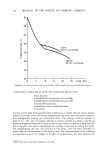
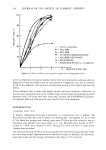
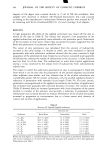
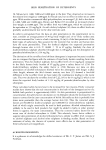
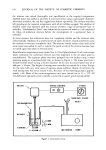
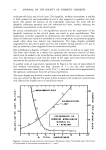
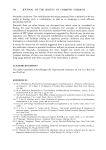
176 JOURNAL OF THE SOCIETY OF COSMETIC CHEMISTS surfactant-rich layer and oil-rich layer. The lipophilic, sorbitan monooleate, is soluble in both mineral oil and polysorbate-20 and is thus expected to partition into both layers. The greater the amount of the hydrophilic surfactant, the more will the lipophilic surfactant partition into the surfactant-rich layer, thereby reducing the surfactant concentration in the oil-rich phase. By nature, emulsification is a non-equilibrium process and the deprivation of the lipophilic surfactant in the oil-rich phase can result in poor emulsification. This explanation is further supported by observations that whenever such a nonhomoge- neous oil-surfactant mixture is emulsified at room temperature, the photomicrographs would often show two distinct size distributions. The large droplets probably originated from the oil-rich phase and very fine droplets, having diameters of 1/am or less, are believed to have originated from the surfactant-rich phase. The solubilization diagram in Figure 5 shows a lower limit as well as an upper limit. The lower limit shown by a dotted line represents the minimum amount of water which must be added to the oil-surfactant mixture before the mixture would become clear. It is interesting to note that the width of the upper and lower limits becomes narrower as the amount of hydrophilic surfactant is increased. In another series of experiments represented by Figure 6, the ratio of polysorbate-20 and sorbitan monolaurate was kept constant at 2:3, but the total surfactant concentrations were varied from 3 to 8%. The 2: 3 ratio was found to be approximately the optimum combination from the previous experiments. The mean droplet size showed a marked reduction with the total surfactant concentra- tion up to about 5%. Beyond this point, further increase in the surfactant concentration only reduced the droplet size to a much lesser extent. z o J o 15 IO MEAN DROPLET SIZE SOLUBiLiZATi ON LIMIT $0 2O •1 J o POLY80RBATE- 20 $ORBiTAN MONOLAURATE MINERAL OIL • R = 80 MLIMIN õ 6 TOTAL o 2 3 4 7 8 9 io % $URFACTANT$ Figure 6. Variation of total surfactant concentration. (Emulsions contain 75% distilled water, 20% mineral oil, polysorbate-20 and sorbitan monolaurate at 2 ß 3 ratio.)
Purchased for the exclusive use of nofirst nolast (unknown)
From: SCC Media Library & Resource Center (library.scconline.org)