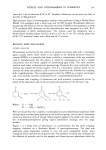
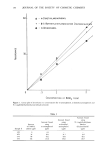
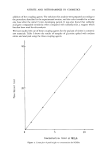
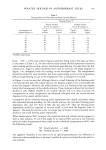
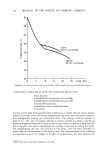
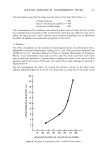
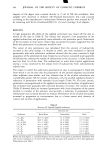
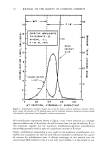
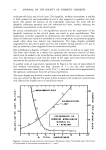
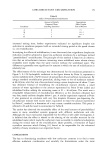
NITRITE AND NITROSAMINES IN COSMETICS 131 addition of the coupling agents. The solutions for analysis were prepared according to the procedure described in the experimental section, and the color is stable for at least one hour after the initial 15-rain developing period. It was also found that sulfanilic acid gave comparable sensitivity when compared with sulfanilamide, a reagent which has also been used for this analysis. We have studied the use of these coupling agents for the analysis of nitrite in cosmetic raw materials. Table I shows the results of samples of glycerine spiked with sodium nitrite and analyzed using the three coupling agents. 4O 2O 5 10 CONCENTRATION (PPM) OF NDELA Figure 2. Linear plot of peak height vs. concentration for NDEIA.

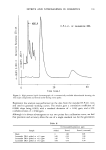
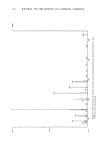
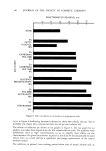
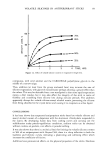
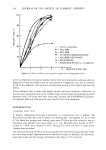
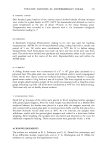
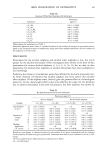
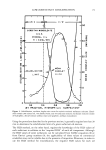
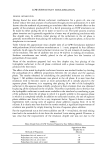
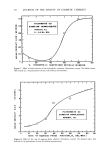
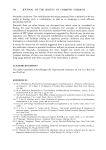
132 JOURNAL OF THE SOCIETY OF COSMETIC CHEMISTS The m-aminophenol coupling reagent also gave linear absorbance plots with standard nitrite solutions in methanol/water mixtures. Thus the technique is applicable to materials which are insoluble in water, but soluble in the mixed solvent system. For example, this has been used to analyze a suspension of magnesium aluminum silicate, which normally forms highly viscous aqueous suspensions, and sodium lauryl sulfate, which becomes pearlescent in straight aqueous solution. In conclusion, both m-aminophenol and dimethylaminophenol can provide an alternate, simple quantitative method for the analysis of nitrite in cosmetic raw materials, when compared with N-l-naphthylethylenediamine dihydrochloride. The latter is more sensitive than the modified Griess reagent and both reagents offer increased stability of the stock solutions. Additionally, these couplers provide the chemist a choice of scanning regions when interfering substances prevent the use of the Griess reagent. NITROSAMINE ANALYSIS The alkanolamides are a class of cosmetic raw materials commonly used as wetting agents in shampoos and lotions. They are produced by the condensation of diethanolamine and either a fatty acid or its methyl ester. If during their manufacture a nitrite source is present, there is a high probability that detectable levels of NDE1A could be produced and find their way into manufactured cosmetic products. At the present time, several methods are available for the determination of NDEIA from a variety of matrices. Most of these methods, however, involve extraction procedures and elaborate sample preparation. None of the methods has been applied to alkanolamides. Our approach to the determination of nitrosamines in alkanolamides has been two-fold: first, the development of a simple screening method using direct sampling and analysis using H.P.L.C. with a detection limit of --- ppm second, the detection of NDE1A using H.P.L.C. area collection followed by silylation and G.C.-nitrogen specific detection of the silylated derivative. This method can detect NDE1A at ppb levels. Final confirmation for both methods has been done by G.C.-M.S. It has been shown that pure standards of NDE1A run by H.P.L.C. show a linear correlation between peak height and concentration down to the low ppb region (9). We have shown that this relationship continues to hold true in the low ppm region, as can be seen in Figure 2. High pressure liquid chromatography of commercially available alkanolamides shows one or two major peaks and several earlier eluting minor peaks using methanol:water (60:40 V/V) as the eluting solvent. Figure 3 is a typical H.P.L.C. showing the major and minor components. Peak//2 has been isolated, silylated and identified as NDEIA by G.C.-M.S. Addition of known NDEIA also showed an enhancement of Peak//2. The mass spectrum of the silylated derivative of NDE1A collected from an unspiked alkanolamide is shown in Figure 4 and is consistent with that reported in the literature (7). The experimental H.P.L.C. procedures involved the generation of a standard NDE1A curve at the 1-10 ppm level followed by injection of a 50% W/V solution of the alkanolamide. Concentrations of NDE1A were then calculated directly from peak height of the identified nitrosamine. Quantitation of the method was demonstrated by additive spiking experiments, results of which are shown in Table II.
Purchased for the exclusive use of nofirst nolast (unknown)
From: SCC Media Library & Resource Center (library.scconline.org)