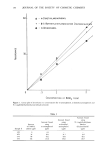
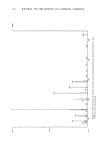
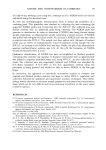
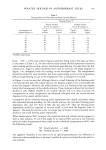
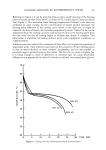
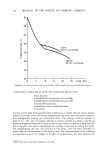
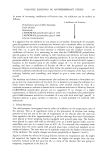
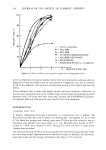
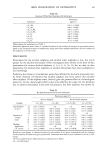
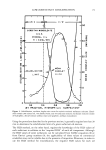
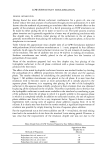
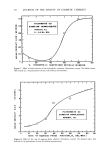
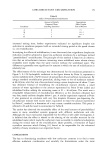
146 JOURNAL OF THE SOCIETY OF COSMETIC CHEMISTS [- 90 o 80 o 70 uJ •0 50 40 5 pbw 10 pbw 0 10 20 30 40 50 TIME, MIN. Figure 7. Cooling curves for stearamide (MP = 104øC)--volatile silicone--stearyl alcohol. II. PHYSICAL PROPERTY CHARACTERISTICS Three characteristics of suspensoid antiperspirant sticks were selected for investigation of additive effects: hardness, lubricity and silicone retention. Each is associated with some perceivable qualities of a stick, and each is susceptible to a measurable change from incorporation of an additive. It was recognized, however, that these three characteristics do not fully define the aesthetics of a stick for improvement in appearance, integrity (reduced friability and crumbling) and payoff are equally important though they would not show up in these measurement dimensions. Table II Freezing Points and Fusion Times for Volatile Silicone-Stearyl Alcohol-Additive Systems Concentration, Freezing Atf Additive pbw Point, øC Min/100 g None 0 52 10 Cetyl Alcohol 5 49 11 10 47 14 CARBOWAX PEG 1000 and 1540 2 53 15 4 53 15 Glycerol Monostearate 5 50 18 10 50 19 PEG 6000 Distearate 5 52.5 18 10 52.0 18 Stearamide 5 52.0 12 10 52.0 12

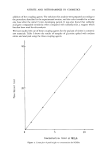
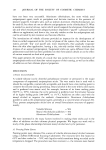
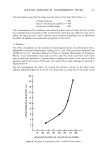
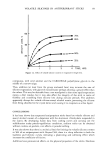
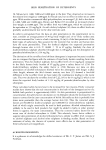
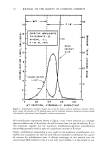
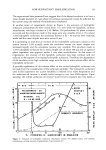
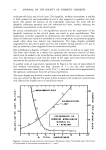
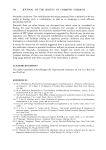
VOLATILE SILICONES IN ANTIPERSPIRANT STICKS 147 The formulation used for the sticks was the same as that described above, i.e., Volatile Silicone = 50% Stearyl Alcohol plus additives = 30% Aluminum Chlorhydrate = 20% The concentration of the additives was subtracted from that of stearyl alcohol, so that the combined total remained at 30%. It should be noted that our objective was not to define the optimal stick, which involves many subjective qualities, but to determine the effect of additives on measurable properties of the sticks. A. Hardness The effect of additives on the hardness of antiperspirant sticks was determined with a Humboldt Universal Penetrometer reading to 0.1 mm. The procedure followed was ASTM D-1321-70, "Standard Method of Test for Needle Penetration of Petroleum Waxes." Each formulation was made up twice and two sticks cast from each batch were divided into quadrants. A penetrometer reading was taken in the center of each quadrant and in the center of the stick. The results from these readings are plotted in Figures 8 and 9. We first investigated the effect of varying the silicone content in the basic stick without additives (Figure 8). It can be seen that there is a steep rise in the slope of the 20- 18 16- 14- 12- 10- 8- 6- 4- 2-- , I I i I I I ! l,, 10 20 30 40 50 60 70 80 CONCENTRATION OF VOLATILE SILICONE Figure 8. Hardness of antiperspirant stick vs. volatile silicone content.
Purchased for the exclusive use of nofirst nolast (unknown)
From: SCC Media Library & Resource Center (library.scconline.org)