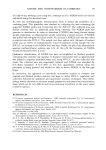
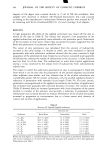
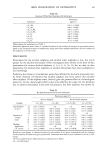
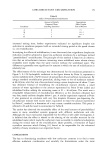
160 JOURNAL OF THE SOCIETY OF COSMETIC CHEMISTS aliquots of the digest were counted directly in 15 ml of NE 260 scintillator. Skin samples were dissolved in Soluene 100 (Packard Instruments Ltd.) and counted according to the manufacturer's instructions. Protective patches were assayed for •4C by extracting with 50 ml of methanol/H20 (1:1 v/v) and counting 1.0 ml aliquots. RESULTS A high proportion (86-102%) of the applied surfactants was rinsed off the skin as shown by the data in Table II. The treated skin retained a low proportion of the applied radioactivity and practically none adhered to the protective patch. Summation of the recoveries in rinse water, treated skin and protective patch suggested that the likely skin penetration of surfactants would be low. The extent of skin penetration was calculated from the amount of radioactivity excreted in the urine during 2 d. Studies in which rats were intubated or injected parenterally with each radioactive surfactant showed that the urine contained a high proportion of the administered dose. Expired air and faeces contained small quantities of radioactivity, whereas the residue of radioactivity in the carcass at 2 d after injection was less than 1% of the dose. The radioactivity in urine from topical applications during 2 d was corrected by the urinary level of radioactivity from subcutaneously injected rats. The extent to which the surfactants penetrated rat skin is summarised in Table III, from which it can be seen that the penetration of the alcohol sulphates and alcohol ether sulphates were similar, and low, whereas that of the alcohol ethoxylates was considerably greater. Of the anionic surfactants, only the alcohol sulphates showed a reduction in penetration with extended chain length (Table IV). For each anionic, penetration was proportional to the applied concentration and number of applications, but increased more gradually with extended duration of contact. The nonionic series (Table V) showed firstly an increased penetration with chain elongation of the parent alcohol, in contrast to the anionics, and secondly a reduction in penetration when ethoxylation was increased beyond six residues. Penetration of the alcohol ethoxylates increased in proportion to concentration, but to a lesser extent with duration of contact and number of applications. Table II Recovery Of Topically Applied Surfactants Recovery (%) Surfactant Rinse Water Treated Skin Patch n C,2 S04 86.7 + 1.4(10) 5.1 + 0.7(10) 0.2 + 0.1(10) n C,, SO4 89.8 + 1.6(6) 1.9 4- 0.2(6) 0.5 + 0.1(6) n C,2 E 3 SO4 92.1 + 10.4(3) 5.8 4- 0.9(3) 1.2 + 0.2(3) n C,5 E t SO4 85.1 + 2.9(6) 2.8 -4- 0.6(6) 1.4 + 0.2(6) n Cu E3 89.4 + 12.2(3) 2.3 ___ 0.2(3) •. + 0.3(3) n C•2 E6 9O.2 + 2.8(9) 2.9 + 0.3(9) 1.6 + 0.2(9) n C•2 E•o 10.2 + 2.2(3) 1.5 -4- 0.3(3) 0.4 + 0.1(3) n C•5 E 3 85.8 + 6.9(10) 7.3 4- 1.9(10) 8.2 4- 4.0(10) Results are mean figures + standard with 1% (w/v) surfactant in 1% (w/v) Abbreviations as in Table 1. deviation for the number of rats given in parenthesis. Treatments were LAS. Treated skin and patch were analysed at 48 hr after application.

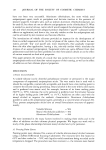
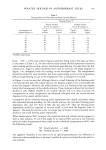
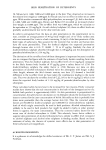
SKIN PENETRATION OF DETERGENTS 161 Table III Summary Of Rat Skin Penetration By Surfactants Penetration Surfactant a (/•g/cm 2) n Cu SO4 0.26 + 0.14(10) n C•5 SO4 0.08 + 0.04(6) n Cu E 3 504 0.39 + 0.12(3) n C•5 E 3 SO 4 0.26 + 0.19(11) n Cu E 3 4.38 + 0.54(3) n C• E 6 4.88 + 0.42(9) n C• E•o 0.85 + 0.26(3) n C•5 E 3 8.3 + 4.5(10) •Abbreviations for surfactants as in Table 1. Penetration figures are mean results _ standard deviation for the number of rats given in parenthesis and are based on the corrected excretion of radioactivity during 48 hr from animals treated with 1% (w/v) solution of the surfactant in 1% (w/v) LAS. DISCUSSION Penetration for the alcohol sulphates and alcohol ether sulphates is low, but much greater for the alcohol ethoxylates. Other investigators have shown a low level of skin penetration for various alcohol sulphates (1, 4, 6, 9, 15, 30, 31), but no data on skin penetration for alcohol ether sulphates or alcohol ethoxylates have been published to our knowledge. Predictive skin irritancy of surfactants seems best afforded by the hand-immersion test, by which Smeenk (32) showed that alcohol sulphate was more potent than alcohol ether sulphate. Of the sulphate series, dodecyl gave the greatest effect in a homologous series (33, 34), the chain length which is also most effective for soaps (35, 36). Irritation due to alcohol ethoxylates is less well documented, but little response was shown by Table IV Rat Skin Penetration Of Anionic Surfactants Penetration (/•g/cm 2) Alcohol Sulphate Alcohol Ether Sulphate Variable n C• SO4 n C•5 SO 4 n C• E t SO4 n C•5 E 3 SO4 Concentration 0.2 0.02 ñ 0.01(3) n.d. n.d. 0.08 ___ 0.02(3) (% w/v) 0.5 0.11 + 0.05(3) 0.04 ñ 0.02(3) 0.11 + 0.01(3) 0.13 + 0.04(3) 1.0 0.23 + 0.11(3) 0.09 ñ 0.04(3) 0.39 + 0.12(3) 0.15 ñ 0.03(3) 2.0 0.84 ñ 0.52(3) 0.26 + 0.12(3) 0.79 ñ 0.75(3) n.d. Duration of 1 0.25 ___ 0.14(3) a 0.05 ñ 0.04(3) 0.48 ___ 0.16a(3) 0.28 ----- 0.10(3) Contact 5 0.47 ___ 0.38(3) a 0.07 ñ 0.03(3) 0.75 ----- 0.13a(3) 0.28 ñ 0.10(3) (min) 10 0.69 ñ 0.15(3) a 0.15 q- 0.01(3) 0.77 ñ 0.45a(3) 0.36 q- 0.10(3) 20 0.97 q- 0.23(3) a 0.14 _____ 0.02(3) 0.93 ñ 0.39a(3) 0.46 q- 0.10(3) Multiple 1 0.14 ñ 0.05(4) 0.04 ñ 0.02(3• 0.11 ñ 0.01(3)• 0.46 ñ 0.22(3) Application 2 0.25 ñ 0.07(4) n.d. n.d. 1.74 q- 0.18(3) (X 5 mins) 4 0.36 q- 0.09(4) 0.21 ___ 0.07(3)• 0.38 q- 0.19(3):• 2.86 ___ 0.62(3) Results are mean figures q- standard deviation for the number of rats given in parenthesis and are corrected for the excretion of radioactivity given parenterally. Treatments were with 1% (w/v) surfactant in 1% (w/v) LAS, except a2% (W/V) and :•0.5% (w/v). Abbreviations for surfactants as in Table 1. n.d.--not determined.
Purchased for the exclusive use of nofirst nolast (unknown)
From: SCC Media Library & Resource Center (library.scconline.org)