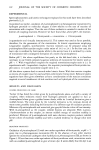
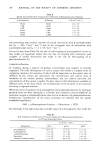
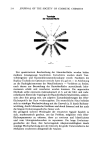
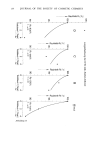
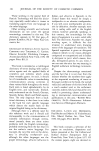
194 JOURNAL OF THE SOCIETY OF COSMETIC CHEMISTS .055 Figure 2. Formation of indophenols. Reaction of p-aminophenols with monohydric phenols under oxidative conditions (8) produces indophenols, as shown in Figure 2. Many of these dyes have been isolated and fully characterized (8). When a mixture of p-aminophenol and resorcinol is oxidized at high pH, an intense blue color develops. By analogy with indophenols, this is believed to be due to the formation of 2-hydroxyindophenol (VI). Attempts to isolate such products have been unsuccessful due to their poor stability. HO HO VI Reaction ofp-aminophenols with m-aminophenol involved oxidative coupling para to the hydroxy group to give 2-aminoindophenols (VII, R = H). Attempts to isolate the parent compound have been unsuccessful. However the products from oxidative coupling of p-aminophenols with 4-amino-2-hydroxytoluene (VII, R = Me) are easily isolated and have been used to establish the identity of this class of dyes. Acid hydrolysis of the dye (VII, R = Me) gives a mixture of p-aminophenol and 2-amino-5-methyl-p-benzoquinone. Elemental analysis (C = 68.4 H = 5.4 N = 12.1%) is consistent with structure (VII, R = Me), as is the n.m.r. spectrum (Table II). Table II n.m.r. Spectrum of 2-Amino-5-Methylindophenol No. of H. Assignment 0.02 ! OH (benz.) 3.12 4 CH (benz.) 3.27 ! CH (quin.) 3.30 2 NH 2 (quin.) 4.40 ! CH (quin.) • 8.20 3 CH 3 •Ortho to NH2 group.

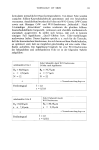
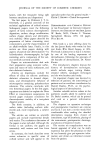
BENZENE DERIVATIVES IN OXIDATIVE HAIR DYEING 195 It is quite possible that in reactions with m-aminophenol, a tri-nuclear dye such as (VIII) is produced. This would account for the drabber colors produced from mixtures ofp-aminophenol and m-aminophenol. The product from oxidation of a mixture ofp-aminophenol and m-phenylenediamine was first isolated by Ullmann and Gnaedinger (9) and was assigned structure (IX). This has been confirmed by unambiguous synthesis by reaction of p-aminophenol with 2,4-dinitrochlorobenzene, reduction of the resulting diphenylamine and oxidation of the product (9) and by the cyclization of the indo-dye (IX) to 2-amino-8-hydroxyphen- azine. SPECTRAL PROPERTIES OF INDO-DYES The colors produced on hair by various p-aminophenol/coupler combinations have been mentioned above and it is pertinent at this point to consider their visible spectra and the effects of pH thereon. Table III gives spectral data for a variety of indophenols formed by coupling p-aminophenol with monohydric phenols. Above pH 9 the dyes exist in solution as the blue anionic form. At lower pH values the solutions become red as the neutral form becomes the predominant species. The color produced on hair is reddish indicating Table III Spectra of Simple Indophenols •kma x (log Anion Neutral Indophenol 637 (4.50) 496 (3.83) 3-methyl 622 (4.38) 485 (3.92) 2-methyl 640 (4.40) 501 (3.83) 3,3'-dimethyl 648 (4.52) 495 (3.97) 3'-chloro 630 (4.45) 504 (3.91) 2'-chloro 630 (4.35) 501 (3.76) 2',3,6'-trichloro 654 (4.35) 513 (3.84) 2,3-benzo 588 (4.33) 480 (4.09)
Purchased for the exclusive use of nofirst nolast (unknown)
From: SCC Media Library & Resource Center (library.scconline.org)