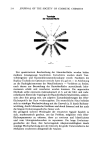
192 JOURNAL OF THE SOCIETY OF COSMETIC CHEMISTS EXPERIMENTAL Spectrophotometric and kinetic techniques employed in this work have been described previously (2,3). As pointed out earlier, oxidation ofp-aminophenol to p-benzoquinone monoimine by hydrogen peroxide or molecular oxygen is slow relative to the rate of reaction of monoimine with couplers. Thus the use of these oxidants is unsuited to studies of the kinetics of coupling reactions. However we have found that, above pH 7, the reaction p-aminophenol + 2 ferricyanide • monoimine + 2 ferrocyanide is quantitative and virtually instantaneous (2). This system was used as far as possible, therefore, for the generation of the monoimine. In kinetic experiments employing 4-equivalent couplers, stoichiometric reaction mixtures can be prepared using the p-aminophenol:ferricyanide:coupler molar ratios of 1:4:1 or 2:4:1. In the first case, the leuco dye is oxidized by ferricyanide while in the second case it is oxidized by a mole of monoimine with consequent formation of a mole ofp-aminophenol. Below pH 7, the above equilibrium lies partly to the left-hand side it is therefore necessary to use freshly prepared aqueous solutions of monoimine for kinetic work at pH 7. With 4-equivalent couplers the required monoimine:coupler ratio is 2:1. In experiments with 2-equivalent couplers, the requisite p-aminophenol:ferricyanide:cou- pier ratio is 1:2:1 and monoimine:coupler ratio is 1:1. All the above systems lead to second-order kinetic forms. With less reactive couplers an excess of coupler must be used and first-order kinetic forms result. Relevant kinetic equations have been given elsewhere as has a consideration of the reaction conditions required to avoid interference of side reactions such as hydrolysis of the monoimine. RESULTS AND DISCUSSION COLORS PRODUCED ON HAIR Tucker (4) has listed the colors given by p-aminophenols alone, and with a variety of couplers, when solutions mixed with hydrogen peroxide are applied to hair. p- Aminophenol alone gives a golden brown shade, while its 2-methyl derivative gives a reddish brown. The color given by the 3-methyl derivative is, by contrast, devoid of warm tones, possibly indicating the formation of a different type of oxidation product. Mixtures ofp-aminophenols and resorcinol give greyish blonde colors of low intensity. With m-aminophenol as the coupler, reddish browns are obtained. With 4-amino- 2-hydroxytoluene as the coupler, an intense reddish orange of excellent stability is produced. Mixtures of p-aminophenols with meta diamine couplers produce reddish brown colors of moderate stability and with a marked tendency to change color with pH. REACTION PRODUCTS Oxidation ofp-aminophenol (I) with two molar equivalent of ferricyanide, at pH 7, gives rise to p-benzoquinone monoimine (II). In the absence of any other reactive species the monoimine undergoes slow hydrolysis to p-benzoquinone (III), as shown in Figure 1. If less than two molar equivalents of ferricyanide are used, monoimine reacts with un-oxidized p-aminophenol to give a brown dye. It seems likely that this dye is an

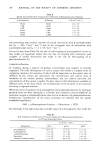
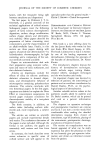
BENZENE DERIVATIVES IN OXIDATIVE HAIR DYEING 193 NH • -I-- 2 Fe(CN)63- --• 0 ],/N H 3,,• N H2 HO I. 4- -'1"' 2 Fe(CN) 6 O III IV i +1 ii oxidn H 0 ,j•• NH-•O'•• .,•OH v Figure 1. Oxidation ofp-amino-phenol. analogue of Bandrowski's base (5). It is formed by self-coupling to give (IV) which reacts with a further molecule of the monoimine to give a product which, on oxidation, gives the trinuclear compound (V). The structural assignment is supported by the observation that hydrolysis of the dye in acid gives a mixture of 2,5- dihydroxybenzoquinone and p-aminophenol. The mass spectrum gives m/e at 323, which we believe to be an M q- 2 peak such as is commonly found with quinonoid compounds (5), including Bandrowski's base (7), and is believed to result from reduction of the quinonoid ring in the heated inlet system of the mass spectrometer. Elemental analysis (C -- 63.2 H = 4.8 O = 19.0 N = 12.3%) is consistent with the formula C•8H•sN303 ß H20 i.e., the hydrate of (V). The n.m.r. spectrum (Table I) is consistent with the structure (V). Table I n.m.r. Spectrum of the Trinuclear Compound (V) r No. of H Assignment 0.07 2 OH (benz.) 2.82 2.92 8 CH (benz.) 3.15 (J = 8 cps) 3.28 3.30 ] 4.05 4.502 6.70 2 NH2 (quin.) 1 CH (quin.) 1 CH (quin.) 1 OH (quin.) ]Ortho to amino group. 2Ortho to hydroxy group.
Purchased for the exclusive use of nofirst nolast (unknown)
From: SCC Media Library & Resource Center (library.scconline.org)