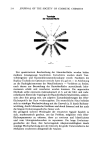
198 JOURNAL OF THE SOCIETY OF COSMETIC CHEMISTS Oxidative coupling reactions can be followed spectrophotometrically by following the rate of color development upon adding a coupler to a solution of the monoimine. Depending on the reactivity of the coupler, reactions can be followed under second-order kinetic conditions by using 2 mol of monoimine to 1 mol of coupler or under pseudo first-order conditions by employing 10 mol of coupler. Since monoimine undergoes hydrolysis to p-benzoquinone (III) with a half-life, at 30øC, of about 60 min, it is desirable to choose reaction conditions under which color formation is complete within a few minutes. By measuring the rate of reaction as a function of pH, it is possible to deduce the nature of the reactive species. Monoimines with Phenols Reaction of monoimines with monohydric phenols gives rise to indophenol dyes. Studies of the stoichiometry of the reaction indicate that, in the absence of an excess of oxidant, 2 mol of monoimine react with 1 mol of phenol to give 1 mol of indophenol and 1 mol ofp-aminophenol, i.e., Monoimine + Phenol • Leucoindophenol Leucoindophenol + Monoimine --• Indophenol + p-AP The reaction exhibits second-order kinetics and the rate is proportional to phenol concentration, indicating that formation of the leuco-dye is rate-controlling. Figure 3 shows the affect of pH on the rate of reaction ofp-benzoquinone monoimine with 2,6-xylenol. Above pH 11 the rate is independent of pH, indicating neutral monoimine and xylenolate ion are the active species. Below pH 11 the rate decreases with pH due to the decrease in concentration of phenolate ion. In the pH range 6-8 the rate is again pH-independent suggesting that the reactive species are the conjugate acid of monoimine and the phenolate ion or neutral monoimine and neutral phenol. Evaluation of specific rate constants and comparison with reactions of di-imines with phenols (12) suggests that the ionic pair of reactants are the major contributors in this pH range. At pH 6 the increase in rate with decreasing pH is indicative of reaction between the conjugate acid of monoimine and neutral phenol becoming the major contributor. Thus, at any pH, the observed rate constant k0 can be expressed as k 0 = kaO/MO/p- q- kbO/M+O/p- q- kcO/M+O/p... (1) where ka, kb, and kc are the specific second-order rate constants for reactions between the various pairs of reactive species M and P-, M + and P-, and M + and P, respectively, and the a's are the fractions existing as the designated species at the pH to which ko pertains. In the pH range in which oxidative dyeing is performed the reaction of neutral monoimine and phenolate ion is the most significant. From data on 23 pairs of reactants we have shown (8) that the rate constant k a for any pair can be expressed as a function of the rate constant for the reaction of the parent monoimine with the phenolate ion (k a' = 50.7 l mol -• min -• at 30øC) and cumulative substituent factors shown in Table VII. Thus for reaction of 2-methyl-p-benzoquinone

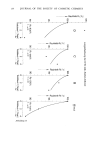
BENZENE DERIVATIVES IN OXIDATIVE HAIR DYEING 199 4.0 3.0 c M+P- pH I I 12 Figure 3. Effect of pH on the rate of reaction ofp-benzoquinone monoimine with 2,6-xylenol at 30øC. The full line shows the theoretical curve calculated from equation (1) and the broken lines show the contributions of the reactions between the various ionic species to the total rate. The open circles represent the experimental results. monoimine with 2,5-xylenol we get k a = 50.7 X 0.039 X 29 X 10 = 5.74 x 10² which compares well with the experimental value of 5.3 x 10²l mol -• min -• Table VII shows that C-methylation of monoimine decreases the reactivity about twentyfold, while C-chlorination has the opposite effect. Conversely, C-methylation of
Purchased for the exclusive use of nofirst nolast (unknown)
From: SCC Media Library & Resource Center (library.scconline.org)