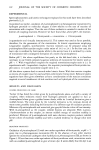
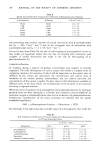
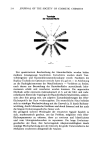
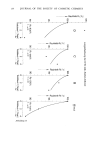
200 JOURNAL OF THE SOCIETY OF COSMETIC CHEMISTS Table VII Effect of Substituents on the Reactivity ofp-Benzoquinone Monoimines and Phenolate Ions at 30øC Substituent Factor 2 Substituent • Monoimine Phenolate 2-Me 0.039 29.0 3-Me 0.059 10.0 2-Cl 40.0 0.12 3-Cl 22.0 0.22 •The imine is numbered with the imino-group in position 4. 2Substituent factor is the factor by which the reactivity is changed by introduction of the designated substituent. 0 o / / / / / / / I i I i-- 8 10 12 pH Figure 4. Effect of pH on the rate of reaction of 2-methyl-p-benzoquinone-4-imine with 4-chlororesorci- nol at 30 ø. The experimental points (circles) are superimposed on the line calculated for reaction of neutral monoimine with resorcinol dianion.

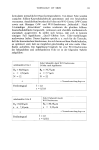
BENZENE DERIVATIVES IN OXIDATIVE HAIR DYEING 201 the phenolate ion increases the reactivity ten to thirtyfold, while C-chlorination decreases it five to tenfold. These effects are in accord with a mechanism involving electrophylic attack of the monoimine on the 4-position of the phenolate ion. Monoimines with Resorcinol As mentioned above, 2-hydroxyindophenols are particularly unstable. Furthermore the rate of reaction of monoimine with resorcinol is extremely fast. In order to deduce the reaction mechanism, it was found necessary to study kinetics of the reaction of the imine from 2-methyl-4-aminophenol with 4-chlororesorcinol. If similar substituent effects pertain as with the monohydric phenols, this pair of reactants should react at a rate 250 times slower than would the parent compounds. Figure 4 shows the effect of pH on the rate of reaction. Above pH 11 the rate is almost independent of pH. Since the first pKa of 4-chlororesorcinol is 10.6, it can be concluded that, at high pH, the reaction is between neutral monoimine and resorcinol dianion. As would be expected, below pH 1! the rate decreases with decreasing pH. However at pH 9 the observed rate constant is higher than would be predicted due, presumably, to contributions of reactions between neutral monoimine and resorcinol monoanion and the conjugate acid of monoimine with the artions. The reaction between monoimines and resorcinols can thus be represented as shown in Figure 5. and/or + HO 0•. NH2 Jr- and/or -- HO H H + II or Xl VI ß I Figure 5. Reaction between monoimine and resorcinol. Table VIII gives rate constants for reactions of certain monoimines with resorcinol dianions. It can be seen that methylation of resorcinol increases the reactivity by a factor of 7, while chlorination reduces it by a factor of 8. Methylation of the imine meta to the imino group decreases the reactivity by a factor of 0.06. Using this data we estimate the rate constant for reaction of neutral monoimine with resorcinol dianion to be 1.9 x 10⁶l mol -• min -•.
Purchased for the exclusive use of nofirst nolast (unknown)
From: SCC Media Library & Resource Center (library.scconline.org)