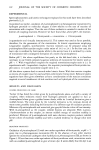
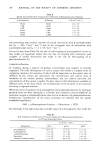
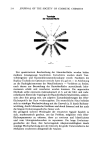
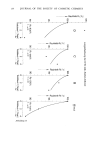
208 JOURNAL OF THE SOCIETY OF COSMETIC CHEMISTS A I 1 7 11 pl'-I Figure 8. Variation with pH of the rate of reaction of dye (XX, R=H, X=Me) in aqueous solution at 30 ø . The circles represent the experimental points and the solid line the overall rate calculated from the theoretical equation. Broken lines represent contributions to the total rate from A-acid hydrolysis, P-cyclization to the phenazine and H-alkaline hydrolysis. substitution of the quinonoid ring and methyl substitution of the benzenoid ring facilitate cyclization and vice versa. This is in accord with the proposed mechanism for the cyclization involving electrophylic attack of the imino-nitrogen of the ortho- quinonoid form of (XlII) on the benzenoid carbon ortho to the azine bridge. The products of oxidative coupling of p-aminophenols and m-phenylenediamines are

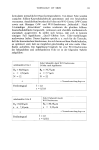
BENZENE DERIVATIVES IN OXIDATIVE HAIR DYEING 209 2-amino-N'- (p-hydroxyphenyl)-p-benzoquinone di-imines (X). Preliminary experi- ments showed that the products of decomposition of these dyes depend on the pH. At pH 12, the major reaction involves hydrolysis of the terminal imino-group, resulting in formation of the corresponding 2-aminoindophenol (XIII) which then cyclizes to the 2,8-dihydroxyphenazine (XIV), as discussed above. Below pH 5, the major reaction is hydrolytic fission at the azine bridge to give the p-aminophenol and the 2-amino- benzoquinone monoimine (XVII). In the intermediate pH range, the major product is the 2-amino-8-hydroxyphenazine (XVIII) formed by intramolecular cyclization. We have measured the rates of these reactions as a function of pH. A plot of the rate constant for the consumption of the indo-dye is shown in Figure 8. At high pH the rate is almost independent of pH, but falls with decreasing pH in the pH range 11-12.5. This is consistent with the rate-controlling step in the hydrolysis involving attack by the hydroxide ion on the iminium group of the zwitterionic form (X) of the indo dye. At low pH ( 4) the tenfold increase in rate with each unit decrease in pH is consistent with the hydrolytic fission involving attack of a water molecule on the dicationic form (XIX) of the indo dye. This is analogous to the hydrolysis of 2-aminoindamines on which we have reported earlier (1). In the intermediate pH range the rate of reaction shows a minimum at about pH 6. Over the pH range 7-10 the major product is the phenazine (XVIII) and the rate increases with pH in a way that is consistent with cyclization of the zwitterionic form (X) of the indo dye. These reactions are summarized in Figure 9. + HO H2N•['I 2 HO'• XlX XVll -2 H + 02 • ./N -0 H I•IH 2 HO N NH•_ X XVIII OH- XIII ' XIV Figure 9. Decomposition of 2-amino-N'-(p-hydroxyphenyl)-p-benzoquinone diimines.
Purchased for the exclusive use of nofirst nolast (unknown)
From: SCC Media Library & Resource Center (library.scconline.org)