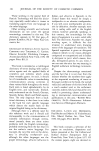
210 JOURNAL OF THE SOCIETY OF COSMETIC CHEMISTS The rates of consumption of the indo-dyes can be expressed as kob s = kfo/[H +] + kcoz + kho/[OH- ] where kob s is the experimental first-order rate constant and kf, k o and k h are the specific first- or second-order rate constants for fission, cyclization and hydrolysis, respectively, and oz is the proportion of dye present as the zwitterion at the pH to which kob s pertains. Values of these rate constants for the dyes (XX) are given in Table XIV. .•N RN H,•N x HO H xx It can be seen that methyl substitution, either on the ring or on the 2-amino-group, has only a minor effect on the hydrolysis rate constant. However, cyclization is considera- bly facilitated by methyl substitution on the 2-amino group. This has been previously observed with 2-aminoindamines. Table XIV Rate Date for Decomposition of the Dyes (XX) in Aqueous Solution at 30øC Compound (XX) R X 10 2 kf k h (2mol -•s-') 104kc(s ') (2mol's •) H H 3.14 0.84 1.35 H Me 3.71 0.70 2.45 Me Me 2.53 13.80 0.50 CONCLUSION The present study has shown that, in oxidative dyeing, oxidation of.p-aminophenols to .p-benzoquinone monoimines is the first step in color formation. Unlike the corresponding di-imines, the monoimines react as the free base at pH 8. Coupling of the neutral monoimines with meta difunctional benzene couplers as the free bases or the anions, results in the formation of leucoindo-dyes. The latter undergo rapid oxidation to the highly colored indo-dyes. Oxidation of mixtures containing both .p-aminophenol and .p-phenylenediamine results in preferential oxidation of the .p-aminophenol. In the absence of couplers, the resulting monoimine reacts with both unoxidized .p-aminophenol and with .p-phenyl- enediamine to give analogues of Bandrowski's base. In the presence of couplers, these latter reactions are suppressed and reaction occurs preferentially with the coupler. The reactivity of commonly employed couplers towards monoimines is in the order resorcinol 4-amino-2-hydroxytoluene 2,4-diaminoanisole m-aminophenol.

BENZENE DERIVATIVES IN OXIDATIVE HAIR DYEING 211 These results show that the inclusion ofp-aminophenols in oxidation dye formulations contributes significantly to the color produced on hair and the resultant dyes have comparable stability to those formed from p-phenylenediamine. REFERENCES (1) j. F. Corbett, The role of meta difunctional benzene derivatives in oxidative hair dyeing. I Reaction with p-diamines,J. Soc. Cosmet. Chem., 24, 103-134 (1973). (2) J. F. Corbett, Benzoquinone imines, part I,j. Chem. Soc., B, 1%9, 207-212. (3) J. F. Cotbert, Intermediates and products in oxidative hair dyeing, Proc. Joint Conf Cosmet. Sci., Washington, D.C., 159-178 (1%8). (4) H. H. Tucker, Hair coloring with oxidation dye intermediates, J. Soc. Cosmet. Chem., 18, 609-628 (1%7). (5) J. F. Corbett, Benzoquinone imines. III The structure of Bandrowski's Base, J. Soc. Dyers and Colourists, 85, 71-73 (1%9). (6) R. T. Aplin and W. T. Pike, Mass spectra of 1,4-dihydroxybenzenes and p-benzoquinones, Chem. and Ind., 48, 2009 (1966). (7) K. C. Brown, Unpublished data. (8) J. F. Corbett, Benzoquinone imines. VIII,J. Chera. $oc. B, 1502-1509 (1970). (9) F. Ullmann andJ. Gnaedinger, Indamines, Bet., 45, 3437 (1912). (10) J. F. Corbett, Benzoquinone imines. V,J. Chera. $oc., B, 823-835 (1%9). (11) J. F. Corbett, Benzoquinone imines II, Ibid., 213-216 (1%9). (12) J. F. Corbett, Benzoquinone imines VII, Ibid., 1418-1427 (1970). (13) K. C. Brown and j. F. Cotbert, Benzoquinone imines XVI, In press. (14) K. C. Brown andJ. F. Corbett, Benzoquinone imines XIII,J. Cbera. $oc., Perkin II 1125-1131 (1977).
Purchased for the exclusive use of nofirst nolast (unknown)
From: SCC Media Library & Resource Center (library.scconline.org)