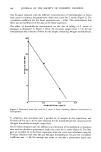
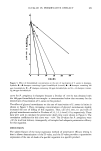
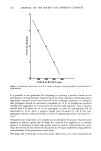
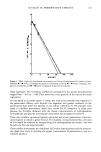
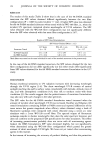
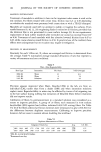
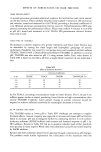
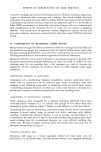
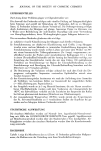
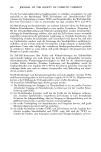
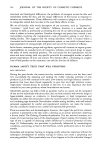
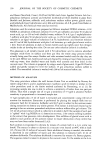
192 JOURNAL OF THE SOCIETY OF COSMETIC CHEMISTS Table XII Immersion Time in Solution Fog. Cationic % Concentration 2-10 Minutes 20 Hours CTAB 0.100 .39 .40 CTAB 0.010 .30 .25 SAAC 0.100 .47 .49 DMSA 0.100 .39 .46 FPAC 0.100 .19 .20 FPAC 0.010 .17 .21 surfaces and then increases at a diminishing rate as interior sites become occupied (31). III. ANIONIC SURFACTANTS An important difference between currently used anionic and cationic surfactants is in their relative affinity to hair. Typically, cationics sorb strongly, resist desorption and produce low frictional coefficients. This suggests that if sufficient anionic surfactant were retained on hair, easier combing and lower friction might result. ANIONIC CONCENTRATION A usual means for increasing sorption is to increase the surfactant concentration. The preceding work, in conjunction with cationic studies, indicates that, for anionics, fiber friction does decrease as solution concentration is raised. To confirm this, 10 fibers were measured at increasing concentrations of TEALS and then in water. In a second experiment, separate groups of 10 fibers were measured at each TEALS concentration. Fibers were from one individual (LAL) but were separately bleached for each experiment. Results in Table XlII show a decrease in friction with increasing concentration. When Table XIII Concentration Effects % TEALS Water 0.1 1.0 5.0 10.0 20 Hrs. 48 Hrs. Exp. 1 -- .39 .32 .29 .33 .34 Exp. 2 .41 .32 .24 .25 -- -- the first set was remeasured in water, friction increased as expected from desorption considerations. Combing tests on bleached hair tresses treated with TEALS confirm that unrinsed tresses are easier to comb than rinsed tresses. In 0.1% FPAC solution, friction of fibers from the second experiment fell to 0.14, indicating that even at 10%, TEALS is less effective than a good cationic in agreement with combing.

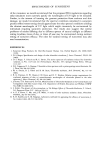
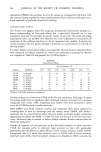
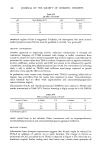
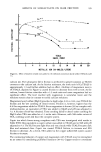
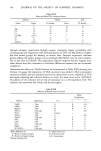
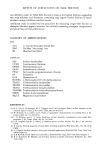
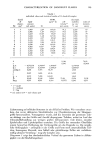
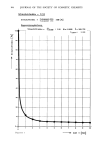
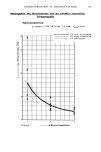
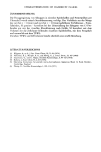
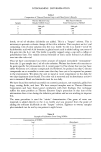
EFFECTS OF SURFACTANTS ON HAIR FRICTION 193 FIBER PRETREATMENT A second procedure provided additional evidence for less friction with more anionic on the hair surface. Fibers similarly bleached were soaked 5 minutes in 10% aluminum salt solution, rinsed and measured in 0.1% TEALS, providing a frictional coefficient of 0.18. Without aluminum pretreatment, friction was 0.41. Polyethyleneimine (PEI) also proved interesting for pretreatment effects. Fibers were soaked 5 minutes in 0.1% PEI at pH 10.2, rinsed and measured in 0.1% TEALS. PEI pretreatment reduced friction from 0.40 to 0.24. STRUCTURE OF ANIONICS By analogy to cationic sorption (31), greater retentivity and hence lower friction may be attainable by varying the chain length and hydrophilic groupings of anionic surfactants. Feasibility was tested by comparing decyl and hexadecyl alcohol sulfates (TEADS, TEACS) with a Dodecylbenzenesulfonate (TEADBS). In addition to neutral pH, TEADBS was also tested at pH 3.5 using acetate buffer. Each value shown in Table XIV is based on ten fibers, all from a single bleach treatment of one individual's hair. Table XIV Effect of Surfactant Structure Frictional Coefficients % AI TEADS TEACS TEADBS TEADBS (pH 3.5) 0.1 .44 .42 .45 .44 1.0 .33 .33 .38 .40 5.0 .27 .29 .32 .36 10.0 .25 .27 .31 .31 As for TEALS, increasing concentrations leads to lower friction. The C-10 and C-16 sulfates appear similar as tested, producing lower friction at high concentrations than neutral TEADBS. Evidently, much greater change in anionic structure would be required to achieve sufficient retentivity for meaningful decreases in friction. pH OF ANIONIC SOLUTIONS The TEADBS results at lower pH in Table XIV challenge our attempt to explain frictional effects. Anionic sorption was expected to increase with lower pH but friction failed to decrease. pH was investigated further by measuring friction in 0.1% sodium dodecane sulfonate (SDDS) buffered with acetate and lowered stepwise to pH 3 by HCI addition. Results in Table XV led us to question whether hard rubber mandrels were peculiar in some respect. Wool cloth was substituted and pH was raised stepwise by NaOH addition. Results with both substrates show friction passing through a maximum as pH changes. The problem needs further exploration but coincidence of the maximum with the
Purchased for the exclusive use of nofirst nolast (unknown)
From: SCC Media Library & Resource Center (library.scconline.org)