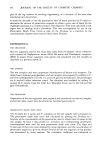
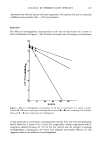
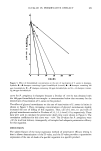
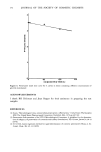
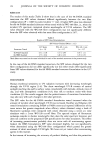
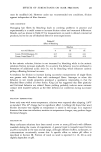
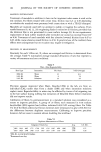
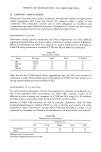
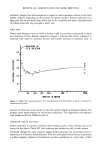
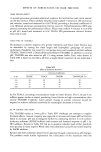
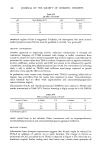
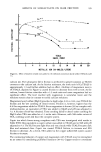
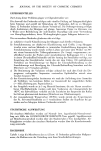
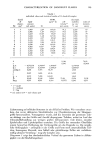
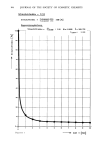
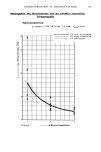
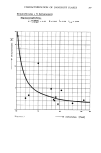
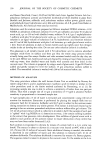
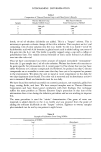
194 JOURNAL OF THE SOCIETY OF COSMETIC CHEMISTS Table XV pH Effect with SDDS pH Hard Rubber (F.C.) pH Wool (F.C.) 6.9 .32 7.4 0.37 6.0 .37 5.1 0.44 5.0 .41 3.0 0.38 4.O .42 3.0 .38 isoelectric region of hair is suggested. Evidently, the assumption that more anionic sorbed produces lower friction must be qualified to include "at a given pH." ORGANIC COUNTERIONS Another approach to improving anionic surfactant substantivity is through the counterion. Sorption of CTAB increased with change in buffer counterion from acetate to citrate (31) and it seemed reasonable that anionic sorption could likewise be promoted by cations other than TEA or sodium. Properties such as aqueous solubility, activity coefficient, surface activity and CMC are known to be influenced by specific counterions, including tetra-alkylammonium ions (37,38). For convenience in screening trials, a salt is added to TEALS with sufficient interchange expected to permit detection of any specific effects on friction. In preliminary tests, tresses were shampooed with TEALS containing added salt or organic base and fibers from the tresses were measured in water. Tetra-ethylammo- nium bromide had no effect while diglycolamine and aminomethylpropanediol reduced friction slightly. Glucosamine (GCA) and dimethyloctylamine (DMOA) were added to TEALS with results summarized in Table XVI. Friction lowering is slight except for 0.13% DMOA Table XVI Effect of Organic Cations in TEALS • Amine or Cation % Added F.C. % Added F.C. None -- .42 -- -- GCA 0.1 .38 0.2 .37 DMOA 0.07 .38 0.13 .31 •0.1% TEALS at pH 7.2 which caused haze in the solution. Other counterions such as isopropanolamine, octyltrimethylammonium and aminomethylpropanol appeared ineffective. METALLIC CATIONS Information from shampoo experiments suggests that friction might be reduced for TEALS by addition of calcium ion or water hardness. The change in friction as increments of CaC12 are added to 1% TEALS is depicted in Figure 4. The initial rise to a maximum requires further testing since hard water may contain these quantities of

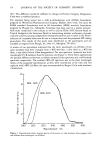
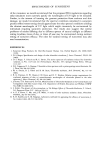
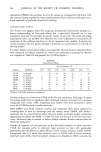
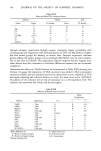
EFFECTS OF SURFACTANTS ON HAIR FRICTION 195 .4O .2O TEALS EQUIV. POINT I I I I I •1 I I I I ,, 2 4 6 8 I0 12 14 16 18 20 METALLIC ION ( M- MOLES / LITER} Figure 4. Effect of divalent metallic ions added to 1% triethanol ammonium lauryl sulfate (TEALS) at pH 7.5. calcium ion. The subsequent fall in friction is attributed to greater sorption as TEALS converts to the calcium salt. At the friction minimum, the mole ratio of Ca:TEALS is approximately 1:2 and further addition had no effect. Addition of magnesium ions to 1% TEALS, depicted in Figure 4, caused friction to decrease from 0.34 to 0.26. As for calcium, lowest friction coincides with a 1:2 mole ratio and more magnesium had no significant effect. The level reached with magnesium is somewhat lower and the solutions remain clear in contrast to turbid calcium solutions. Magnesium lauryl sulfate (MgLS) provided a slight edge, 0.32 vs. 0.34, over TEALS for friction and for wet combing of rinsed tresses. Friction is, however, higher than the 0.26 for magnesium added to TEALS. Since magnesium is known (39) to complex with triethanolamine, an equivalent of TEA was added to MgLS and pH was adjusted to 7.5. A friction of 0.26 was obtained. Tress combing failed to detect easier combing for MgLS when TEA was added at a 1:1 molar ratio. However, with 50% molar excess of TEA, combing scores did favor the complex system. Cuptic ion which forms strong complexes with TEA was investigated with results in Table XVII. One equivalent as cupric sulfate was added to TEALS and to SLS with pH adjusted to 7.5. The SLS became light blue and very cloudy while TEALS became dark blue and remained clear. Cuptic ion caused TEALS friction to increase and SLS friction to decrease. As a check, TEA added to the copper sulfate:SLS system caused friction to increase. The contrasting behavior of copper and magnesium with TEALS may be rationalized to an extent by considering published literature (39-41). Copper tends to coordinate
Purchased for the exclusive use of nofirst nolast (unknown)
From: SCC Media Library & Resource Center (library.scconline.org)