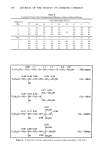
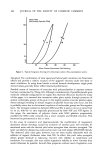
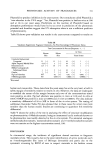
266 JOURNAL OF THE SOCIETY OF COSMETIC CHEMISTS n-octadecanoic (stearic), 2-heptylundecanoic and 2-hexyldecanoic acids as model compounds, in order to examine the structures of lipophilic groups in the surfactant molecules which affect their emulsifying properties and the stability of w/o emulsions prepared with them. These esters were prepared by usual esterifiaction of the corresponding acids with TEG in the presence of a trace amount of BF 3 at 100øC and purified by column chromatography. The structures, physical properties and purities, estimated by gas chromatographic analyses of the above esters, are summarized in Table VII. Table VII Triethyleneglycol (TEG) Fatty Acid Esters GC State Purity No. Compound Structure (mp, øC) (%) 1 TEG oleate 2 TEG elaidate 3 TEG (Z)-9,10- methylene- octadecanoate 4 TEG n-octa- decanoate 5 TEG 2-heptyl- undecanoate CO2R L 97 ß /CO2R L 97 CO2R CO2R C 97 (42-43) CO2R L 97 6 TEG 2-hexyl- CO2R L 97 decanoate ] The first three esters readily afforded good w/o emulsions with considerable stability, and no appreciable disparites were observed among them. The similarities in their emulsifying properties can be evidenced by the following facts: The proportion of emulsified layer of the emulsion [TEG ester (5%)-liquid paraffin (28%)-water (67%)] observed after 72 hr (stored at 45øC) was %.9, 94.9 and 94.9 (volume %) for TEG oleate, -elaidate and -(Z)-9,10-methyleneoctadecanoate, respectively. In addition, absorbance at 450 nm of the diluted emulsion (500-fold dilution with liquid paraffin) measured 0.38, 0.40 and 0.41 for the above three compounds. In contrast, w/o emulsions produced with TEG n-octadecanoate, -2-heptylundecanoate and -2-hexyldecanoate were all labile and separated into two or three layers in a short time, as shown in Figure 4. These results obviously indicate that neither the presence of double bond(s) nor the peculiar cis-configuration is a principal factor involved in the stabilization of w/o emulsion with which oleyl system, for instance, is concerned. Moreover, surfactants

NEW NON-IONIC SURFACE ACTIVE AGENTS 267 ß • . .• .-, k% -• . . .. • ? • •. : .. . Figure 4. •/o emulsification with TEG esters. A: Right after preparation B: After 1 month. Numbers given to each bottle correspond to those in Table VII. possessing a relatively long side chain at •-carbon in lipophilic group are very likely to fail of good w/o emulsification, probably owing to the steric hindrance in orientation of surfactant molecules at interface. The dynamic behavior of these model compounds in reversed micellar state was examined by •3C-NMR spectroscopy to find an explanation of the peculiar nature of the former three compounds. Since the relaxation of a nuclear spin is efficiently caused by the fluctuation of surrounding magnetic field brought about by molecular motion, the dynamic behavior of mobile molecules can successfully be interpreted on the basis of •3C spin-lattice relaxation times (T•'s). Observed T• values are able to yield information on the rate and anisotropy of overall molecular tumbling of a rigid carbon framework in solution. They also effectively probe detailed internal motions along aliphatic chains, which in turn monitor the anchoring of ionic or polar sites together with the segmental motion of long carbon chains. As the •C spin-lattice relaxation of
Purchased for the exclusive use of nofirst nolast (unknown)
From: SCC Media Library & Resource Center (library.scconline.org)