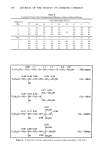
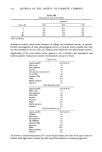
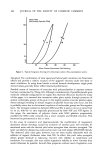
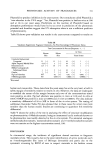
268 JOURNAL OF THE SOCIETY OF COSMETIC CHEMISTS protonated carbons in large and intermediate sized molecules is reported to be in general predominantly governed by •3C-•H dipolar interactions with the attached hydrogens (5), no attempt was made to evaluate the nuclear Overhauser enhancement factors, from which T•a a (T• for dipole-dipole relaxation, being theoretically and quantitatively relevant to effective correlation time) can be calculated. If the rotational reorientation of a molecule is such that satisfies the condition of 'extreme narrowing limit,' then, T• of a carbon is given by 1/T• = N h 2"¾C2"¾H2rCH --6Teff , (3) where N is the number of directly bonded hydrogens, h is Planck's constant, q/c and qri• are the gyromagnetic ratios for 13C and 1H, rcx• is the internuclear distance (1.09 •), and reft is an effective rotational correlation time of the C--H vector. Validity of the above condition was confirmed by the measurement of line width which is related to spin-spin relaxation time (T2). The width of each signal was found in the range of 3 to 4 Hz, thereby corroborating its validity. CMR parameters of TEG esters and Inversion Recovery Fourier Transform (IRFT) spectrum of TEG (Z)-9,10-methyleneoctadecanoate are shown in Table VIII and Fig. 5, and also T•, NT 1 and calculated reft are given in Table IX. For a rigid molecule rotating isotropically, reft is equal to the correlation time for overall molecular reorientation. If internal motions are present or if the overall reorientation is anisotropic, (reft) -• is represented by a sum of rates for internal and overall rotation: (reft) -• = (r•) -• + (rg) -•, (4) where r, is the correlation time for overall reorientation of the molecule, and rg is that for internal motion due to rotation about individual carbon-carbon bonds in the chain. Although r, is not yet available, ref t data can be analysed by using a self-consistent Table VIII CMR Parameters of TEG Esters a 19 17 15 13 11 8 6 4 2 1' O 4' 5' OH Compound Chemical Shift (ppm) No. 18q b 17t c 16t 15t 14t 13t 12t lit 10t/d d 19t 1 14.1 22.7 32.0 29.1 29.1 29.3 29.6 27.2 129.9 2 14.1 22.8 32.0 29.0 29.2 29.2 29.6 32.7 130.4 3 14.1 22.7 32.0 29.4 29.4 29.7 29.7 28.8 15.8 4 14.1 22.7 32.1 29.4 29.5 29.6 29.7 29.7 29.9 11.0 9t/d 8t 7t 6t 5t 4t 3t 2t is e 1 129.6 27.2 29.7 29.7 29.6 29.3 24.9 34.1 173.5 2 130.1 32.7 29.8 29.8 29.6 29.4 25.0 34.1 173.9 3 15.8 28.7 30.3 30.2 29.5 29.2 25.0 34.2 173.9 4 29.9 29.9 29.9 29.9 29.6 29.2 25.0 34.1 173.8 •CDCI3, 0.5M. bQuartet. CTriplet. dDoublet. eSinglet.

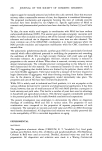
NEW NON-IONIC SURFACE ACTIVE AGENTS 269 t 15 sec 5 2 Figure 5. IRFT-CMR spectrum of TEG (Z)-9,10-methyleneoctadecanoate (CDCL 3, 0.5 M, 30 ø C). treatment (6) that considers the molecular motion in terms of the rate [r(i, j)]-•, defined as the difference in the rates which characterizes the motions of carbons i and j in a given molecule, i.e. [•-(i, j)]-•--(i7'eff)--I -- (J7'eff) --1. (5) Substitution of Eq. 4 into Eq. 5 yields [T(i, j)]-I = (i7.g)-I __ (j7.g)-l, (6) since the overall correlation times (r,) of all carbons in a given molecule are equal (by Table IX T•, NT• and Calculated re• Values of Compound (3) a Carbon No. T, (s) NT, (s) •e• (ps) 18 4.5 13.5 3.5 b 17 3.9 7.8 6.0 16 3.0 6.0 7.8 15 1.5 3.0 15.5 14 1.5 3.0 15.5 13 1.6 3.2 14.6 12 1.6 3.2 14.6 11 1.1 2.2 21.2 10 1.4 1.4 33.3 19 0.84 1.7 27.4 9 1.5 1.5 31.1 8 0.98 2.0 23.3 Carbon No. • (s) N• (s) • (ps) 7 O.99 2.0 23.3 6 0.95 1.9 24.5 5 1.1 2.2 21.2 4 1.1 2.2 21.2 3 1.1 2.2 21.2 2 1.1 2.2 21.2 1' 1.0 2.0 23.3 2' 1.1 2.2 21.2 3' 1.7 3.4 13.7 4' 1.7 3.4 13.7 5' 2.6 5.2 9.0 6' 2.4 4.8 9.7 'CDCI3, 0.5M, at 30øC. bBecause of the spin-rotation contribution, only an upper limit can be given.
Purchased for the exclusive use of nofirst nolast (unknown)
From: SCC Media Library & Resource Center (library.scconline.org)