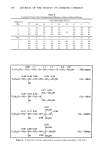
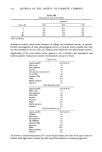
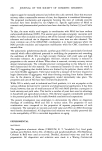
256 JOURNAL OF THE SOCIETY OF COSMETIC CHEMISTS preparation of w/o cosmetics endowed with both physiological safety and sufficient physical and chemical stability. The development of such surfactants has been one of the major concerns of a number of cosmetic scientists. We now wish to report on two new types of surface active agents with excellent emulsifying properties and minimal toxicity: N-(3-alkyloxy-2-hydroxypropyl)alkanol- amines and N-(3-alkyloyloxy-2-hydroxypropyl)alkanolamines. In the present work, the physical nature and the scope of application to cosmetic preparations of these surfactants are examined, and the correlation between their dynamic behavior characterized by •3C-nuclear magnetic resonance spectroscopy (CMR) and the stability of w/o emulsions is discussed. In addition, physiological safety of the new compounds is also evaluated. EXPERIMENTAL PREPARATION OF SURFACE ACTIVE AGENTS Various surface active agents (aminoether and aminoester types as shown below) were prepared by reaction of glycidyl alkyl ethers or glycidyl alkanoates with an excess of alkanolamines in the absence of any solvents: R 2 RxCH2OCH 2 CHCH2N (1) I N OH R 3 R 2 R•CO2CH2 CHCH2N (2) OH R3 Formula 1 is the aminoether type, N-(3-alkyloxy-2-hydroxypropyl)-alkanolamine. Formula 2 is the aminoester type, N-(3-alkyloyloxy-2-hydroxypropyl)-alkanolamine. R• represents the alkyl or alkenyl group (Cn-C2•) R2 and R• each represent the hydroxyalkyl group (C2-C6), CH• or H. Glycidyl ethers of stearyl, isostearyl, oleyl, palmityl, myristyl and lauryl alcohols and glycidyl esters of behenic, stearic, isostearic, oleic, palmitic, myristic, lauric and soy bean oil fatty acids were chosen as starting materials, which in turn were prepared by the reaction of epichlorohydrin with respective alcohols or fatty acids. As alkanol- amines, monoethanolamine (MEA), diethanolamine (DEA), diisopropanolamine (DIPA), 2-amino-2-methyl-l,3-propanediol (AMPD), 2-amino-2-ethyl-l,3-propanediol (AEPD), trimethylolaminomethane (TMAM) and N-methylglucamine (MG) were used. In this report we use abbreviations for the new compounds. For instance, N-(3-stearoxy-2-hydroxypropyl)-diethanolamine and N-(3-oleyloyloxy-2- hydroxypropyl)-trimethylo!aminomethane will be designated as ST-DEA and OLA- TMAM, respectively.

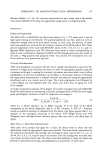
NEW NON-IONIC SURFACE ACTIVE AGENTS 257 The following synthetic scheme for OL-DEA is representative: molecular C•,H35OCH2C H C H 2 HN(CH2CH2OH)2 distillation • / + 70øC, 3-4 hr 0.05 To, O below 160øC column chromatography Residue •' C•8H350CH2CHCH2N(CH2CH20H)2 I OH OL-DEA (pale yellow viscous liquid) Examples of the synthetic procedure for a few surfactants are described below: OL-DEA--To glycidyl oleyl ether (325 g) kept at 70øC was added 160 g of diethanolamine with vigorous stirring at a rate to maintain the same temperature. After the addition of diethanolamine, the reaction mixture was held at that temperature with stirring for an additional 3 hr. Subsequent molecular distillation (0.05 Torr, below 160øC) of the crude product and purification of the residue by column chromatogra- phy gave almost pure OL-DEA (350 g). OL-TMAM--A mixture of glycidyl oleyl ether (325 g) and trimethylolaminomethane (170 g) was heated at 120øC for 4 hr with continuous stirring. After the reaction, the reaction mixture was left standing at 90øC without stirring for 5 hr. The upper layer was skimmed out by decantation, dissolved in 1000 ml of acetone, filtered at 50øC, cooled to -5øC and stored in a refrigerator overnight. The precipitated pale yellow crystals were collected, washed with two 500 ml portions of cold acetone and dried in vacuo to yield colorless crystals, OL-TMAM (305 g). Other compounds were prepared by an analogous method. Identification of their structures was tentatively based on mass spectral data of their TMS or TFA derivatives and confirmed by •3C-NMR information. EMULSIFICATION TEST Emulsions composed of three components, surfactant (5%), liquid paraffin (28%) and water (67%), were prepared by the following procedure: In a 50-ml glass bottle, 1.5 g of surfactant was dissolved in 8.5 g of liquid paraffin usually at room temperature or at an elevated temperature when necessary. Then, 5 g of water (20øC) was added to the solution, and the bottle was shaken well until the liquor assumed an appearance of homogeneous, milky fluid. Another 5-g portion of water was added again with powerful shaking, and successive stepwise addition of two 5-g portions of water and similar shaking resulted in the formation of a slightly viscous, milky emulsion. The amount of water added was 20 g in total. The stability and viscosity of the emulsion thus obtained and particle size of water droplet in the emulsion were examined in order to evaluate the properties of surfactants as emulsifiers. Emulsion particles were observed with an optical micro- scope (magnification: 400 x ).
Purchased for the exclusive use of nofirst nolast (unknown)
From: SCC Media Library & Resource Center (library.scconline.org)