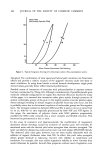
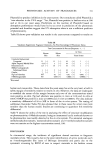
RHEOLOGY OF MAS/XANTHAN GUM DISPERSIONS 285 after extended storage, have also been observed as an added benefit related to the non-thixotropic nature of the MAS-XG blends at the preferred 9:1 to 2:1 ratios. The balance of viscosity and yield value will enable such blends to be used in many applications at levels below 1%. These properties suggest particular utility for the MAS-XG combination in stabilizing free flowing lotions, suspensions, and liquid makeups. CONCLUSION Useful and interesting properties are obtained when magnesium aluminum silicate and xanthan gum are used in combination. Synergism in both viscosity and yield value can be obtained. The thixotropy imparted to aqueous systems by the mineral can also be minimized. Blends with magnesium aluminum silicate: xanthan gum ratios in the range of 9:1 to 2:1 are recommended for the best balance of viscosity, yield value, and flow. Such blends will be effective in stabilizing flowable lotions, suspensions, and makeups. REFERENCES (1) H. van Olphen, An Introduction To Clay Colloid Chemistry, (Wiley Interscience, New York, 1977) pp 92-110. (2) B.C. Carlson, VEEGUM in eye makeup, Am. Perf Cosmet., 86, 39-44 (March 1971). (3) B.C. Carlson, VEEGUM in cosmetic gels and sticks, Cosmet. Toiletries, 92, 81-86 (July 1977). (4) P. A. Ciullo, Magnesium aluminum silicate in water-in-oil emulsions, Drug Cosmet. Ind., 126, 50-56 (May 1980). (5) Xanthan Gum/Kdtrol/Kdzan a natural biopoOsaccharide for scientific water control, Second Ed., Kelco Div. of Merck Co., Inc. (6) D. A. Rees, Shapely polysaccharides, Biochem. J., 126, 257-273 (1972). (7) D. A. Rees, Biophysical Society Winter Meeting, London (1973). (8) A. Jeanes, Applications of extracellular microbial polysaccharide-polyelectrolytes: review of literature, including patents,J. Polym. Sci. Part C, Symp. No. 45, 209-227 (1974). (9) R. L. Bowles, R. ?. Davie and W. D. Todd, Interpretation of Brookfield viscosities, Mod. Plastics, 33, 140-148 (November 1955). (10) B. K. G. Theng, Formation andSProperties of Clay-Polymer Complexes, (Elsevier, New York, 1979) pp 243-261.

j. Soc. Cosmet. Chem., 32, 287-301 (September/October 1981) Optimization techniques in product formulation JOSEPH B. SCHWARTZ, Merck Sharp & Dohme Research Laboratories, lVest Point, PA 19486. a) Received May 6, 1981. Presented at the SCC Annual Scientific Seminar, lVashington, D.C., May 22, 1981. Synopsis Methods of optimization are well documented in the literature of several fields and are easily adapted to formulation and processing studies in the pharmaceutical and the cosmetic industries. The techniques most widely used for optimization are of two basic types: one where experimentation continues as the study proceeds and a second where experimentation is completed before optimization takes place. The first type may be represented by procedures such as EVOLUTIONARY OPERATIONS (EVOP) and the SIMPLEX METHOD the second type includes the more classical MATHEMATICAL and SEARCH METHODS. For these techniques of the second type, appropriate statistical design of experiments is an important consideration. Based on the resulting data from the required number of experiments, one is able to generate a mathematical model to which the appropriate optimization technique is applied. No matter which method is selected it is important that the formulator be able to distinguish the independent (formulation or controlable) variables from the dependent variables (product properties). Properly designed experimentation and subsequent analysis can lead not only to the optimum or most desirable product and process, but, if carried far enough, can shed light on the mechanism by which the independent variables affect the product properties. There are appropriate statistical techniques by which such analyses can be carried out. It has been shown that such models can be used to accurately predict not only the physical properties of the drug product (such as dissolution, tablet disintegration time, and tablet breaking strength), but also biological properties (such as peak plasma time and absorption rate constant). The application to cosmetic products is indicated. INTRODUCTION The procedure for optimizing the formulation and process for a drug product, or a cosmetic product, is generally the process of making it as perfect as possible within a given set of restrictions or constraints. Physical, chemical, and biological properties must all be given due consideration in the selection of components and processing steps for that dosage form or product. The final product must be one which meets not only the requirements placed on it from a bioavailability standpoint, but also the practical mass production criteria of process and product reproducibility. With a rational approach to the selection of the several excipients and the manufacturing steps a)Present address: Philadelphia College of Pharmacy and Science, 43rd St., Woodland Ave. and Kingessing Mall, Philadelphia, PA 19104. 287
Purchased for the exclusive use of nofirst nolast (unknown)
From: SCC Media Library & Resource Center (library.scconline.org)