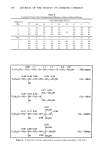
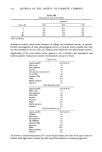
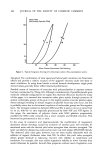
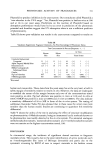
290 JOURNAL OF THE SOCIETY OF COSMETIC CHEMISTS Table I A 2 3 Factorial Design Factor Level Trial x• x= x 3 1 --1 --1 --1 2 1 --1 --1 3 --1 1 --1 4 1 1 --1 5 --1 --1 1 6 1 --1 1 7 --1 1 1 8 1 1 1 where the coordinates of the vertices represent the individual trials. In this case, the area bounded by the cube is being studied. A modification and expansion on this design, proposed by statisticians Box and Wilson (6) involves the question, "Suppose we want to cover more territory than the cube." In that case, (Figure 2), we select an axial point, some distance from the center of the cube, take a point (a trial) outside each face and one in the center. Such a design is shown in Table II where 15 experiments are required. (The first eight represent the full factorial design the next six represent two extremes for each axis and the last represents, the central point with coordinates [0, 0, 0]). This is called a "three factor, orthogonal, central, composite, second order design." Each trial represents a formulation, all qualitatively identical, but quantitatively Figure 1. Graphical representation of a 2 3 Factorial Design. (Eight experimental trials required.)

OPTIMIZATION TECHNIQUES 291 I Figure 2. A three-factor composite design. (o• = axial point distance.) Table II A Three-Factor Composite Design Factor Level Trial x, x 2 x3 1 --1 --1 --1 2 1 --1 --1 3 -1 1 -1 4 1 1 -1 5 -1 -1 1 6 1 -1 1 7 --1 1 1 8 1 1 1 9 --a O O 10 a O O 11 0 --a 0 12 0 a 0 13 0 0 --a 14 0 0 a 15 0 0 0
Purchased for the exclusive use of nofirst nolast (unknown)
From: SCC Media Library & Resource Center (library.scconline.org)