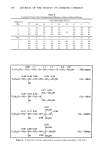
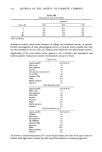
PHOTOTOXIC ACTIVITY OF FRAGRANCES 313 within a fragrance class requires a rapid, inexpensive device to aid in the selection of the best candidate for commercial development, including scale-up production. The yeast assay accomplishes this objective. Similarly, the screen should provide a tool for molecular modification efforts in order to reduce the hazard of phototoxic activity from commercially desirable, but phototoxic series of analogues. The potential to accomplish this was illustrated in the coumarin experiment (Table V) where it was demonstrated that saturation of the molecule eliminated the phototoxic inhibition of yeast. Of course, our results were easily predicted on the basis of what is known regarding UV absorption in saturated and highly unsaturated molecules of this type. However, as novel molecules are encountered and these are modified by methods directed towards improving the commercial performance, our ability to correctly predict phototoxic properties may not be as accurate. Biological data are needed, but need not necessarily be generated in animals. The failure of physical methods (UVA absorption) to predict photobiologic activity was emphasized with Phantolid which was phototoxic in vivo yet failed to give a clear indication of its phototoxic potential during analysis of UV absorption data. Further, the UV absorption by a chemical in a flask may not reflect performance in vivo because of effects of excipients or metabolism modifying the chemical structure and consequently UV absorption characteristics. In terms of hazard assessment, the yeast system has not failed to detect a known phototoxic substance. To fail in such an identification (a false negative) would greatly weaken its value. False negatives would cause an unfounded sense of security in those that determine the concentration of test material to be put on human skin, whether it be on test volunteers or consumers. On the other hand, the finding of a phototoxic event in vitro which does not correlate with epidemiological data at the same concentration is not so serious a barrier to the safety assessment process. In these cases, one merely is given a quantal basis for caution. The test data in Tables III and IV suggest that the screen is more sensitive than the human, perhaps ten-fold or more. This information is used to set initial, safe doses for human volunteers. Initial concentrations tested in humans may be ten-fold higher than the highest no-effect dose for yeast without undue hazard. Phototoxic reactions in humans at this level, if any, should be at the lower limit of sensitivity and thus be mild and rapidly reversible. The failure of humans to react at any concentration following positive data in the screen does not necessarily constitute a failure of the assay rather, it reflects the need for understanding of the reasons why humans were protected from an intrinsically active molecule. This conservative line of reasoning is valid for virtually every screen in vitro used to predict human response. It applies for example, to such important tests as mutagenicity assays in bacteria, teratogenicity in cultured embryos, and carcinogen- icity screening in cell culture. When an adverse finding is obtained in vitro, the tiered battery approach appears to be a rational alternative to impulse condemnation. Thus a positive phototoxic response in vitro indicates, simply, that the potential to produce phototoxic reaction exists. Whether this potential is realized in vivo depends on a more complex series of factors, some of which are discussed below. One way in which the response of intact skin may be modified is through alteration of the test material to an intrinsically more or intrinsically less toxic metabolite. Metabolism plays an important role in systemic toxicology but the influence of metabolizing enzymes in skin on phototoxic responses to fragrance materials are likely

314 JOURNAL OF THE SOCIETY OF COSMETIC CHEMISTS to be less important. Compared to the liver, metabolizing enzymes in the skin are in low concentration and many standard assays for the studies of enzymes in liver are insufficiently sensitive for the study of enzymes in skin (8). Since the finding of novel phototoxic chemicals in fragrance materials is an uncommon event, it is further unlikely that human derreal metabolism will fortuitously act to cause an unexpected phototoxic response. Metabolic participation of the liver in producing phototoxic dermatitis is possible, but the liver would receive dilute quantities of fragrance material substrates. The products of these substrates would then be further subject to excretion by the usual routes, leaving the remainder to be in equilibrium with preferential storage sites. Most of these would be inaccessible to ultraviolet radiation. An additional explanation for the relatively greater sensitivity of the screen compared to intact skin may be attributed to the natural barriers that skin possesses with regard to penetration of test substance or UV light. Alternatively, compromised human skin in which barriers to penetration have been lowered may reduce or even eliminate the differential in sensitivity between the in vitro and in vivo systems. Barriers to penetration in normal skin may be lowered by such factors as disease, advanced age, use of penetrating creams (9), or use of occlusive clothing. It seems appropriate, therefore, that before commercial release of products which have significant photo- toxic activity in vitro, results of tests in humans should be repeated using a suitable model of skin compromised with regard to its resistance to penetration of light and test agent. Lastly, the skin may be less sensitive than the in vitro system in view of the complex series of events which provide the endpoint in vivo. This endpoint, erythema, is a function of dilation of the derreal vascular bed and is in turn dependent on the effects of vasoactive mediators. Such mediators are released following damage (in this case phototoxic damage), and the ability to perceive this effect is subjective compared with the quantitative measurement of zones of inhibition of yeast growth. When recording results in the yeast assay system, it is important to recall that the apparent potency of test materials is a function of diffusion through the agar medium. Evidence of comparable rates of diffusion should be obtained before relative potencies of two materials may be examined. When diffusion becomes a significant concern, fungistatic activity as an indicator of phototoxic events can be monitored in a shaker culture rather than in a semi-solid agar medium. A simple method of measuring light transmittance can provide the measure of light-dependent inhibition. Since diffusion in agar is allowed to progress for 18 hours under UVA exposure, slowly diffusing chemicals should have more than adequate time to migrate, making the use of liquid media rarely necessary. In both the agar and shaker culture method of screening, the dark controls should always be retained. Eugenol, Isoeugenol, methyl salicylate and some of the Coumarin molecules inhibit yeast in the dark as well as in the light. In these cases, a positive phototoxic effect can be declared only when there is a substantial increase in the light mediated inhibition over that in the dark. REFERENCES (1) F. Daniels, Jr., A simple microbiological method for demonstrating phototoxic compounds,J. Invest. Dermatol., 44, 259 (1965).
Purchased for the exclusive use of nofirst nolast (unknown)
From: SCC Media Library & Resource Center (library.scconline.org)