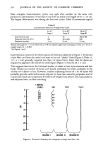
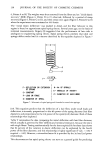
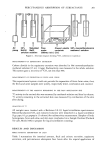
228 JOURNAL OF THE SOCIETY OF COSMETIC CHEMISTS EXPERIMENTAL Dark brown hair fibers* from DeMeo "blue string" hair were used in this investigation. The fibers were washed with one percent sodium laureth sulfate (3EO) [Conoco Inc.] at pH 7 and dried in air before use. For all fibers, diameter was estimated by the linear density method (7), weighing the fibers on a 3 mg capacity Precision Balance.•' WATER SETTING SINGLE FIBERS Single hair fibers (30 cm _+ 0.2 cm with 1 gram weight) were taped by their root end with Scotch Brand © electrical tape to a 7.98 mm diameter glass rod (tape covering about 0.5 cm of fiber), and a one gram weight (alligator clip) was attached to the tip end. The glass rod was placed in a wooden support with the rod at an angle of approximately 10 degrees from horizontal and the rod slowly turned, to produce a spiral coil about the rod with approximately 11 turns, the tip end taped to the rod. The rod was then placed in water (deionized) at room temperature for 30 minutes, then removed and allowed to dry at 40 percent RH overnight in a glove box containing a saturated solution of zinc nitrate. Data from these experiments represent means of 8 or more replicas unless otherwise noted. LOAD-ELONGATION MEASUREMENTS For load-elongation measurements electrical tape was placed over the root end of a single fiber, and the tape doubled over on itself, glued to a small cellulose-acetate tab, and a small hole punched through this fiber support. It was then secured to a 7.98 mm glass rod by applying a rubber band over the tape-fiber holder, and the fiber coiled and water set as above. Fibers coiled in this manner were carefully released from the rods and the root end hung on a hook attached to the probe of a Cahn -+ electrobalance, Model RM-2 (Figure 1). The tip end of the fiber was placed in an alligator clip attached to a Brookfield* Hellpath © stand Model D (a platform programmed to descend and/or rise at a constant speed), and then stretched to approach its taut length (29.7 cm), and reversed, at a rate of 2.18 cm/min, recording the load-elongation data on a strip chart recorder attached to the Cahn © balance. With this procedure the fiber did not actually uncoil during extension however, fibers were also tested by attaching the tip end to a clip glued to a 3 cm diameter petri dish (total wt. 3.1 g) resting on light mineral oil in a small dish on the Helipath © stand. By this method (extension) coil stretching and fiber uncoiling were achieved simultaneously. ELASTIC AND CREEP BEHAVIOR MEASUREMENTS Water set single hair coils were removed from the rods, hung vertically from alligator clips, and the length of the coiled hair measured with a cathetometer calibrated in tenths of a millimeter. For physical measurements, weights were made by cutting small pieces of masking tape, which were weighed on the 3 mg Precision balance, and *DeMeo Brothers, 39 West 28th St., New York, N.Y. •'Federal Pacific Electric Company, Newark, N.J. + Ventron Instruments Corp., Paramount, California. *Brookfield Engineering Labs, Stoughton, Mass.

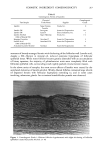
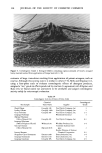
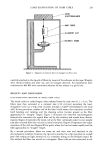
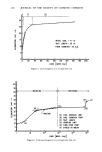
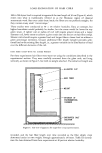
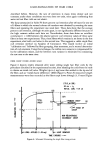
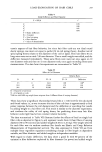
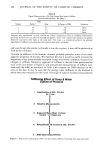
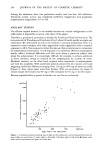
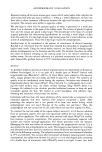
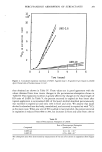
LOAD-ELONGATION OF HAIR COILS 229 •.• CAHN ELECTROBALANCE HAIR FIBER ALLIGATOR CLIP HELIPATH STAND Figure 1. Apparatus to measure force to elongate hair fiber coils. carefully attached to the tip end of fibers by means of the adhesive on the tape. Weights were checked before and after use, and no changes detected. All experiments were conducted at 40% RH over a saturated solution of zinc nitrate in a glove box. RESULTS AND DISCUSSION LOAD-ELONGATION BEHAVIOR OF SINGLE FIBER CURLS The initial curled or coiled length, when released from the rods, was 9.5 -+ 2.5 cm. The fibers were then extended at a constant rate (2.18 cm/min) recording the load- elongation curve on a strip chart recorder through a Cahn © electrobalance (the load cell). In one procedure, neither end of the fiber could rotate thus extension involved both bending and twisting, and the shearing action became greater as the fiber approached its "straight" length. Figure 2 illustrates the observed load-elongation behavior for extension of a typical fiber coil by this method, and reveals three distinct regions. Region I represents the initial curl or the fiber coil length under its own weight just after removal from the rod and its initial extension. Region II represents the major extension of the coil, and Region III the point where the load increases rapidly and the fiber approaches its "straight" length. By a second procedure, fibers are water set and their root end attached to the electrobalance as before however, the tip end is attached to a clip mounted on a small petri dish resting on light mineral oil in a container sitting on the Hellpath stand. By this method the fiber can uncoil as it elongates. Fiber coils are then extended at the
Purchased for the exclusive use of nofirst nolast (unknown)
From: SCC Media Library & Resource Center (library.scconline.org)