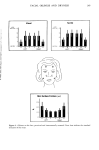
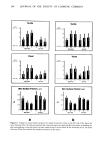
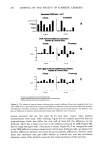
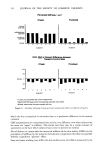
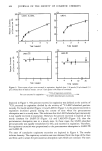
FACIAL OILINESS AND DRYNESS 253 GBE. This change is readily perceived by subjects, but perceived stiffening may not correspond exactly to that measured by the GBE. Effective emollients soften the skin surface there is a change of 20-50% that is readily perceived by subjects. Changes are more easily perceived on the cheeks than on the forehead, whether the skin surface is stiflened or softened. The reason for this, as some subjects suggested, may be that the eyebrows reduce perceptiveness on the forehead, perhaps because the skin there is not as effectively "treated" by emollients, etc. In cosmetic science research, sensitive objective methods can be of limited usefulness if the changes measured by them are not perceived by subject or observer in real-life situations. In the present study, we have defined a range of instrumental changes which correspond to skin surface changes perceived by subjects. This exercise greatly enhances the utility of these instruments for development and evaluation of topical products. ACKNOWLEDGEMENT The authors thank Mr. B.C. Tillery for his many helpful suggestions and expert editorial assistance in the preparation of this manuscript. REFERENCES (1) S. Nacht, J. Close, D. Yeung, and E. H. Gans, Skin friction coefficient: Changes induced by skin hydration and emollient application and correlation with perceived skin feel,J. Sac. Cosmet. Chem., 32, 55-56 (1981). (2) M. S. Christensen, C. W. Hargens, S. Nacht, and E. H. Gans, Viscoelastic properties of human skin: Instrumentation, hydration effects, and the contribution of the stratum corneum,J. Invest. Derm., 69, 282-286 (1977). (3) E1-Shimi, A. F., In viva skin friction measurements,J. Sac. Cosmet. Chem., 28, 37-51 (1977).

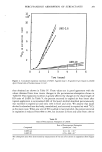
j. Soc. Cosmet. Chem., 34, 255-262 (August 1983) Simplified procedure for evaluating antiperspirants: A method for rapid screening with subsequent assessment of axillary antiperspirant activity E. H(3LZLE, Department of Dermatology, University of Dusseldorf, Moorenstrasse 5, D-4000 Dusseldorf l, [Vest Germany, and A.M. KLIGMAN, Department of Dermatology, University of Pennsylvania, Duhring Laboratories, Medical Education Building, Room 244, 36th & Hamilton [Valk, Philadelphia, P/I 19104. Received January 17, 1982. Synopsis A two-stage simplified procedure for evaluating antiperspirants has been designed. For screening, the test agents were applied to the forearms for 3 hours via Duhring Chambers. The next day, after a heat stimulus, sweat suppression was estimated by the silicone imprint technique. For final testing, a simplified gravimetric method was utilized for estimating sweat secretion in the axilla. Female subjects were preselected on the basis of their susceptibility to sweat suppression by 20% aqueous aluminum chloride. The axillae were treated twice daily for 3 days with measurements on the 4th. The subjects entered a hot box at 55øC and 35% R.H. When forearm sweating was noted, axillary sweat was collected in special pads for a 10 minute period and weighed. The rank order of antiperspirant efficacy in forearm and axilla tests were the same. Reproducibility was good. The efficacy of aluminum salts was dose dependent. INTRODUCTION The development of proprietary antiperspirants is a costly, time-consuming enterprise. Animal models are generally not relevant, since only man is endowed with a fully developed eccrine apparatus. Results obtained on the paws of rats or mice (1,2) are of doubtful applicability. Currently, it is thought that meaningful results require assess- ment of sweat suppression in the axilla. This rule was established because many materials which readily suppress sweating when applied occlusively to the forearm are far less effective in the axilla. Axillary testing has many handicaps. Only one agent can be evaluated at a time. Sweat output is exceedingly liable and subject to perturbations by a multitude of factors which are not easily controlled. Emotions can trigger sudden outpourings in certain persons even under seemingly nonstressful situations. Postural changes such as 255
Purchased for the exclusive use of nofirst nolast (unknown)
From: SCC Media Library & Resource Center (library.scconline.org)