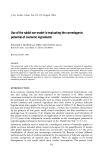
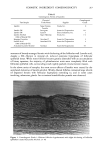
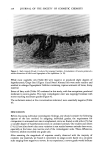
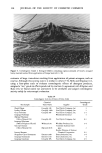
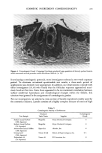
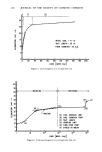
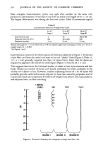
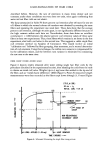
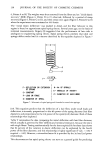
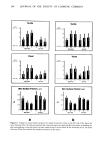
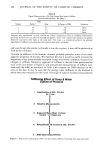
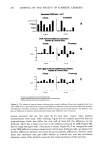
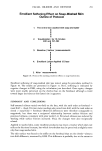
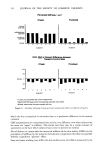
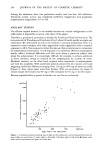
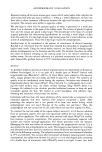
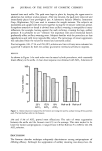
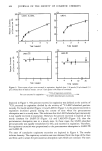
230 JOURNAL OF THE SOCIETY OF COSMETIC CHEMISTS z uJ I II III 30 • • 20 15 INITIAL CURL = 7.7 cm I• TAUT LENGTH= 30 cm I0 = . 0 0 •,0 4o 6o so i00 I•,0 140 160 leo •,oo t. OAD [MASS (,.g)] Figure 2. Load-elongation curve of single fiber coil. 6O 55 5O 45 • 35 z 30 ß • 25 - 20 UNCURLING _ I_ STRETCHING -i (A) CURL HOOKEAN LIMIT (B) CURL TURNOVER POINT (C) TAUT LENGTH (D) HOOKEAN LII•IT (E) TURN OVER POINT (F) STRESS TO BREAK I i i i i m i i I I0 I0 2 I0 3 I0 4 I0 õ LOAD [MASS (m(])] Figure 3. Total load-elongation curve of single hair fiber coil. (E)I ..... (F)

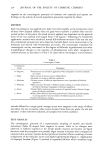
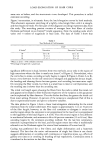
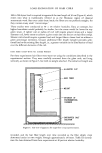
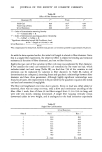
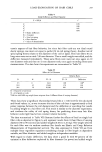
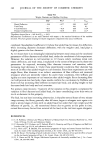
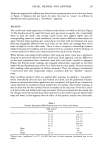
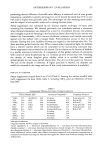
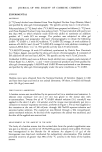
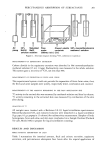
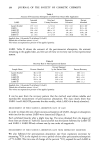
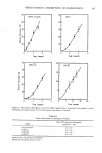
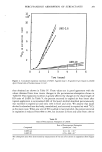
LOAD-ELONGATION OF HAIR COILS 231 same rate as before, and the stress-strain curve developed. This procedure is called extension-uncoiling. Figure 3 summarizes, in schematic form, the load-elongation curves by both methods. This schematic represents stretching of a tightly coiled single fiber until it is straight, and then begins to break. The first part of this diagram (uncoiling) represents data from this study. The stretching portion consists of averages from four fibers of similar thickness performed on an Instron © tensile apparatus. Note the semilog scale which varies over 5 orders of magnitude in load units. The data of Table I show that Table I Two Methods of Coil Extension Load ñ % Strain* Extension Extension Uncurling 99 319 + 38 242 + 29 91 58 + 6.2 50 + 9.0 84 27 + 1.1 28 + 3.3 *Mean, in dynes _+ 95% confidence interval. *Percentage of length with 1 gram load. significant differences in load, between these two methods, occur only in the region of high extensions where the fiber is nearly taut (near C of Figure 3). Nevertheless, when the coil is free to rotate, uncoiling actually begins in region II (Figure 3, Points A to B), but at a very slow rate. As the coil continues to elongate and approaches its taut length, the bending and shearing forces become greater, and uncoiling becomes more rapid. On reversing the fiber recoils, but there is a small loss in twist or coil (hysteresis), and the recoiling rate is slower than the uncoiling rate. The initial coil length upon releasing the fibers from the rods is called the initial curl and appears to be related to fiber thickness: 64 percent of the variation in this parameter can be explained by fiber diameter. Thus the thicker the fiber, the greater the initial curl from water setting. However, 36 percent of the variance is unexplained. Part of this is due to experimental scatter and part to unknown variables. The data plotted in Figure 2 show a linear load-elongation relationship for the initial extension from the initial coiled state. This region is approximately 3 cm or 19 percent of the fiber length however, as the fiber coil continues to elongate it enters into another region where the extension is not proportional to the load, but is proportional to the logarithm of the load (Figure 3, A to B). Thus this second region is very different in mechanical behavior, and amounts to 40 to 60 percent extension (12 to 18 cm). Here uncoiling begins by the extension-uncoiling method. For the last few centimeters, extension is proportional to the load, and this region enters into what is traditionally referred to as the Hookean region for normal load extension of human hair (8). Cycling was performed for a few fibers, and slight deformation and a hysteresis detected. The fact that the entire coil-extension of single hair fibers is not elastic suggests deformation or uncoiling with continuous or repetitive stress, e.g., effects of gravity over time or in combing or brushing of hair respectively. Continuous stress is considered in the section on hair fiber creep.
Purchased for the exclusive use of nofirst nolast (unknown)
From: SCC Media Library & Resource Center (library.scconline.org)