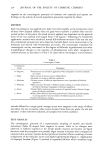
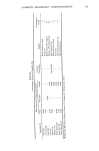
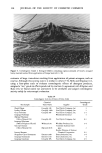
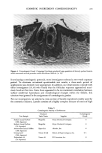
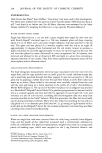
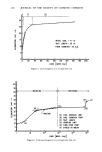
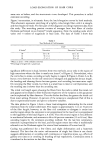
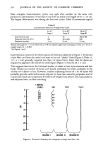
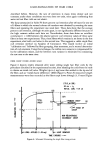
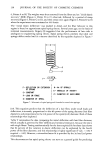
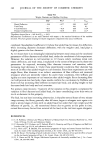
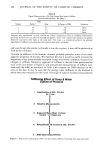
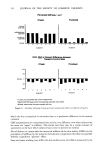
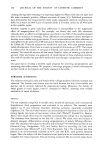
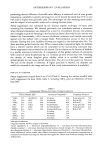
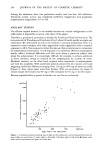
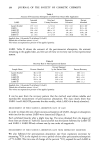
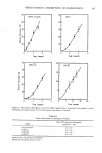
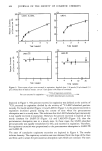
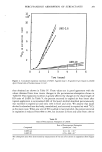
232 JOURNAL OF THE SOCIETY OF COSMETIC CHEMISTS Nine complete load-extension cycles, one right after another on the same coil, produced a deformation of less than 4 cm from an initial coil length of 9.5 -+ 2.5 cm. The largest deformation was during the first two cycles. Table II summarizes typical Table II Load-Extension Behavior of Single Fiber Coils* (to A) -+ (A to B) * (B to C)* Stage I Stage II Stage III Load Limit (dynes) 4 30 200 to 500 Extension Limit (% of Lt) lOøk 40 to 60% lOOk Ext•hsion (median) 3 cm 15 cm 2.5 cm *Initial curl length 9.5 + 2.5 cm. Fibers set on 7,98 mm diameter glass rods containing 11 turns. Lt = 30 cm = straight length, 40 _+ 2% RH. -+ See Figures 2 and 3. load-extension values for the three regions of extension depicted in Figure 2. To extend a hair fiber curl from the initial curl state to its coil "elastic" limit (Figure 3, Point A, 12.5 _+ 2 cm) generally required less than 3.9 dynes force fewer than 30 dynes are required to approach the end of the yield region (Figure 3, Point B, 28 _+ 1 cm), This suggests that forces for frictional studies, to relate to hair style retention and hair body, should not exceed 30 dynes and should preferably be lower, probably in the vicinity of 4 dynes or less. However, studies employing forces of 1 to 30 dynes will probably provide useful information relevant to these hair assembly properties, and of course such loads are to represent the effects of weight from sebum, dirt, hair products, and adjacent hairs, on fiber uncurling. E i I0-- 15- 20-- 25 (INITIAL CURL ) (A) {B} {LTI /k / v 'v ' v REGION I REGION II 'REGION Ill Figure 4. Schematic illustrating the elongation of single hair fiber coils.

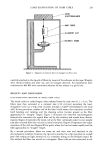
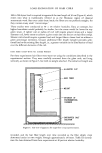
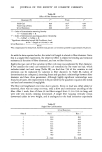
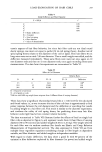
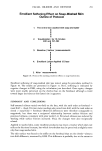
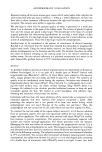
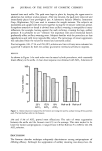
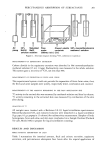
LOAD-ELONGATION OF HAIR COILS 233 200 to 500 dynes load is required to approach the taut length of 30 cm (Figure 4), which enters into what is traditionally referred to as the Hookean region of classical stress-strain work. But even under these loads, the fibers are not perfectly straight, for they contain many small "microcrimps." These studies were conducted at 40 + 2% relative humidity. Data at constant, but higher humidities would probably be similar, but the stress would be lower for any given strain. A tighter coil or radius of curl will require greater stress and a larger diameter coil, lower stress to achieve a given strain (see the section on hair fiber creep). Shorter coils should require a greater load and longer fibers a lower load to achieve a given percentage extension, because additional fiber length (weight) provides addi- tional load to the existing fiber length, i.e., a greater variation in the distribution of load over the different elements of the coil. HAIR FIBER CREEP WITH NO ADDED WEIGHT For these experiments hair fibers were water set using the conditions described in the experimental section. They were carefully removed from the glass rods, and hung vertically, as shown in Figure 5, but with no weight attached. The initial curl length was . • ALLIGATOR CLIP -- HAIR FIBER --WEIGHT • INTERIOR OF ENVIRONMENTAL CHAMBER r SATURATED SALT SOLUTION Figure 5. Side view of apparatus for single fiber creep experimentation. recorded, and the hair fiber length over time recorded as the fiber slowly crept downward under its own weight, through approximately 24 hours. Table III summa- rizes the data obtained from these experiments at 40 percent relative humidity.
Purchased for the exclusive use of nofirst nolast (unknown)
From: SCC Media Library & Resource Center (library.scconline.org)