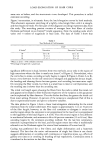
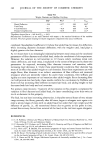
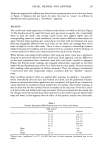
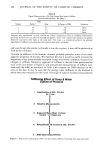
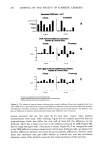
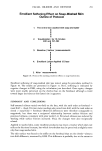
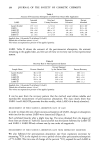
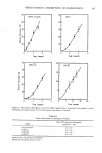
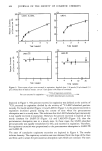
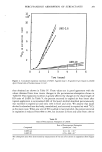
270 JOURNAL OF THE SOCIETY OF COSMETIC CHEMISTS Table V Percent Excreted of the Dose Absorbed Percutaneously LAEO Percent Excreted Percent Excreted in Expiration in Urine and Feces /•o) /•o) Lauryl Alcohol 60 2.6 LAEO-1 28 31 LAEO-2.6 6.9 62 LAEO-10 6.0 51 4 hours after topical application. 31%. With increasing EOs the percent excreted in expired air is reduced, and the amount excreted in feces and urine increases approximately 50% to 60%. To account for the results, LAEO has to cleave at the ether bond between the lauryl group and the ethylene oxide unit. Although in general the ether bonds are difficult to cleave, the expiratory excretion of LAEO-1 at 28% suggests a strong possibility of cleavage. In the present study a limited amount of material was applied. The percutaneous absorption and expiratory excretion both increased linearly with time even though percutaneous absorption amounted to as much as 30% of the applied dose. This finding suggests a constant concentration at the skin surface from which the diffusion into the stratum corneum takes place. This may have been produced by evaporation of our solvent leaving a layer of LAEO in direct contact with the skin. REFERENCES (1) j. Scala, D. E. McOsker, and H. H. Relier, The percutaneous absorption of ionic surfactants,J. Invest. DermatoL, 50, 372-379 (1968). (2) K. Minegishi, M. Osawa, and T. Yamaha, Percutaneous absorption of c•-olefin sulfonate (AOS) in rats, Chem. Pharm. Bull., 25,821-825 (1977). (3) D. Howers, The percutaneous absorption of some anionic surfactants,J. $oc. Cosmet. Chem., 26, 47-63 (1975). (4) J. G. Black and D. Howers, Skin penetration of chemically related detergents,J. Soc. Cosmet. Chem., 30, 157-165 (1979). (5) Y. Iwata, K. Nakajima, and S. Ohta, Percutaneous absorption of squalene,J. Soc. Cosmet. Chem. Japan, 13, 71-80 (1979). (6) R.J. Scheuplein and I. H. Blank, Permeability of the skin, Physio/. Rev., 51,702-747 (1971). (7) R.J. Scheuplein, Permeability of the skin, Handhook of Physiology, Sect. 9, Reactions to environmental agents, pp 299-322 (1977). (8) T.J. Franz, Percutaneous absorption. On the relevance of in vitro data,J. Invest. DermatoL, 64, 190-195 (1975). (9) T. J. Franz, The finite dose technique as a valid in vitro model for the study of percutaneous absorption, Curt. Prohl. Dermatol., 7, 58-68 (1978). (10) R. L. Bronaugh, E. R. Congdon, and R.J. Scheuplein, The effect of cosmetic vehicles on the penetration of N-nitrosodiethanolamine through excised human skin, J. Invest. Dermatol., 76, 94-96 (1981). (11) tt. Tsuruta, Percutaneous absorption of organic solvents. I. Comparative study of the in vivo percutaneous absorption of chlorinated solvents in mice, Industrial Health, 13, 227-236 (1975). (12) A. Mizuchi, Y. Miyachi, K. Tamaki, and A. Kukita, Percutaneous absorption of betamethasone 17-benzoate measured by radioimmunoassay,J. Invest. Dermatol., 67,279-282 (1976). (13) R. C. Wester and H. I. Maibach, Relationship of topical dose and percutaneous absorption in rhesus monkey and man,J. Invest. Dermatol., 67,518-520 (1976).

PERCUTANEOUS ABSORPTION OF SURFACTANTS 271 (14) R. Hruby, The absorption of p-toluenediamine by the skin of rats and dogs, Fd. Cosmet. Toxicol., 15, 595-599 (1977). (15) J. E. Walberg, Impairment of skin barrier function by depilatories, J. Invest. DermatoL, 59, 160-162 (1972). (16) R. B. Stoughton, Animal models for in vitro percutaneous absorption, in Animal Models in Dermatology, ed. H. I. Maibach (Churchill Livingstone, Edinburgh, 1975), pp 121-132. (17) R. B. Stoughton, Penetration of drugs through the skin, Dermatologica, 152, 27-36 (1976).
Purchased for the exclusive use of nofirst nolast (unknown)
From: SCC Media Library & Resource Center (library.scconline.org)