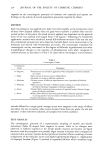
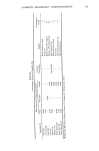
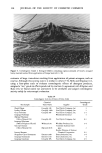
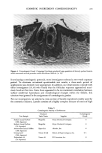
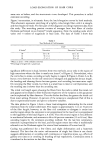
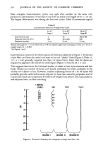
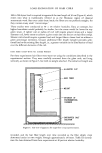
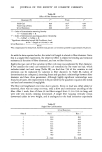
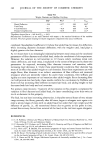
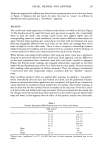
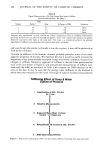
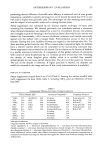
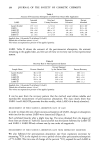
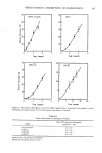
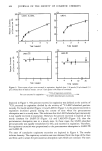
234 JOURNAL OF THE SOCIETY OF COSMETIC CHEMISTS Table III Effect of Fiber Diameter on Curl Parameter (Y) r 2+ F Calc. r 2ñ Initial Curl 0.59 16.95 0.64 Total Creep (24 hrs.) 0.83 39.7 • 0.84 % Curl Retention 0.68 22.0 • 0.73 +r 2 = Index of determination assuming linearity Y = Constant (Dia) + K -+r 2 = Index of determination assuming quadratic relationship Y = C•(Dia) 2 + C2(Dia) + K • Significant relationship beyond 99% Confidence Level 30 cm - (length at 1345 min) x 100 % Curl Retention = 30 cm *No compensation for Initial Curl, therefore max percent curl retention possible is approximately 80 percent. As with the data reported earlier, the initial coil length is related to fiber diameter. Since this is a single fiber experiment, the observed effect is related to bending and torsional resistance (a function of fiber diameter), and not to fiber friction. Eighty-four per cent of the variation in fiber coil creep was explained by fiber diameter. If we consider the total curl retained (% curl retention) by the water set hair, which includes initial curl and creep (Table III), we find that 73% of the variation in curl retention can be explained by variation in fiber diameter. In Table III, indices of determination are compared, assuming linear and quadratic relationships between fiber diameter and these three parameters. Although highly significant relationships were found in all cases, the improvement in fit provided by the quadratic equation (for initial curl and curl retention) is negligible. The fiber coil lengthened over time due to gravity. Since no load was either added or removed, there was no creep recovery, only a slow and continuous uncoiling of the fiber. After 1 week, four of these 30 cm fibers ranged from 11.3 to 19.6 cm long, and were still very slowly creeping downward. A single fiber hanging vertically creeps downward under its own weight, and is analogous to the load extension experiment Table IV Single Fiber Curl Retention % Curl Retention Fiber # Run 1 Run 2 1 43.4 3O.6 2 55.6 44.8 3 32.3 23.3 4 52.3 40.4 5 53.3 43.8 6 58.6 52.5 7 64.1 53.4 8 74.7 69.1 9 70.0 63.8 -- -- A • 56.0 B = 46.86

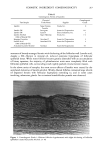
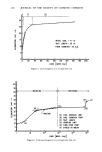
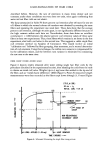
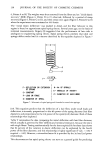
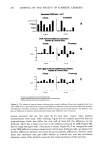
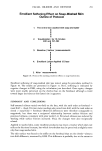
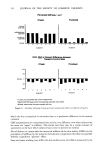
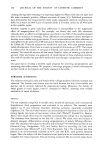
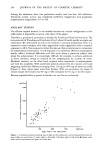
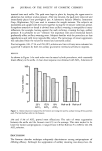
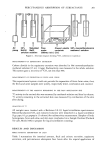
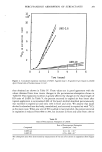
LOAD-ELONGATION OF HAIR COILS 235 described before. However, the rate of extension is many times slower and not constant under these conditions recovery does not exist, once again confirming that water set hair fiber coils are not elastic. The data summarized in Table IV show percent curl retention after 24 hours for one set of 9 fibers in which the second column of numbers was obtained by resetting the same fibers and repeating the experiment one week later. These data show that the average percent curl retention, although 10 units apart, is not significantly different because of the high variance within each data set. Nevertheless, these data show an excellent correlation (r --- 0.99) between the. relative percent curl retention values of these same fibers in these two experiments. Thus, those fibers.which retained a set better in the first experiment, also held a set better in the second one. This suggests a viable single fiber curl retention method via Analysis of Covariance. This would involve an initial "calibration run" followed by fiber grouping, then treatment, and a second determina- tion of curl retention. Using this technique, the Within runs variance is compensated for by the calibration values, and the between runs variance is minimized by conducting the test runs at the same time. FIBER CREEP UNDER ADDED LOAD Figure 6 depicts results obtained after water setting single hair fiber coils by the procedure described in the experimental section, then releasing the coils from the rods to obtain an initial curl value. Weights (up to 3 mg) were then added to the tip end of the fiber, and an "initial elastic deflection" (IED) (Figure 6, Point A) measured. Length measurements were then recorded as the fibers crept down through •21.5 hours (Figure 10 m (78.3 F DiK) 30 ½• = L T INITIAL cU•L = 9.9 cm TOTAL _ilL_ fPRIMARY CREEP (El CREEP (C) 'l•-'-` RECOVERY II (D} ! - - :lED IO ,,,•'.•LOAD APPLIED (I.45 rag} •"2 nd STAGE OF CREEP NON-I•ECOVERABLE SECONDARY CREEP I ' i I II• I1• I 20 30 40 LOAIJ: REMOVED TIME (-HOURS) • Figure 6. Schematic illustrating the single fiber creep process.
Purchased for the exclusive use of nofirst nolast (unknown)
From: SCC Media Library & Resource Center (library.scconline.org)