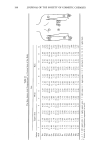
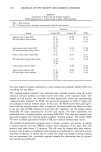
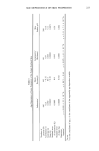
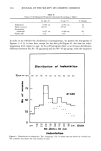
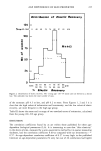
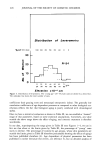
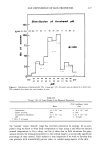
228 JOURNAL OF THE SOCIETY OF COSMETIC CHEMISTS A basic problem in the cosmetic R & D policy today is the fact that whereas the aging process affecting the elastic property of the skin consists mainly of changes occurring in the dermis (7), agents claimed to be active on the dermis are not, according to the present laws, cosmetic preparations but drugs. Three of our parameters (indentation, elastic recovery, slackness) are connected with the behavior of the dermis (3,8,9) and show significant age-dependent changes--presumably deterioration. If we can develop locally acting agents capable of changing an individual measurement which is outside the limits described in Table III into a value which is within those limits, then we have--scientifically speaking--an active ingredient (10). In principle this is a known possibility and it is done every day, e.g. by applying a preparation containing lactic acid to the forehead skin of a woman whose skin pH is more than 5.8 (2). Of course, the underlying assumption is that one knows the distribution and statistics of that parameter in that population. The statistical data presented by us represent, at best, women in Israel people with colored skin might or might not have different values. The point we wish to make is that the distribution of a given skin parameter in the population should be measured first, and those data should be the basis for any claim to a cosmetic skin-improving effect for the same population. We believe that such an approach would bring cosmetic skin care products nearer to the realm of pharmacology. ACKNOWLEDGEMENT The authors wish to thank Mrs. A. Orgad, 81 Dizengoff Street, Tel-Aviv, for carrying out the pH and indentometric measurements. REFERENCES (1) (2) (3) (4) (5) (6) (7) (8) (9) (10) S. Dikstein and A. Hartzshtark, "In Vivo Measurement of Some Elastic Properties of Human Skin," in Bioengineering and the Skin, R. Marks, Ed. (M.T.P. Press, Lancaster, 1981), pp 45-53. S. Dikstein and A. Hartzshtark, The performance of a medicocosmetic consultation unit, Artz. Kosmetol., 12, 280-286 (1982). A. Hartzshtark and S. Dikstein, Mechanical testing of human skin in vivo. Rev. Pure Appl. Pharmacol. Sci., 3, 83-122 (1982). A. Shoen, The Skin Surface pH as a Function of Age. M. Pharm. Thesis, Hebrew University (1982). J. W. Hollingsworth, A. Hashizume, and S. JabIon, Correlations between tests of aging in Hiroshima subjects--an attempt to define "physiological age," YaleJ. BioL Med., 38, 11-26 (1965). A. Comfort, Measuring the human aging rate, Mech. Aging and Development, 1, 101-110 (1972). F. J. G. Ebling, Physiological background to skin aging, Int. J. Cosm. Sci., 4, 103-110 (1982). S. Dikstein and A. Hartzshtark, What does low-pressure indentometry measure? Artz. Kosmetol. (In press, 1983). S. Dikstein and A. Hartzshtark, Effect of intradermal hyaluronidase on indentometry, Bioeng. Skin, 4, 48-51 (1982). S. Dikstein and A. Hartzshtark, Cyclic nucleotides and second generation skin cosmetics as revealed by indentometry. Experientia, in press.

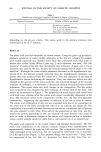
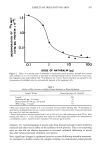
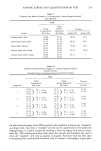
J. Soc. Cosmet. Chem., 35, 229-230 (July 1984) Letter to the Editor TO THE EDITOR: Over the years, numerous studies of the effect of heat on keratin (primarily wool) have been carried out [see informative reviews by Menefee and Yee (1965) and McLaren and Milligan (1981)]. The results, not surprisingly, indicate progressive changes in the chemical structure and indeed, evidence of physical degradation of the fiber at elevated temperatures. Hydrothermal treatments have been found much more damaging than dry heat but even in the case of the latter, prolonged exposures (24 hours) at temper- atures 100øC are required to bring about discoloration and weakening of fibers. Heat setting of hair is a convenient technique for style impartation and is readily accomplished by the use of heated rollers. A legitimate question arises as to the potential for heat damage to hair with frequent use of such appliances. In heated rollers the initial surface temperature rarely, if ever, exceeds 120øC, falling precipitously upon contact with the hair that is being wound on. The setting process is completed within 5-15 minutes and, depending on the brand of the appliance, the final temperature of the hair is between 30-50øC. While a reasonable argument could be made that the heat damage to hair under such conditions is likely to be trivial, the experimental evidence (supportive or otherwise) is lacking. A need for the latter is exemplified by the fact that the spectre of "heat damage" associated with heat appliances has acquired a material existence in the minds of many and has been exploited as a credible and useful tool in frequent advertising campaigns. To generate information regarding the effect of heat on hair under conditions relevant to users of heat setters, tresses of hair were set repeatedly (50 setting cycles) on Kindness Deluxe and Custom Care hair setters. Each of the setting cycles was carried out in the following manner: 12 hair tresses (intact DeMeo hair, 61/2" long, 2 g each) were sham- pooed (single lathering) with a commercial shampoo product for 1 minute, rinsed for 30 seconds, and then combed out and blow dried. After 5 minutes rest at room temperature and 50% R.H., the tresses (four tresses per appliance) were set on medium size rollers for 15 minutes, removed from the rollers, combed out, and after an addi- tional 30 minutes, shampooed again prior to the next setting cycle. Two tresses served as no-treatment controls and another two underwent 50 shampoo-blow drying cycles with no hot roller setting. At the conclusion of the experiment, 20 fibers were selected at random from each test group, their bottom segments mounted on tabs and stretched in H20 to break on a table model Instron. The results of those tests, given in Table I, provide no evidence of any weakening of hair by repetitive use of hot rollers. 229
Purchased for the exclusive use of nofirst nolast (unknown)
From: SCC Media Library & Resource Center (library.scconline.org)