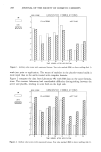
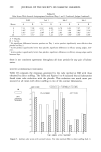
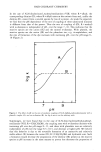
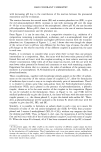
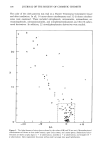
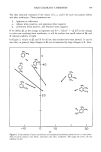
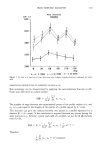
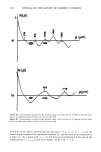
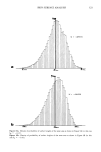
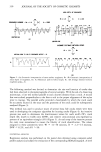
HAIR COLORANT CHEMISTRY 301 In the case of N,N-disubstituted p-phenylenediamines (VIII where R=alkyl), the corresponding diimine (IX where R = alkyl) exists as the cationic form and, unlike the diimine (II), cannot form a neutral species by loss of a proton. As would be expected, we find that the pH dependence of the rate of coupling of these substituted diimines is different from that of the parent. Thus the rate of coupling of (IX R=methyl) with m-diamines is independent of pH, over the range 7-10. This indicates that the reactive species are the cation (IX) and the neutral m-diamine. With phenols, the reactive species are the cation (IX) and the phenolate ion, e.g. o•-naphtholate, and the rate of formation of the dye increases with increasing pH, over the pH range 8- 10 (Figure 2). I I I 7 9 pH Figure 2. The effect of pH on the rate of oxidative coupling of N,N-dialkyl-p-phenylenediamine with a phenolic coupler (A), and an m-diamine (B) the log k axis is on the arbitrary scale. Surprisingly, we have found that in the case of N,N-bis(2-hydroxyethyl)-p-phenyl- enediamine (VIII R = CH2CH2OH), the coupling rates with m-diamines decrease with increasing pH over the pH range 8-11, and those with phenolate ions are relatively independent of pH over the range 8.5- 10.5, and decrease at higher pH. We believe that this behavior is due to the reversible formation of an unreactive and relatively stable adduct (X) between the cation (IX R = CH2CH2OH) and hydroxide ions. Such a formation would decrease the proporation of the diimine (IX) present as the reactive species as pH increases in the same manner as proton loss decreases the proportion of

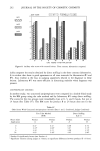
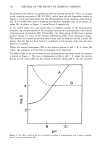
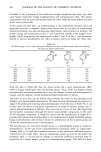
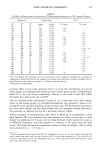
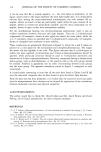
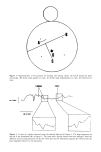
302 JOURNAL OF THE SOCIETY OF COSMETIC CHEMISTS the diimine cation (III) in its equilibrium with the neutral species (II). Thus, in contrast to the coupling reactions of (IX R = CH3), which have the pH dependence shown in Figure 2, it has now been found that the pH dependence of the coupling of the diimine (IX R = CH2CH2OH ) with m-diamines and phenols resembles that of the parent di- imine (II), as shown in Figure 1, curves B and A respectively. In our earlier work (3) it was found that, in marked contrast to the benzoquinone diimines, the reactive species in the coupling reactions ofp-aminophenol is the neutral p-benzoquinone monoimine (XI). Presumably, the imino group of (XI) bears a partial positive charge as a result of the electron withdrawing effect of the quinonoid oxygen. This renders the neutral monoimine much more reactive than the neutral diimine (II) which, thus far, has not been found to contribute to the reaction with even the most reactive of couplers. While the neutral monoimine (XI) is'the reactive species at pH 8, at lower pH values, the conjugate acid becomes increasingly more important. The effect of pH on the rate of reaction ofp-benzoquinone monoimine with a m-diamine is shown in Figure 3. The rate is independent of pH at pH 8, where the reactive species are the imine (XI) and the neutral m-diamine. Below pH 8, the rate increases 4 i , / B I I 8 10 pH Figure 3. The effect of pH on the rate of oxidative coupling ofp-aminophenol with 5-amino-2-methyl- phenol (A) and an m-diamine (B).
Purchased for the exclusive use of nofirst nolast (unknown)
From: SCC Media Library & Resource Center (library.scconline.org)