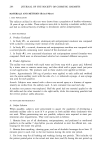
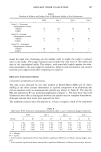
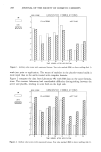
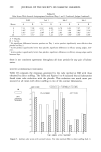
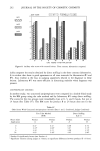
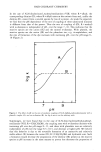
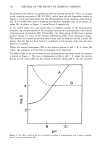
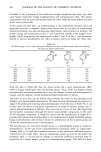
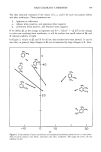
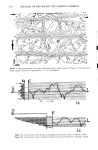
HAIR COLORANT CHEMISTRY 303 with decreasing pH due to the contribution of the reaction between the protonated monoimine and the m-diamine. The reaction between the neutral imine (XI) and m-amino-phenolate ion (XII), to give the red aminoindophenol (XIII), increases in rate with increasing pH over the range 8-10 due to increasing ionization of the aminophenol. Above pH 10, the rate becomes pH-independent. Below pH 8, there is a contribution to the rate of reaction between the protonated monoimine and the phenolate ion. From Figure 3 it can be seen that, in a competitive situation (e.g. oxidation of a composition containing p-aminophenol, m-diamine, and a m-aminophenol) lower pH favors reaction with the m-diamine and higher pH favors reaction with the m-amino- phenolate ion. Comparison of Figures 1, 2, and 3 shows that even though the shapes of the curves of rate vs pH are very different for the three type of imine, the effect of pH change on the relative reactivity of the different couplers is qualitatively the same in each case. Finally, it is necessary to consider what occurs when there is more than one primary intermediate in a composition. Here, the imine with the lower redox potential will be formed first and will react with the couplers according to their relative reactivity and relative concentration. Only when all of that imine has reacted, will the one with the next lower redox potential be formed and commence to react with remaining couplers. Experiment has shown that in a mixture, the order of oxidation of the primary inter- mediates is p-aminophenol, N,N-disubstituted p-phenylenediamine, and, finally, p- phenylenediamine. These considerations, together with knowledge already gained on the effect of substit- uents on the reactivity of the various classes of couplers (2,3) •, allow for formulation of oxidation dyes in such a way as to couple selectively pairs of intermediates. Thus if it is desired to obtain some blue indo-aniline from the N,N-disubstituted p-phen- ylenediamine (VIII), and a phenol in the presence of p-pheny_lenediamine, a phenolic coupler, chosen as to be the most reactive of the couplers in the composition (Figure 4), can be included in the formulation. Since, in Figure 4, 1st. case (VIII) will be oxidized preferentially to give the diimine A, the latter will react with the most reactive coupler present, i.e., the chosen phenol C, to give the desired indo-aniline AC. There- after, p-phenylenediamine will be oxidized to the diimine B, which will react with the couplers to give dyes BC, BD, and BE. Similarly, it is possible to formulate an auburn shade in such a way as to assure the formation of some of the red amino-indophenol dye (XIII R=CH3) from p-amino- phenol and 5-amino-2-methylphenol (XII R = CH3), without any magenta dye form the diimine and (XII). Thus, in Figure 4, 2nd. case, the monoimine A will be formed first and will react with all of the m-amino-phenol (coupler C) and with some of coupler D. When the imine B is formed, all of C has been consumed and no dye BC is formed. • In the present paper, the effect of pH on the relative reactivity of different coupler classes has been discussed. The reactivity of couplers within a class, e.g., m-diamines or phenols, can be markedly affected by the introduction of C-substituents. Thus C-methylation and, to an even greater extent, methoxylation increase the reactivity of the coupler, and C-chlorination reduces it. Furthermore, for polysubstitution, the effects are cumulative thus 2,6-xylenonl is about 900 times more reactive than phenol and about 30 times more reactive than o-cresol.

304 JOURNAL OF THE SOCIETY OF COSMETIC CHEMISTS Phase 1. 1st. Case• Where [A] • [C] A is oxidized to imine Imine A + Coupler C . Dye AC Phase 2. B is oxidized to imine Imine B Coupler C ) Dye BC Coupler D Dye BD Coupler E • Dye BE 2nd Case• Where [A] • [C] Phase 1o A is oxidized to imine Imine A Coupler C Coupler D Phase 2. B is oxidized to imine Dye AC Dye AD Coupler D • Dye BD Imine B • " , CouPler E • f Dye BE Figure 4. Schematic diagram of the coupling reactions occurring in a composition containing two primary intermediates A and B, where A is the more readily oxidized, and three couplers having relative reactivity [C][D][E].
Purchased for the exclusive use of nofirst nolast (unknown)
From: SCC Media Library & Resource Center (library.scconline.org)