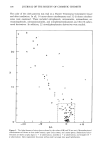
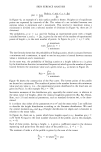
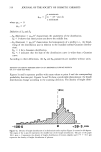
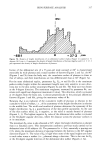
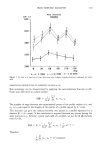
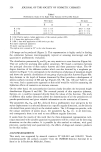
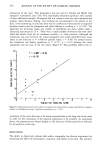
336 JOURNAL OF THE SOCIETY OF COSMETIC CHEMISTS orientation of the trace. This dependence was not seen by Nicolls and Marks who measured "surfometric area" (18). This relationship remained significant after analysis of three additional samples. Plumpness did not correlate with any other mathematical analysis. Since flatness, flaking, and cracking are all presumed to be related to dry skin, it was interesting to note that there was no correlation (either positive or negative) between visual scores for plumpness and either flaking or cracking (r = 0.1125). The algorithm for detecting cracks was capable of identifying all cracks visible under a dissecting microscope at 25 X. There were a small number of features that were iden- tified but which could not be confirmed visually, i.e., false positives. Although the correlation was poor between the visual assessment and cracks identified from traces taken in one direction (r = 0.400 for parallel traces r = 0.467 for normal traces), the correlation was highly significant (r = 0.757, p 0.01) between the visual assessment and the sum of the two traces (Figure 9). This probably reflects the re- 15. a:: 6 ltl 6 7 8 Y = 2. BSX + B.94 r = B.757 + + I 2 3 4 5 SUBJECTIVE ERREKING SCORE Figure 9. Relationship between the subjective evaluation of cracks and the number identified by computer analysis of surfanalysis tracings. Correlation significant at p 0.01. quirement of the trace direction to be nearly perpendicular to the long axis of the crack in order for the constraints of the physical parameters to be satisfied. As mentioned above, the parameters are biased slightly in the direction of false positives as reflected by the positive y-intercept. DISCUSSION The ability to objectively evaluate skin surface topography has obvious importance for examining the effects of environment, cosmetics, and disease on the skin. The ultimate

OBJECTIVE AND SUBJECTIVE SKIN SURFACE EVALUATION 337 goal is to be able to use these parameters to predict clinical response and/or consumer perception. The results of the present study represent a significant step towards reaching that goal. The roughness parameters Ra and Rz appear to be the most useful for the character- ization of the general topography of the skin. It is important to remember that "rough- ness" here is used in the context of the metals industry and not in terms of skin condition perception. An increase in these parameters correlated with plumpness scores obtained from evaluation of SEM photomicrographs and have been taken to be a positive indicator of skin condition. These results are consistent with SEM work t•y Wolfram et al. (16) who reported a "pronounced swelling of the major subdivisions" as a result of hydrating human skin in vivo. This interpretation is not in agreement with surface profile analyses reported by Nicolls et al. (8) or Cook (10) who reported a decrease in roughness parameters (assessed as a "smoothing") after treatment with emollient lotions. A large part of this discrepancy may be accounted for by material deposited in the furrows resulting in a smoother profile with little change in the skin surface itself. This interpretation is supported by SEM analysis by ourselves and others (17, 19). In addition, it has been reported that some changes in plumping and moisturization were not detectable at the level of the stratum corneum, but were reflections of deeper changes (19). It is possible that the parameters measured here more accurately reflect those changes. If plumping is in fact a result of changes beneath the stratum corneum, it is not surprising that is would not correlate with cracking or flaking, which are a reflection of surface damage. This would be consistent with the results of this study. This current study is one of the few to have directly compared surfanalysis to a visual evaluation of normal skin. We are currently investigating the relationship between plumpness and the tactile perception of smoothness and softness. To our knowledge this report is unique in the ability to objectively evaluate a sample for cracks, one of the hallmarks of "chapped" skin. The advances mentioned above in combination with the capacity to take consecutive replicas of the same site (14) will allow the effects of cosmetic agents to be quantitated. Results of preliminary investi- gations suggest that this technique can be used to evaluate wash-off products, i.e., soaps as well as leave-on products. ACKNOWLEDGEMENTS The authors thank James R. Swafford and William P. Sharp, Department of Botany and Microbiology, Arizona State University, for their excellent technical assistance with the scanning electron microscopy, and Robert W. Washam II for assistance with.the statistical analysis. REFERENCES (1) D. R. Highley, V. O. Savoyak, J. J. O'Neill, and J. B. Ward, A stereomicroscopic method for the determination of moisturizing efficacy in humans, J. Soc. Cosmet. Chem., 27, 351-363 (1976). (2) C. Wagner and R. W. Goltz, Human cutaneous topography, Cutis, 23, 830-842 (1979). (3) R. J. Marshall and R. Marks, Assessment of skin surface by scanning densitometry of macrophoto- graphs, Clin. Exp. Dermatol., 8, 121-127 (1983). (4) P. T. Pugliese, Instrumental techniques for evaluating the performance of skin care products, Drug and Cosmetic Industry, 125, 32-34, 78 (1979).
Purchased for the exclusive use of nofirst nolast (unknown)
From: SCC Media Library & Resource Center (library.scconline.org)