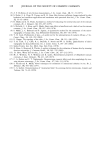
338 JOURNAL OF THE SOCIETY OF COSMETIC CHEMISTS (5) (6) (7) (8) (9) (10) (11) (12) (13) (14) (15). (16) (17) (18) (19) A. F. EI-Shimi, In vivo friction measurements,.]. Soc. Cosmet. Chem., 28, 37-51 (1977). S. Nacht, J. A. Close, D. Yueng, and E. H. Gans, Skin friction coefficient changes induced by skin hydration and emollient application and correlation with perceived skin feel, J. Soc. Cosmet. Chem., 32, 55-63 (1981). R. Marks and A.D. Pearse, Surfometry a method of evaluating the internal structure of the stratum corneum, Br. J. Dermatol., 92, 651-657 (1975). S. Nicholls, C. S. King, and R. Marks, Short term effects of emollients and a bath oil on the stratum corneum, J. Soc. Cosmet. Chem., 29, 617-624 (1978). S. Makki, J. C. Barbenel and P. Agache, A quantitative method for the assessment of the micro- topography of human skin, Acta Dermatovener (Stockholm), 59, 285- 30 ! (1979). T. H. Cook, Profilometry of skin--A useful tool for the substantiation of cosmetic efficacy, J. Soc. Cosmet. Chem., 31, 339-359 (1981). U. Hoppe, The topology of the skin, J. Soc. Cosmet. Chem., 30, 213-240 (1979). T. H. Cook, T. J. Craft, R. L. Brunella, F. Norris and W. A. Griffin, Quantification of skin's topography by skin profilometry, Int. J. Cosmet. Science, 4, 195-205 (1982). Surface Texture, Am. Soc. Mech. Eng. New York, (1978). R. Ryan, S. Hing and R. Theiler, A replica technique for the evaluation of human skin by scanning electron microscopy, J. Cutaneous Pathol., 10, 262-276 (1983). B. Idson, Water and the skin, J. Soc. Cosmet. Chem., 24, 197-212 (1973). M. A. Wolfram, N. F. Wolejsza and K. Laden, Biomechanical properties of delipidized stratum corneum, J. Invest. Dermatol., 59, 421-426 (1973). C. A. Garber and C. T. Nightingale, Characterizing cosmetic effects and skin morphology by scan- ning electron microscopy, J. Soc. Cosmet. Chem., 27, 509-531 (1976). S. Nicolls and R. Marks, Novel techniques for estimation of intracorneal cohesion in vivo, Br. J. Dermatol., 96, 595-602 (1977). C. A. Gather, Characterization of"moisturized skin" by scanning electron microscopy, Cosmetics and Toiletries, 93, 74-83 (1978).

j. Soc. Cosmet. Chem., 35, 339-343 (September/October 1984) Abstracts The Annual Scientific Meetings and Seminars of the Society of Cosmetic Chemists are important venues for informing the participants about the state of the art and recent technical advances in the field of Cosmetic Science. To provide broader dissemination of that information, the Publication Committee has decided to publish abstracts of the technical presentations made at these Meetings and Seminars in the Journal.--The Editor. Society of Cosmetic Chemists Annual Meeting December 6-7, 1984 Leszek J. Wolfram, Ph.D. (Clairol Inc.)and James Whittam, Ph.D. (Shaklee Corp.), Program Co-Chairmen SCIENTIFIC SESSION I HAIR PROPERTIES, PART I New insights into the structure and chemistry of human hair Helmut Zahn, Dr.-Ing, Deutsches Wollforschungs Institut, an der Rheinisch-West falischen, Tech- nischen Hochschule Aachen, West Germany For studies of hair's morphological components, cu- ticle, cortex, cell membrane complex, and melanin were isolated chemically and analyzed. The isodi- peptide gamma-glutamyllysine crosslinks proteins not only in the medulla but also in the cuticle. 92 single hair samples have been analyzed with the two-dimensional electrophoretic gel electrophoresis method of R. C. Marshall Mellbourne. Up to 62 isolated protein spots were found. Cosmetic treat- ments such as bleaching or perming make the pro- tein spots in the sulfur-rich region diffuse and weak. Internal lipids from the cell membrane complex were found in formic acid extracts as well as in wash liquors of thioglykolate-treated hair. The fracture behavior of negroid hair was studied to clarify the causes of fiber breakage at low levels of extension. Microscopic observation of the fiber reveals frequent twists, with random reversals in direction and high ellipticity along the length. Si- multaneous measurements of the effect of tensile load on extension and on the axial angle of un- twisting of specimens with a single twist indicate that failure at low extensions is due to the initiation of cracks at flaws near the twists, which relieves torsional stresses in these regions. Extension at failure is higher in wet fibers, probably because plasticization relaxes these stresses. Treatment of fibers with solutions of humectants such as poly- acrylic acid or glycerine has been found to reduce premature failure significantly. Scanning electron microscopy of fracture ends reveals a predominance of step fractures and fibrillated ends, indicating a large number of flaws, and poor cohesion between cortical cells. Fatiguing hair fibers seem to accen- tuate fiber damage and reduce intercellular cohesion in the cortex, leading to a predominance of fibril- lated fracture ends. Mechanical and fractographic behavior of ne- groid hair Y. K. Kamath, Ph.D., S. B. Hornby, and H. D. Weigmann, Ph.D., Textile Research Institute, P.O. Box 625, Princeton, NJ Relationship between triboelectric charging and surface modifications on human hair J. Jachowicz, Ph.D., G. Wis-Surel, and M. L. Garcia, Ph.D., Clairol Inc., 2 Blachley Rd., Stam- ford, CT 06922 339
Purchased for the exclusive use of nofirst nolast (unknown)
From: SCC Media Library & Resource Center (library.scconline.org)