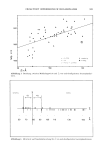
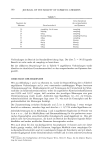
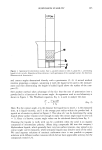
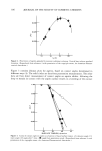
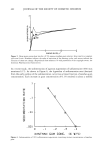
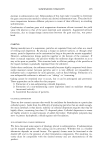
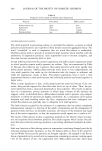
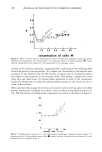
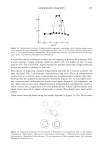
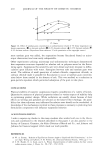
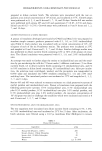
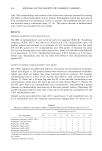
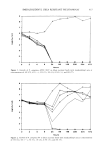
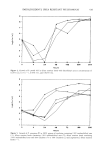
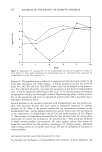
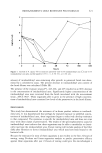
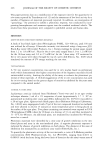
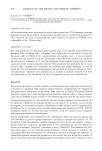
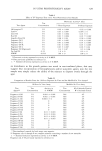
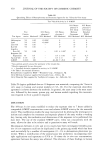
SUSPENSION STABILITY 405 storage. The addition of salt resulted in a change from a defiocculated to a fiocculated system. Aluminum chloride was effective at a much lower concentration than calcium chloride, which acted at a much lower concentration than sodium chloride. This order was in agreement with the Schulze-Hardy rule. Apparent viscosity of an aluminum hydroxide gel suspension was a maximum when the pH of the medium was adjusted to the zero point of charge (20). This is indicative of flocculation attractive forces dominate at the zero point of charge because of the absence of charge repulsion. On either side of the zero point of charge, apparent viscosity de- creased, indicating that deflocculation took place. In suspensions that contain an adsorbed surfactant as a wetting agent, the properties of the surfactant can strongly influence flocculation behavior. Using sedimentation volume, apparent viscosity, and refiltration as fiocculation probes, Liao and Zatz (21) investigated local anesthetic suspensions containing members of a single family of non- ionic surfactants as wetting agents. Measurements of critical surface tension, surfactant / .... adsorption, and anesthetic solubfi•zauon were also conducted. Sedimentation volume (represented here by the symbol F) of benzocaine suspensions was a function of the initial particle size and polyoxyethylene chain length of the surfactant (Figure 7). Liquid bridging and incomplete wetting accounted for the enhanced fioccu- lation observed in some of the systems (21). The effect of added salts on fiocculation of benzocaine suspensions was also studied (22). In these suspensions, charge was not expected to be a significant factor, and so increased flocculation at low salt concentrations was not anticipated. Indeed, a decrease in the extent of flocculation was observed (Figure 8). This was accompanied by enhanced ad- 0.8 F 0.6 0.4 0.2 i i i I I , 10 20 30 40 50 n Figure 7. Sedimentation volume of benzocaine suspensions as a function of mean number of polyoxyethy- lene units per surfactant molecule. Suspensions standing undisturbed. (O) 2.3 benzocaine (0) 20.3 I-tin benzocaine. (Reproduced from reference 21 with permission of the copyright owner. )

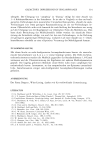
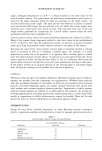
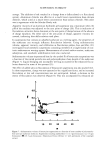
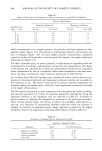
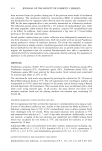
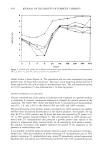
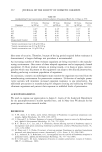
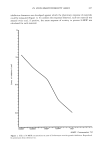
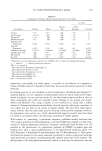
406 JOURNAL OF THE SOCIETY OF COSMETIC CHEMISTS ø.8 f 0.4 0.2 I I I I I 1.0 2.0 3.0 4.0 5.0 concentration of salts (N) Figure 8. Effect of various salts on sedimentation volume of benzocaine suspensions containing polyox- yethylene (15) nonylphenol. (Z•) sodium sulfate (¸) magnesium sulfate ([•) sodium chloride (•') calcium chloride. (Reproduced from reference 22 with permission of the copyright owner.) sorption of the nonionic surfactant, suggesting that a tightening of the stabilizing layer around the particles was responsible. At a higher salt concentration, flocculation again increased. It was observed that the effectiveness of various ions in causing flocculation was related to their position in the lyotropic series. This finding, coupled with cloud point data and observation of incipient phase separation in some of the suspensions, implicates dehydration of surfactant polyoxyethylene groups as the reason for the in- crease in flocculation. Other materials that change the solvation of nonionics used as wetting agents will affect particle interactions. Examples are polyols, such as sorbitol and propylene glycol (23, 24). The flocculation of sulfamerazine suspensions by polyols is illustrated in Figure 9. 0.4 0.3 0.2 0.1 0 • 21 I • l 0 40 60 POLYOL CON. (% v/v ) Figure 9. Sedimentation volume (F) of 10% sulfamerazine suspensions containing various polyols. propylene glycol (¸) polyethylene glycol 400 (I) sorbitol solution. (Reproduced from reference 24 with permission of the copyright owner.)
Purchased for the exclusive use of nofirst nolast (unknown)
From: SCC Media Library & Resource Center (library.scconline.org)