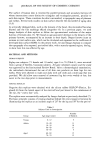
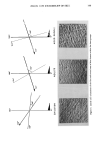
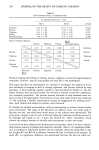
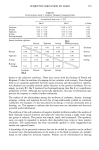
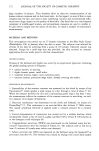
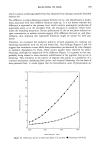
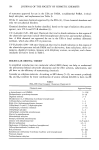
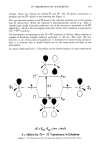
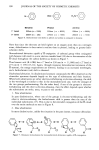
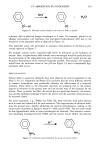
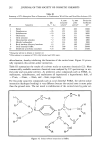
198 JOURNAL OF THE SOCIETY OF COSMETIC CHEMISTS Benzene Phenol An III ne 1 ø band: 202nm (½--7400) 210nm ( ½ = 8200) 230nm ( ½ = 8600) 2 ø band: 255nm (•: = 230) 270nm ( ½ = 1450) 280nm ( ½ = 1430) Figure 6. Bathochromic (red) shifts in phenol and aniline as compared to benzene. Note that since the electrons are held tighter on an oxygen atom than on a nitrogen atom, delocalization is thus easier in aniline than in phenol, leading to greater bath- ochromic shifts. Monosubstituted derivatives capable of H-conjugation. A carbonyl group when conjugated with benzene will result in a new electron transfer band (14) due to the extension of the H-cloud throughout the carbon skeleton as shown in Figure 7. Thus benzoic acid (R= OH) has a 1 ø band at 230 nm (½ = 11,600) and a 2 ø band at 273 nm (½ = 970) (15,16). Again, through resonance delocalization (extension of the H-system), the energy requirements are lowered, leading to an increased wavelength, and a bathochromic (red) shift is observed. Disubstituted derivatives. In disubstituted aromatic compounds the effect observed on the ultraviolet spectrum depends largely on the type of substituents and their location. When both substituents are either electron-withdrawing or electron-releasing, the shift in the wavelength is similar to that in the monosubstituted case, with the stronger of the two groups predominating. On the other hand, if one of the groups is electron- withdrawing and the other is electron-releasing, then the effect depends upon whether the substituents are ortho, meta, or para to one another. 1. Para disubstitution In para disubstitution, where one of the groups is electron-withdrawing and the other is electron-releasing, the bathochromic shift is greater than the sum of the individual substituents (17). This is due to the extended conjugation of the H-cloud over the entire molecule as seen in Figure 8. 2. Meta disubstitution In meta disubstitution, unlike the situation in the para isomer, resonance delocaliza- ?-% (•C--O C:O R R Figure 7. Resonance delocalization for monosubstituted derivatives capable of II-conjugation.

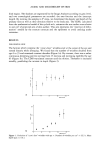
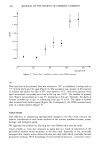
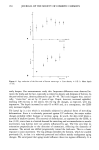
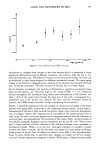
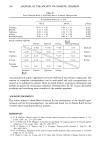
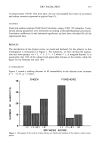
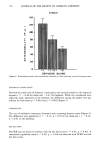
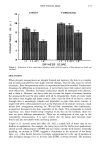
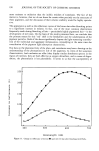
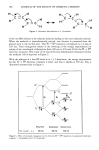
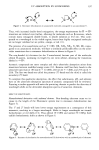
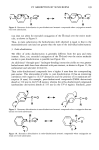
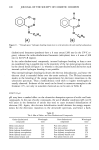
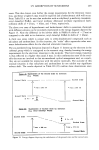
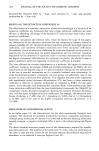
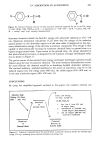
UV ABSORPTION BY SUNSCREENS 199 Figure 8. Resonance delocalization in para-disubstituted aromatic compounds where conjugation extends over both substituents. tion does not allow for extended conjugation of the H-cloud over the entire mole- cule, as shown in Figure 9. Thus, in meta substitution the bathochromic shift observed is equal to that in the monosubstituted case (and not greater than the sum of the individual substituents). 3. Ortho disubstitution The effect of ortho disubstitution is generally different from the para and meta isomers. Here, too, extended conjugation of the H-cloud over the entire molecule similar to para disubstitution is possible (see Figure t0). An additional "through space" hydrogen-bonding interaction yields an even greater bathochromic shift than those observed with para isomers, as shown in Figure 1 t, for anthranilate and salicylate derivatives. Thus ortho-disubstituted compounds have a higher K max than the corresponding para isomer. This relationship of ortho vs. para disubstitution (3) has an interesting correlation with regard to its UV absorption and the position of its maximum ab- sorption (K max). For example, para-disubstituted compounds (PABA derivatives) absorb at 3 t0 nm (in the UV-B region), whereas the ortho-disubstituted compounds (anthranilate derivatives) absorb at 335 nm (in the UV-A region). Similarly, para- Figure 9. Resonance delocalization in meta-disubstituted aromatic compounds where conjugation does not extend over both substituents. Figure 10. Resonance delocalization in ortho-disubstituted aromatic compounds where conjugation ex- tends over both substituents.
Purchased for the exclusive use of nofirst nolast (unknown)
From: SCC Media Library & Resource Center (library.scconline.org)