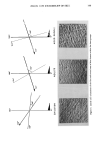
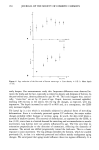
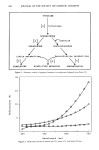
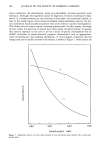
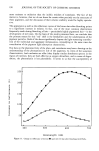
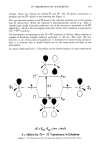
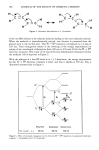
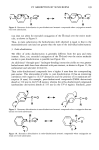
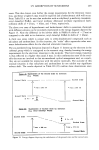
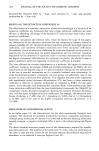
196 JOURNAL OF THE SOCIETY OF COSMETIC CHEMISTS H\C • /H --C H / N•= /H H / XH H\Dc/H ' H / •"'-• /H C--C H / +•H Figure 2. Resonance delocalization in 1,3-butadiene. of the two MO orbitals in the ethylene molecule leading to four new molecular orbitals. When the molecule is photochemically excited, one electron is promoted from the ground state to the excited state. This II -• II* transition corresponds to a X max of 230 nm. Thus conjugation results in the lowering of the energy requirements (or raising of the wavelength of absorption from 180 nm to 230 nm) (9) for the II --• II* electronic transition. This is due to the ease of electron delocalization (resonance) within the molecule (10) as depicted in Figure 2. With the addition of a third H-bond as in 1,3,5-hexatriene, the energy requirements for this II -• II* electronic transition is lower, and thus it absorbs at 258 nm. This is illustrated schematically in Figure 3. i I I I i I I \ Ethylene Butadlene Hexatrlene For ]'[---*:]'[*, • = 180 nm 230 nm 258 nm Figure 3. Effect of increased conjugation on the electronic II -- II* transitions in unsaturated molecules: ethylene, 1,3-butadiene and 1,3,5-hexatriene.

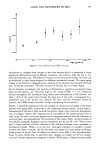
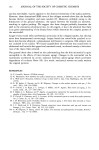
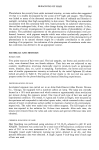
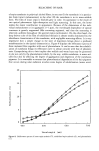
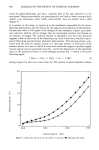
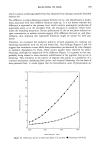
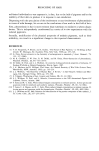
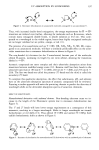
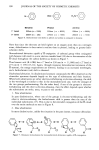
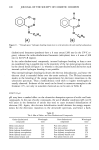
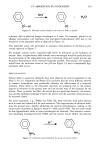
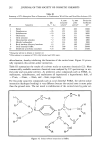
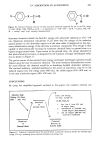
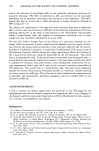
UV ABSORPTION BY SUNSCREENS 197 \ / Figure 4. Resonance delocalization in unsaturated molecules conjugated to an auxochrome Y. Thus, with increased double-bond conjugation, the energy requirements for H -- H* transition are reduced even further, allowing for molecules such as lB-carotene, which contain many conjugated double bonds, to absorb radiation at 452 nm. This corre- sponds to a wavelength in the visible region hence these highly conjugated molecules are no longer colorless but are yellow, orange, or red (11). The presence of an auxochrome such as Y = OH, OR, NH2, NR2, X, SH, SR, conju- gated to an unsaturated molecule, will have a similarily predictable effect on the ultra- violet transitions due to resonance delocalization as shown in Figure 4. The non-bonded (n) electrons (on the Y-auxochrome) become part of the molecular orbital H-system, increasing its length by one extra orbital, allowing for transitions labeled n--) H*. Aromatic compounds are more complex and their ultraviolet absorption arises from transitions between modified energy states (12). Benzene itself has three bands in the ultraviolet spectrum at 184 nm (½ = 47,000), 202 nm (½ = 7,400), and 255 nm (½ = 230). The first two bands are called the primary (1 ø) bands and the third is called the secondary (2 ø ) band. To complete this qualitative description, the effect that substituents, pH, and solvents have on the ultraviolet absorption spectrum of aromatic compounds will be reviewed. Pursuing a similar approach will assist the practicing chemist to predict the direction of wavelength shifts in the ultraviolet absorption spectra of sunscreen chemicals. EFFECT OF SUBSTITUENTS Monosubstituted derivatives with unshared electrons. Non-bonding electrons cause an in- crease in the length of the H-aromatic system due to resonance delocalization (see Figure 5). The 1 ø and 2 ø bands will have lower energy requirements as a consequence of this resonance, resulting in a longer wavelength. Shifts to longer wavelength are termed bathochromic or red shifts (13). Thus phenol (Y=OH) and aniline (Y=NHi) both exhibit bathochromic shifts as shown in Figure 6. Figure 5. Resonance delocalization for monosubstituted (Y) derivatives with an unshared pair of electrons.
Purchased for the exclusive use of nofirst nolast (unknown)
From: SCC Media Library & Resource Center (library.scconline.org)