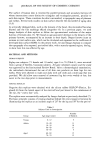
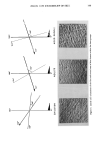
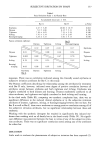
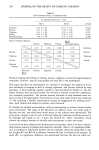
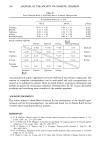
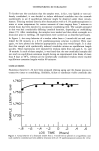
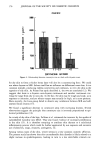
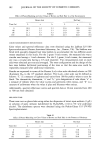
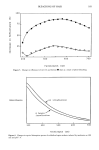
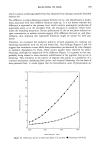
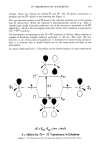
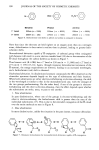
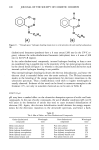
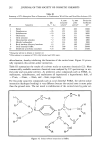
202 JOURNAL OF THE SOCIETY OF COSMETIC CHEMISTS Table III Summary of UV Absorption Data of Sunscreens in Combination With Polar and Non-Polar Solvents (22) # Sunscreen h• max h 2 max Extinction Ah non-polar polar Coefficient (•'2 -- k•.) solvent • solvent u (e) u 1 PABA - 27 293 266 13600 2 Dioxybenzone - 26 352 326 9400 3 Sulisobenzone - 10 334 324 8600 4 Oxybenzone - 8 329 321 9300 5 Octyl salicylate - 2 308 306 4900 6 Homomenthyl salicylate - 2 310 308 4800 7 Menthyl anthranilate q- 2 334 336 5600 8 Butyl methoxy dibenzoyl methane q- 9 351 360 31000 9 Octyl dimethyl PABA q- 16 300 316 28400 10 Ethylhexyl p-methoxy cinnamate + 23 289 312 24200 Non-polar solvent is hexane or mineral oil. Polar solvent is a mixture of 70% ethyl alcohol and 30% water. delocalization, thereby inhibiting the formation of the excited state. Figure 14 pictor- ially represents this solvent-solute interaction. Table III summarizes the results of a solvent study on sunscreen chemicals (22). Most commercially available sunscreen chemicals were analyzed by UV spectroscopy in sev- eral polar and non-polar solvents. As predicted, polar compounds such as PABA, di- oxybenzone, sulisobenzone, and oxybenzone all experienced a hypsochromic shift, of - 27nm, - 26nm, - 10nm, and - 8nm, respectively. For less polar sunscreen compounds such as octyl dimethyl PABA, the solvent-solute interaction (hydrogen bonding) is very different because the excited state is more polar than the ground state. The net result is stabilization of the excited state by polar sol- Figure 14. Solute-solvent interaction in PABA.

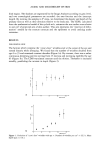
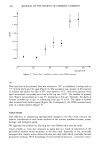
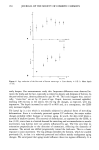
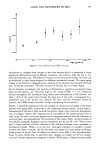
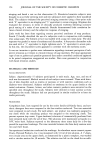
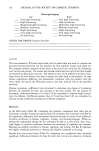
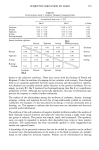
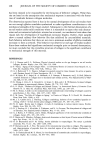
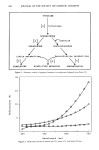
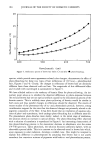
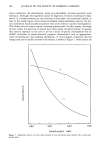
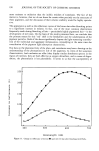
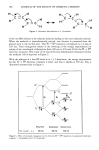
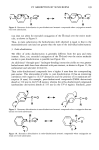
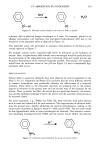
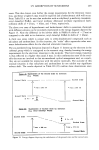
UV ABSORPTION BY SUNSCREENS 203 vents. This then lowers even further the energy requirements for the electronic transi- tion, and hence a higher X max would be expected and a bathochromic shift will occur. From Table III it can be seen that molecules such as ethylhexyl p-methoxy cinnamate, octyl dimethyl PABA, and butyl methoxy dibenzoyl methane experienced bath- ochromic shifts of q-23nm, q- 16nm, and q- 9nm, respectively. The above two cases of hypsochromic and bathochromic shifts in sunscreen chemicals with different solvents can be pictorially represented in the energy diagram depicted by Figure 15. Note the difference in the solvent shifts in PABA (X shifts of -27nm) as compared to the shift in its derivative, octyl dimethyl PABA (• shifts of q- 16nm). A third case exists which is unique only to ortho-disubstituted compounds such as salicylates and anthranilates. In this situation, the "ortho" effect supercedes other reso- nance delocalization effects for the observed ultraviolet transitions. The six-membered ring formation depicted in Figure 11 loosens up the electrons in the carbonyl group which is conjugated to the aromatic ring, thereby lowering the energy requirements for the electronic transition in the molecule. This lower energy transition is thus reflected in a higher than usual • max. In this conformation most of the avail- able electrons are involved in this six-membered cyclical arrangement and, as a result, they are not available for interaction with the solvent molecules. The outcome of this unusual situation is that salicylates and anthranilates do not exhibit any significant solvent shift. The results depicted in Table III (22) confirm these observations since Ca.•.•z.•._.• Slablllzallon o! Ihe Ground State by Solvatlon (e.g. PABA) Excited State .................. • max . 293 nm Ground State .. /• • = - 27 '.... Excited State • ma[ ß 266 nm -. ß - Ground State CaseJ• Slablllzallon of Exclled State by Solvallon (e.g. Oclyl Dimethyl PABA) Excited State Ground State ee ** ß Excited State •max ß 300 nm T Amax = 316 nm Ground •ale . ß .. ee eee* e. ee ee .e Figure 15. Energy diagram depicting the stabilization of the ground state and the excited state.
Purchased for the exclusive use of nofirst nolast (unknown)
From: SCC Media Library & Resource Center (library.scconline.org)