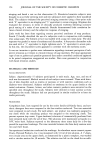
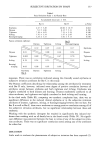
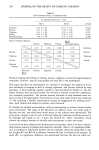
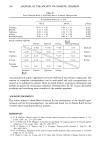
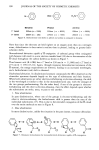
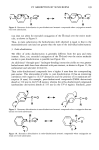
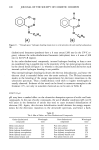
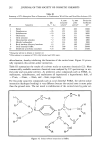
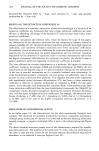
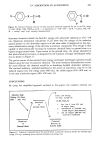
204 JOURNAL OF THE SOCIETY OF COSMETIC CHEMISTS homomenthyl salicylate shifts by -2nm, octyl salicylate by -2nm, and menthyl anthranilate by + 2nm only. EFFECTS ON THE EXTINCTION COEFFICIENT (E) The effectiveness of a sunscreen chemical at a particular wavelength is a function of its extinction coefficient (e). Chemicals that have a high extinction coefficient are more efficient in absorbing the energy of the harmful UV radiation than those with a lower extinction coefficient. Symmetry, calculations and selection rules, which are beyond the scope of this paper, can characterize all the electronic transitions for any compound as symmetry allowed or symmetry forbidden (23,24). Symmetry allowed transitions generally have high extinction coefficients, and symmetry forbidden transitions have lower extinction coefficients. Nevertheless, trends in extinction coefficients for sunscreen chemicals can be arrived at qualitatively, by studying both the spatial requirements and the electronic transition responsible for the observed UV spectrum. Since it has been demonstrated earlier that the degree of resonance delocalization in a molecule can predict the relative }, max, a similar qualitative prediction regarding its extinction coefficient is possible. The more efficient the electron alelocalization in a molecule, the higher its extinction coefficient. Compare, for example, PABA and menthyl anthranilate. In PABA, the two substituents on the benzene ring are in a para relationship whereas the two substituents in the case of menthyl anthranilate are in a sterically hindered ortho relationship. In ortho-disubstituted aromatic compounds, the two groups are sufficiently close to one another to cause a deviation from planarity. This slightest deviation from coplanarity will significantly reduce resonance delocalization (25), and hence a lower extinction coefficient is observed in menthyl anthranilate as compared to PABA. For the same reason, octyl salicylate and homomenthyl salicylate (both ortho-disubstituted) have lower extinction coefficients than the para-disubstituted compounds. See Table III for comparative results. Increased conjugation, allowing for increased resonance delocaliza- tion, will also result in higher extinction coefficients. For example, the extinction coef- ficient of ethylene is 15,000, that of 1,3 butadiene is 21,000, that of 1,3,5-hexatriene is 35,000, and in the case of the highly conjugated molecule, B-carotene, it is 152,000. MECHANISM OF SUNSCPdSENING ACTION In an earlier paper (3), the characteristics for the ideal sunscreening chemical were outlined. The chemicals are generally disubstituted aromatic compounds possessing a carbonyl group (either part of a ketone or an ester) and an electron-releasing substituent (usually nitrogen- or oxygen-containing) ortho or para to the carbonyl group (see Figure 16). The above chemical structures possess most of the characteristics required for suitable sunscreen protection. The presence of the substituent Y, with a lone pair of electrons in the ortho or para position, allows for the necessary electron alelocalization required for absorbance at the observed }, max (see Figures 8 and 10).

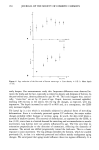
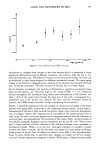
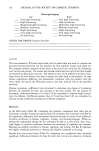
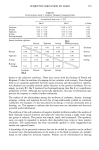
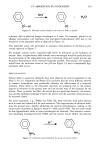
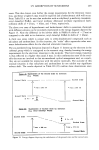
UV ABSORPTION BY SUNSCREENS 205 C--OR R y Figure 16. General chemical structure of most sunscreen chemicals approved for use in the US, where Y=OH, OCH 3, NH2, N(CH3)2 and X = no substituent or -CH=CH - and R = C6H4Y, OH, OR' (R' = methyl, amyl, octyl, menthyl, homomenthyl). Sunscreen chemicals absorb the harmful, energy-rich ultraviolet radiation at 250-350 nm. Quantum mechanical calculations (5,23) show that the energy of the radiation quanta present in this ultraviolet region is of the same order of magnitude as the reso- nance delocalization energy of the electrons in aromatic compounds. This energy is thus capable of photochemically exciting the sunscreen chemical from its ground state to a higher energy-excited state. Upon return to the ground state, the energy absorbed in this photochemical excitation is dissipated by the emission of longer wavelength radia- tion as shown in Figure 17. The precise nature of this emitted lower energy and longer wavelength radiation would depend upon the type of sunscreen chemical. The more resonance delocalization occurs, the more efficient the chemical would be in absorbing harmful ultraviolet radiation. The emitted radiation, rendered harmless by the action of sunscreens, may be in the infrared region (very low energy above 800 nm), the visible region (450-800 nm), or in the near ultraviolet region (380-450 nm). (3). CONCLUSIONS By using the simplified approach outlined in this paper, the cosmetic chemist can Absorbs High Energy UV Rays (250 - 350 nm) / Chemical In Ground State Chemical In Excited State /•'-•Emlts Low Energy UV Rays (Longer N) /In the F•rm of: • 1. Ver'• Low E (over 800 nm) \• IR Region (Heat) 2. Intermediate E (450-800 nm) Visible Region (Flourescence) 3. Low UV Region (380-450 rim) .•/ (CIs/Trans Isomerlsm) Chemical Returns to Ground State Figure 17. Schematic representation of the process where a sunscreen chemical absorbs the harmful high- energy UV rays, rendering them relatively harmless low-energy rays.
Purchased for the exclusive use of nofirst nolast (unknown)
From: SCC Media Library & Resource Center (library.scconline.org)