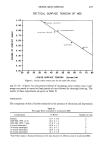
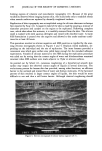
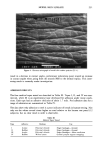
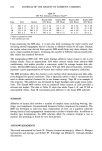
j. Soc. Cosmet. Chem., 39, 225-234 (July/August 1988) A model skin surface for testing adhesion to skin JOHN C. CHARKOUDIAN, Polyken Technologies, Division of the Kendall Company, 17 Hartwell Avenue, Lexington, MA 02173-3195. Received February 26, 1988. Synopsis A model skin surface (MSS) for testing adhesion to skin was developed as an alternative to costly and highly variable human skin substrates. This material, which is composed of a protein (crosslinked gelatin), a synthetic lipid-like substance, and water, was evaluated in terms of surface energies. By measuring the contact angles of different liquids on MSS layers varying in protein:lipid ratio, it was found that with a ratio of 3:1, surfaces were obtained which approximated the polar and dispersive forces of human skin. Further surface characterization indicated a critical surface tension of 3 3.4 dynes/cm. Human topography was imparted to the MSS using a silicone elastomer replication technique. Comparison of adhesion mea- surements made on human skin in vivo and on MSS layers for several medical tapes indicated the potential value of this substrate. INTRODUCTION The development and evaluation of pressure-sensitive tapes for the medical industry involve complex issues in adhesion-to-skin and related testing procedures. Although human test panels provide in vivo data, the procedures are costly and difficult, and are characterized by large variability. Indeed, even the same test site on the same human being will change with time. In vitro methods using excised human skin and animal models are also highly variable, tedious, and preparation-intensive. Other test sub- strates, such as steel and glass, offer ease and precision, but the results are not easily related to actual skin surfaces. Previous studies (1,2) addressing this issue have proposed smooth polyamide surfaces of collagen and Nylon 66. These materials do not include a lipid component nor do they account for the topographical aspects of human skin. There is a need, therefore, for an inexpensive, reproducible test surface whose properties significantly reflect those of human skin. Skin is a complex, organized structure composed primarily of protein, lipid, and water. The outermost layer, the nonviable epidermis or stratum corneum, has a normal water content of about 25% of its dry weight this percentage may increase to greater than 75 % under conditions of hydration. This already intricate arrangement is further com- plicated by the elevations and depressions characteristic of human skin topography. This paper describes a method for producing a surface whose general chemical and physical properties reflect those reported for in vivo human skin. To accomplish this, a 225

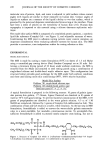
226 JOURNAL OF THE SOCIETY OF COSMETIC CHEMISTS molecular mix of protein, lipid, and water is adjusted to yield surfaces whose contact angles with liquids are similar to those measured on human skin. Contact angles of liquids on surfaces are a measure of the liquid's ability to wet that surface, which is governed by the polar and dispersive intermolecular forces acting at the interface. There have been a series of articles on the wettability of human skin (2-6). Human skin topography is imparted to this material using a silicone elastomer replication tech- nique. The model skin surface (MSS) is composed of a crosslinked protein (gelatin), a synthetic lipid-like substance (Ceraphyl GA--see Figure 1), and adjustable amounts of water. Conditioning the MSS prior to adhesion testing permits water content variation, an important consideration when evaluating adhesive systems for human skin. The MSS provides a convenient, time-independent surface for testing adhesion to skin. EXPERIMENTAL MODEL SKIN SURFACE The MSS is made by coating a warm formulation (50øC) on sheets of 1.3 mil Mylar using a controlled-gap coating device (Paul Gardner Company) set at 20 mils. Fol- lowing a minimum drying period of 36 hours under ambient conditions, the MSS is removed from the Mylar and attached to steel testing panels using a combination of single-faced silicone and double-faced acrylic adhesive tapes. This configuration (see structure below) provides good anchorage for the MSS under both ambient conditions and those used during moist skin conditioning (98øF, 100% relative humidity). Model Skin Surface Polyken 781 single-faced silicone tape Polyken 126 double-faced acrylic tape Steel test panel 6" x 2" x 1//16" A typical formulation is prepared in the following manner: 10 grams of gelatin (gran- ular porcine skin gelatin, 175 bloom, Sigma Chemical) are dissolved in 83 grams of water at 50øC with good stirring. To prevent bacterial contamination of the MSS, 0.05 grams of propylparaben are dissolved in the warm gelatin solution. 4.5 cc of 1 M NaOH are introduced, followed by 3 grams of Ceraphyl GA (abbreviated as GA). This combination of base and GA results in a stable, white emulsion. As the last step in MSS formulation, formaldehyde is added to convert the water-soluble gelatin macromole- cules to a water-swellable, but insoluble, proteinaceous matrix. To accomplish this, sufficient formaldehyde is added to promote nearly complete cross linking, but not so O H CHa_{CH•)i • CH2_C_O_Ci_ H 0 II H-C-O-C-CH2-{ CH:z)4-CH• •-••-_ C H•-(C H2)•-Ca I O=C C=O CHa-(CH2) • CHa-•i-O-C-H I I i O H H-O O-H Figure 1. Structure of Ceraphyl GA which is 2-(alkoyloxy)-l-[(alkoyloxy)methyl]-ethyl-7-(4 heptyl- 5,6-dicarboxy-2-cyclohexane-l-yl)heptanoate. It is abbreviated in the paper as GA.
Purchased for the exclusive use of nofirst nolast (unknown)
From: SCC Media Library & Resource Center (library.scconline.org)