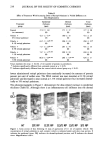
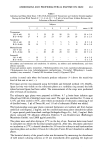
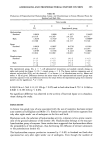
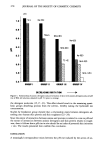
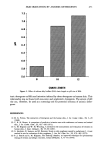
EFFECT OF RETINYL PALMITATE ON SKIN 239 tissue, note that changes in skin composition and the epidermal proliferative changes are also apparent. DISCUSSION Cosmetic materials are generally accepted to have a minimal effect on skin biology. The proven benefits of the application of cosmetic skin treatment products have usually been attributed to a moisturization effect. One particular material used in cosmetic formula- tions, vitamin A, is known to have systemic physiological and biochemical effects (7,13). All of the physiological functions of retinoids (such as the requirement for normal vision and reproduction) cannot be satisfied by retinoic acid (7). Indeed, these functions seem to be adequately satisfied by retinol. However, the role of retinoids in the regulation of skin development seems to be best satisfied by retinoic acid. Thus, part of the actions of retinyl palmitate in skin may depend on its conversion to retinoic acid (13). This conversion depends on the enzymatic cleavage of the ester bond in the retinyl palmitate. Nonspecific esterase enzyme activity exists within skin (14). In addi- tion, the skin must be able to oxidize the retinol to retinoic acid. It has been demon- strated that skin preparations can indeed convert retinyl to retinoic acid (15). Although it has been known that retinyl palmitate has the potential to effect a change of skin composition and physiology, this potential has never been examined. Retinoids, in general, prevent connective tissue atrophy. This prevention of atrophy is probably mediated by an inhibition of collagenolytic activity (16). In addition, dermal repair in response to UV damage, which is accelerated by retinoic acid administration, appears to involve a zone of regenerating connective tissue (17). Although retinoids inhibit collagen synthesis (3,5,18), they do promote glycosaminoglycan synthesis (5,19,20). Therefore, some of the effects of retinoids in terms of altering dermal com- position can be thought of as due to an inhibition of connective tissue breakdown and a promotion of the synthesis of glycosaminoglycans. This hypothesis is .supported by the observed changes in skin composition following treatment with retinyl palmitate. The increase of DNA content within the skin can be partially explained by the influx of inflammatory cells into the skin. Although there was an increase of skin DNA content following treatment with 0.1% retinyl palmitate, this was the maximal response. There is then a decrease of DNA content with increasing concentrations of retinyl palmitate. This may be due to the inhibitory effect of high concentrations of retinoids on both cell mobility and cellular proliferative capacity (18,21). However, at the highest dose ad- ministered (5 %), there was a tremendous increase in DNA content. This may be due to an irritant/inflammatory response to the application of the retinoid. Of interest in this study is that even with irritation present, there was little or no change in the punch biopsy weight. This suggests that the response is not significantly mediated by an edematous response. Finally, retinyl palmitate administration causes an accumulation of collagen within the dermis. These changes indicate that although there is an irritation response in the skin treated with RP, there is also a significant effect on the collagen content within the dermis. This alteration of the collagen content is unlikely to be due to an irritation response.

240 JOURNAL OF THE SOCIETY OF COSMETIC CHEMISTS Thus, cosmetic products which contain retinyl palmitate, in an active form, may indeed bring about biochemical changes with both the epidermis and the dermis. REFERENCES (1) J. Kubilus, Modulation of differentiation by retinoids, J. Invest. Dermatol., 81, 55s-58s (1983). (2) W. Wolbach and P. R. Howe, Tissue changes following deprication of fat soluble vitamin A, J. Exp. Med., 42, 753-777 (1925). (3) H. Oikarinen, A. Oikarinen, E. Tan, R. Abergel, C. Meeker, M. Chu, D. Prockop, and J. Uitto, Modulation of procollagen gene expression by retinoids, J. Clin. Invest., 75, 1545-1553 (1985). (4) R. Beach and C. Kenney, Vitamin A augments collagen production by corneal endothelial cells, Blochem. Biophys. Res. Commun., 114, 395-402 (1983). (5) M. Kenney, L. Shih, U. Labermeir, and D. Satterfield, Modulation of rabbit keratocyte production of collagen, sulfated glycosaminoglycans and fibronectin by retinyl and retinoic acid, Biochim. Biophys. Acta, 889, 156-162 (1986). (6) P. Benya and S. Padilla, Modulation of the rabbit chondrocyte phenotype by retinoic acid terminates type II collagen synthesis without inducing type I collagen: The modulated phenotype differs from that produced by subculture, Develop. Bid., 118, 296-305 (1986). (7) F. Chytil, Retinoic acid: Biochemistry and metabolism, J. Am. Acad. Dermatol., 15, 741-747 (1986). (8) D. Counts, P. Knighten, and G. Hegreberg, Biochemical changes in the skin of mink affected with Ehlers-Danlos syndrome: Increased collagen biosynthesis in the dermis of affected mink, J. Invest. Dermatol., 69, 521-526 (1977). W. Schneider, Determination of nucleic acids in tissues by pentase analysis, Methods Enzymol., 111, 680-684 (1956). O. H. Lowry, N. Rosebrough, A. Farr, and R. Randall, Protein measurement with the Folin phenol reagent, J. Biol. Chem., 193, 265-275 (1951). D. Prockop and S. Udenfriend, A specific method for the analysis of hydroxyproline in tissues and urine, Anal. Biochem., 1, 228-239 (1960). The United States Pharmacopeia, XXIth ed. (United States Pharmacopeial Convention, Inc., Rockville, MD, 1985), p. 1215. S. Shapiro, "Retinoids and Epithelial Differentiation," in Retinoids and Cell DifJSrentiation, Michael Sherman, Ed. (CRC Press, Inc. Boca Raton, FL, 1986), pp. 25-59. Y. Igoshin, Histochemical study of nonspecific esterases, lipase and cholinesterase in normal skin, Vestnik Dermatologii Vernerologii, 12, 13-16 (1976). M. Connor and M. H. Smit, The formation of all-trans retinyl in hairless mouse skin, Blochem. Pharmacol., 36, 919-924 (1987). E. Bauer, J. Seltzer, and A. Eisen, Retinoic acid inhibition of collagenase and gelatinase expression in human skin fibroblast cultures. Evidence for dual mechanism, J. Invest. Dermatol., 81, 162-169 (1983). L. Kligman, Effects of all-trans-retinoic acid on the dermis of hairless mice, J. Am. Acad. Dermatol., 15, 779-785 (1986). R. Hein, H. Mensing, P. Muller, O. Braun-Falco, and T. Krieg, Effect of vitamin A and its deriva- tives on collagen production and chemotactic response of fibroblasts, Br. J. Dermatol,, 1 ! 1, 37-44 (1984). I. King, Increased epidermal hyaluronic acid synthesis caused by four retinoids, Br. J. Dermatol., 110, 607-608 (1984). I. King and F. Pope, Synthesis of cellular and extracellular glycoproteins by cultured human keratin- ocytes and their response to retinoids, Biochim. Biophys. Acta, 887, 263-274 (1986). C. Marcelo and K. Madison, Regulation of the expression of epidermal keratinocyte proliferation and differentiation by vitamin A analogs, Arch. Dermatol. Res., 276, 381-389 (1984). (9) (10) (11) (12) (13) (14) (15) (16) (17) (18) (19) (20) (21)
Purchased for the exclusive use of nofirst nolast (unknown)
From: SCC Media Library & Resource Center (library.scconline.org)