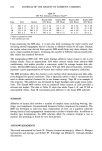
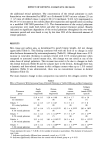
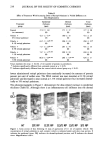
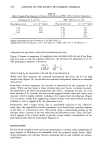
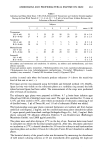
ANDROGENS AND PROPIOBACTERIAL ENZYME ON SKIN 263 Table III Production of Propionibacterial Hyaluronidase, Lipase, and Chondroitinase in Strains Obtained From the Forehead and Back Skin Time (weeks) 0 0 4 8 CG Experimental group Hyaluronidase Forehead Back Lipase Forehead Back Chondroitinase Forehead Back 0.8050 1.0000 1. 3071 1. 5643* - 0.316 - 0.269 - 0.225 - 0.311 1.0250 0.7529 1. 1714 0.8486* ---0.308 __-0.266 ---0.317 +0.301 0.0630 0.0697 0.0710 0.1016 + 0.012 + 0.027 + 0.029 + 0.077 0.0789 0.1546 0.1223 0.0834 + 0.024 + 0.069 + 0.061 + 0.022 (+)1 (+)2 (+)2 (+)2 (-)7 (-)5 (-)5 (-)5 (+)2 (+)0 (+)2 (+)1 (-)6 (-)7 (-)5 (-)6 The experimental group, EG, n = 7, self administered testosterone and anabolic steroids during an eight-week period (see Figure 1). CG = control group, n = 8. The figures indicate comparison unit of enzymic activity/hole (U/h), and the observed (+) or absence (-) of chondroitinase activity. Means and means + SE are given. Differences between the mean values of the experimental and control groups were tested by unpaired t-test and differences between the values within the experimental group were tested by paired t-test for significance. * p 0.05. 0.269 U/h to 1.564 - 0.311 U/h (p 0.05) and in back skin from 0.752 _ 0.266 to 0.848 ___ 0.391 U/h (p 0.05). No significant difference was observed in the activity of bacterial lipase or in chondroi- tinase during the study. DISCUSSION A chronic low-grade type of acne associated with the use of cosmetics has been termed acne cosmetica by Kligman and Mills (17). Similar low-grade mild lesions appeared but only after eight weeks' use of androgens on the face and back. Hyaluronic acid, the substrate of hyaluronidase activity, is known to be a prime constit- uent of the ground substance of the dermis (18). Hyaluronidase belongs to the mucopo- lysaccharidase group of enzymes. Some studies have suggested that hyaluronidase affects the permeability of the epithelium, thus facilitating the diffusion of irritant substances to the perisebaceous dermis (6). The hyaluronidase enzyme production increased (p 0.05) in forehead and back skin specimens but only after eight weeks' use of androgens. Even though the number of

264 JOURNAL OF THE SOCIETY OF COSMETIC CHEMISTS subjects was small, this result suggests that high doses of testosterone and anabolic steroids are capable of increasing the production of hyaluronidase enzymes. The in- creased hyaluronidase production is probably also due to the greater mean doses of androgens used during weeks 5-8. Hyaluronidase activity was detected in simulta- neously obtained samples of the back and forehead skin, and there were no differences between subjects who developed acne and those who did not. This does not demonstrate that there is a parallel between hyaluronidase activity and acne. In this study no changes in bacterial lipase activity were detected. However, in an earlier study (12) performed under the same conditions, we detected an increase in free fatty acids. This supports the view that P. acnes lipase is not necessarily responsible for the occurrence of free fatty acids in skin surface lipids. Increased hyaluronidase activity was detected in samples obtained simultaneously from two different sites of the skin (forehead and back skin), and despite the low statistical significance (p 0.05), this may suggest that there is an increase in exocellular enzyme activity associated with the use of exogenous androgenic steroids. However, controlled trials are needed to assert the real nature of the effect of androgen steroids on propioni- bacterial enzymes. ACKNOWLEDGEMENTS The author wishes to thank Professor Heikki Arvilommi of the National Public Health Institue, Jyviiskylii, for help with planning the enzymic analyses, and also Eeva-Liisa Eskelinen, B.A., of the National Public Health Institute, Jyv'•kylii, for her skillful technical assistance. REFERENCES (lO) (11) (1) K. T. Holland, E. Ingham, and W. J. Cunliffe, A review. The microbiology of acne, Journal of Applied Bacteriology, 51, 195-215 (1981). (2) R. Allaker, J. Greenman, R. H. Osborne, and J. J. Gowers, Cytotoxic activity of Propionibacterium acnes and other skin organisms. Br. J. Dermatol, 113, 229-235 (1985). (3) R. M. Resiner, D. Z. Silver, M. Puhvel, and T. H. Steinberg, Lipolytic activity of Corynebacterium acnes,J. Invest. Demn•tol., 51, 190-196 (1968). (4) M. Gloor, V. Graunman, M. Kionke, I. Wiegand, and H. C. Friedrich, Menge und Zusammenzet- zung der Hautoberfliichelipide bei Patienten mit Acne vulgaris und gesunden Vergleichpersonen. I. Mitteilung, Arch. Dermatol. Forsch., 242, 322-326 (1972). (5) J. G. Weeks, L. McCarty, T. Black, and J. E. Fulton, The inability of bacterial lipase inhibitor to control acne vulgaris, J. Invest. Dermatol. 69, 236-243 (1977). (6) S. M. Puhvel and R. M. Reisner, The production of hyaluronidase (hyaluronate lyase) by Corynebac- terium acnes, J. Ivnest. Dermatol., 58, 66-70 (1972). (7) V. H/Sfler, Production of hyaluronidase by Propionibacteria from different origins, Zentralbl. Bak- teriol. Abt. I (Orig A), 245, 123-129 (1979). (8) C. H/Srhold, E. Miiller, and G. Rose, Steroid unwandelnde Enzyme aus Mikro-organismen, Zeitschrifi fur Allgemeine Mikrobiologie, 19, 731-739 (1979). (9) M. Alan, Effect of androgenic and anabolic steroids on the skin in power athletes. Biomechanics-Kin- anthropometry and Sport Medicxine, Exercise Science. Scientific-Program abstract, 1984 Olympic Scientific Congress, July 19-24, University of Oregon, Oregon. J. v. G. A. Durnin and M. M. Rahaman, The assessment of the amount of fat in the human body from measurements of skinfold thickness, Br. J. Nutr. 21, 681-689 (1976). A. Prader, Testicular size: Assessment and clinical importance, Triangle, 7, 240-243 (1977).
Purchased for the exclusive use of nofirst nolast (unknown)
From: SCC Media Library & Resource Center (library.scconline.org)