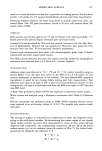
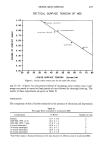
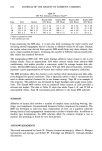
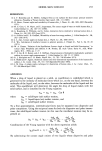
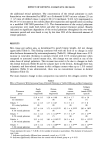
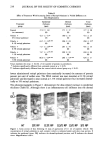
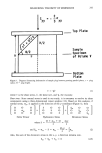
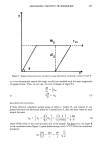
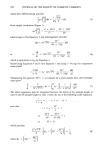
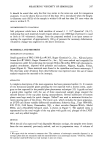
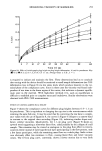
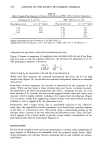
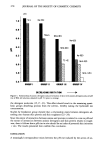
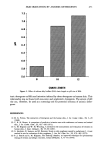
MODEL SKIN SURFACE 229 C•ITICAL SURFACE TENSION OF MSS t• z o t• tu z ! oo o 90 o 80 o 70 o 60 o 50 o 40 o 30 o EO o •o o.oo 20 1 co ho 1 • diiodomethane ethylene glycol • • .... I .... I .... I .... I . . . I . . . i .... i .... E5 30 3• 40 45 50 55 60 65 70 75 80 LIDUID SURFACE TENSION [dynes/cm) Figure 2. Critical surface tension plot for the model skin surface. and 27.1%. A faster, but less precise method of increasing water content was to sub- merge test panels in water for fixed periods of time followed by thorough blotting. The results of these experiments are given in Table II. TOPOGRAPHY The complexity of skin is further enhanced by the presence of elevations and depressions Table II Percentage •,/ater Contained in Conditioned MSS Conditioning % Water • Number of trials Ambient 10.7 -- 0.4 6 100% RH, 98øF, 24 hr 26.3 -- 1.2 3 100% RH, 98øF, 5 days 27.0 -- 1.6 3 5 seconds submerged 29.6 -- 3.7 3 10 seconds submerged 34.1 -- 1.7 4 15 seconds submerged 40.6 _ 2.8 7 20 seconds submerged 43.1 -- 2.9 6 Karl Fisher analysis. Standard deviations are for data obtained on different pieces of conditioned MSS.

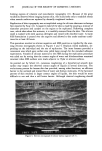
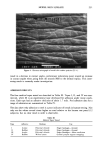
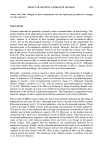
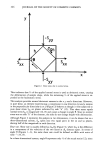
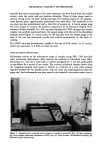
230 JOURNAL OF THE SOCIETY OF COSMETIC CHEMISTS forming regions of coherent and noncoherent topography (11). Because of the great variability observed when imaging human skin, this study seeks only to establish trends when smooth surfaces are replaced by dermally roughened surfaces. Replication of skin topography was accomplished using the silicone elastomer technique first reported by Facq (12). A negative mold of the skin is made by pouring a mixture of elastomer precursor and catalyst on the region to be replicated. Following complete cure, which takes about five minutes, it is carefully removed from the skin. The silicone mold is washed with mild aqueous detergent and rinsed with distilled water. A warm MSS formulation is poured over the negative and allowed to dry under ambient condi- tions for at least 48 hours. This procedure resulted in silicone negatives and MSS positives as typified by the scan- ning electron micrographs shown in Figures 3 and 4. Replicas varied markedly, de- pending on the individual and the site of replication. The inner forearm provided a convenient area which gave surface area yields large enough for the standard adhesion experiments. Transfer of silicone material to the MSS during the replication procedure was ruled out by noting that the contact angles of water and diiodomethane remained invariant when MSS surfaces were made adjacent to Mylar or silicone surfaces. As pointed out by Schott (2), cutaneous roughening of a hypothetical smooth skin surface may impact the observed contact angles of liquids in several directions. The evolutionary process for human skin has provided, among other functions, an efficient barrier to the outward and inward flux of water and foreign molecules. If the furrowed pattern of skin resulted in larger contact angles of liquids, the skin would be more difficult to wet and thus a still better barrier. Although classical roughening should
Purchased for the exclusive use of nofirst nolast (unknown)
From: SCC Media Library & Resource Center (library.scconline.org)