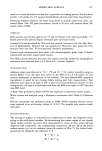
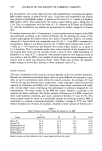
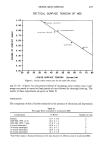
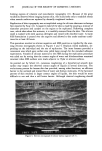
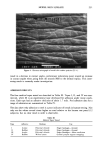
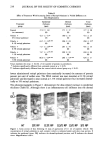
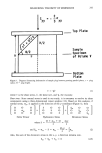
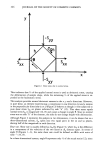
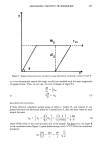
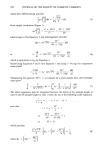
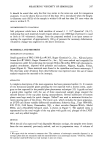
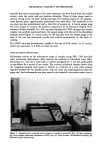
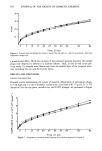
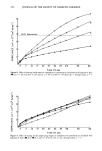
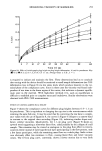
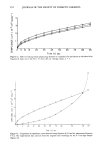
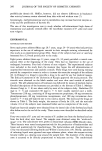
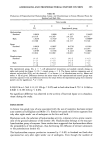
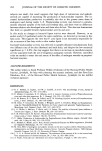
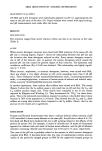
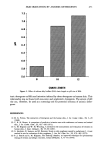
MODEL SKIN SURFACE 231 I•!O I •' SURFACE_ -- -•----•----" '-"' -• " ,PO,.•, . . '- ß ' 3..• • ,•.' • .,,• .. ' .... '• .... '_•:, :- - • ,•-'• .• .. q ..... .: ,, • • •..,•' •. .• ,......• . •.• o.,.. - • . . .-.,...,._. :v.....: •... . :,: .... , . ..•....•,•'•' •' .-- .•....•:.• .• ...... :•.•..., • : A'. ,v. %• "7'• ..• .: ß .... :.•.--.-. ........ .•. ?:.•.- ..... -....•.. -•-:% :L..•..-• ...... e ...... .... . • . : , -•.:.•,•: :• -.-•- • .. ß ...... .. . .. • . "•" "•. 7•"•s:c•' ........ • ....... I'•'• •-- • ,•.•" • ,. , ..... •,.. . ß ß . •, . ..7. ß . .... •.s..-•.i•, •, ' •,•. .. ........... , ....... .•.• • ..• "'. .i• " ß 10KV X• 1000U oe'•:!.0 C•D Figure 4. Electron micrograph of model skin surface positive (25 x ). result in a decrease in contact angles, preliminary indications point toward an increase in contact angles when going from the smooth MSS to the dermal replica. This inter- esting result is currently under investigation. ADHESION RESULTS The four medical tapes tested are described in Table III. Tapes I, II, and IV are com- mercial, while III is an experimental tape developed for adhesion under moist condi- tions. Each tape had an adhesive thickness of about 1.7 mils. Peel adhesion data for a range of substrates are summarized in Table IV. The data show why adhesion to steel is a poor indicator of trends in human testing. Not only are the values several times higher on steel relative to the human test panel (12 subjects), but no clear trend in order is observable. Table III Medical Tapes Tested Tape Adhesive Backing Use I Acrylic Polyvinyl chloride II Rubber Polyvinyl chloride III Acrylic Polyvinyl chloride IV Rubber Woven cotton Finger bandages--General Finger bandages--General Finger Bandages--Moist conditions General purpose support strapping

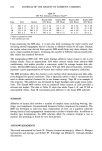
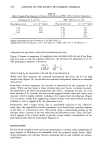
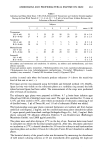
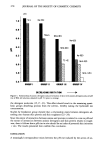
232 JOURNAL OF THE SOCIETY OF COSMETIC CHEMISTS Table IV 180 ø Peel Adhesions of Medical Tapes a'b Smooth MSS Smooth MSS Replica MSS Replica MSS Tape Steel Human 10% Water 26% Water 10% Water 26% Water I 296 ___ 12 82 -4-_ 12 271 ___ 20 137 _+ 13 59 --- 46 40 ___ 38 II 338 -4-_ 11 58 --- 10 254 ___ 18 146 + 20 69 -4-_ 18 32 ___ 20 III 521 ___ 56 280 ___ 55 474 -4-_ 46 208 ___ 5 144 ___ 80 113 ___ 50 IV 205 ___ 2 60 -4-_ 7 196 ___ 11 186 ___ 21 61 ___ 13 29 --- 3 Values in grams/cm width. 50.8 crn/min peel rate. Upon examining the MSS data, it is seen that both increasing the water content and including dermal topography lead to a decline in adhesion values for all tapes. Because the replica values were derived from positive MSS molds from only three subjects, they carry a large standard deviation. Increasing the number of different replicas would prob- ably reduce this standard deviation. The topographical MSS with 10% water displays adhesion values closest to the in vivo human results. Since an approximate 10% water content results from ambient MSS conditioning, this surface provides a convenient model for average human skin sub- strates. Dermal MSS replicas made at about 70øF and 50% relative humidity, therefore, represent a good approximation of human skin surfaces under temperate conditions. The MSS procedure offers the chemist a test method while developing new skin adhe- sives designed for special conditions. This is especially useful in that it circumvents the need to obtain medical clearance for in vivo human testing. Tape III is an example of this situation. This adhesive was developed for finger bandages used under moist condi- tions. The dermal MSS surface with an enhanced water content of 26% provided a relevant test surface. The data in Table IV show that while Tapes I, II, and IV fell to unacceptable values, Tape III maintained good adhesion to the moist MSS substrate. SUMMARY Adhesion to human skin involves a number of complex issues including wetting, rhe- ology, and compliance. Environmental dynamics further complicate the situation. The MSS was developed to yield test data, independent of time, on a synthetic substrate having chemical and topographical characteristics similar to human skin. In addition to medical tape development, the MSS substrate offers the cosmetic chemist a tool to examine the spreading of fluids for new formulations. ACKNOWLEDGEMENTS This study was assisted by Carole W. Dupuis (electron microscopy), Albert G. Marquis (preparation and testing), and Robert W. Etheredge and Mildred C. Richards (helpful discussions).
Purchased for the exclusive use of nofirst nolast (unknown)
From: SCC Media Library & Resource Center (library.scconline.org)