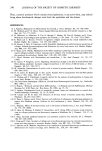
MODEL SKIN SURFACE 233 REFERENCES (9) (10) (11) (12) (1) J. F. Komerska and N. Moffett, Collagen films as test surfaces for skin-contact pressure sensitive adhesives, Proceedings of Pressure Sensitive Tape Council, 108-111 (1985). (2) H. Schott, Contact angles and wettability of human skin, J. Pharm. $ci., 60, 1893-1895 (December 1971). (3) M. E. Ginn, C. M. Noyes, and E. Jungermann, The contact angle of water on viable human skin,J. Colloid Interface $ci., 26, 146-151 (1968). (4) A. Rosenberg, R. Williams, and G. Cohen, Interaction forces involved in wetting human skin, J. Pharm. $ci., 62, 920-922 (June 1973). (5) A. EI-Shimi and E. D. Goddard, Wettability of some low energy surfaces,J. Colloid Interface Sci., 28, 242-248 (1974). (6) J. L. Zatz, Contact angles on human skin, J. Pharm. $ci., 64, 1080 (1975). (7) S. Wu, Calculation of interfacial tension in polymer systems, J. Polymer Sci., Part C, 34, 19-30 (1971). (8) W. A. Zisman, "Relation of the Equilibrium Contact Angle to Liquid and Solid Constitution," in Contact Angle, Wettability and Adhesion, F. M. Fowkes, Ed. (Adv. Chem. Series 43, ACS, Wash- ington, D.C., 1964), pp. 1-27. Y. C. Ko, B. D. Ratner, and A. S. Hoffman, Characterization of hydrophilic-hydrophobic polymeric surfaces by contact angle measurements, J. Colloid Interface $ci., 82, 25 - 37 (1981). R. J. Scheuplein and I. H. Blank, Physiol. Rev., 51, 702-746 (October 1971). S. Makki and P. Agache, Statistical analysis and three-dimensional representation of the human skin surface, J. Soc. Cosmet. Chem., 35, 311-325 (September/October 1984). J. M. Facq, A simple replica technique for observation of human skin, J. Soc. Cosmet. Chem., 15, 87-98 (March/April 1964). APPENDIX When a drop of liquid is placed on a solid, an equilibrium is established which is governed by the intensity of molecular forces which act, on the one hand, between the molecules of the liquid, and, on the other, between the molecules of the liquid and the solid. This equilibrium will determine the angle the drop of liquid makes with the solid surface, and is described by the Young equation: 'YsA = 'YSL + 'YEA Cos0 where 'YSA = solid/vapor (air) surface tension, 'yEA = liquid/vapor (air) surface tension, and 'ISL = solid/liquid surface tension. To a first approximation, intermolecular forces may be separated into dispersive and polar components. Using the reciprocal mean for both the dispersive and polar interac- tions, the solid/liquid surface tension (in this case the interfacial tension) may be ex- pressed as: Combination of the Young equation with the above expression yields: 'YEA(Cos 0 + 1)= .ySd a + .ydEA + 'Y•A + p By substituting the contact angle cosines of two liquids whose dispersive and polar

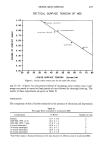
234 JOURNAL OF THE SOCIETY OF COSMETIC CHEMISTS contributions to their surface tensions are known (•/• and v •/l.a), simultaneous solution of the last expression will yield values of •/s•A and qt v from which the ratio •/s•A to •/sPa SA can be calculated. The Zisman plot is described by the equation: CosO = 1 + mO/ta - %) where m = the slope of the line, and % = critical surface tension of solid. As can be seen, liquids with surface tensions equal to or smaller than % will spread indefinitely on the solid surface, while liquids with greater surface tensions will make a finite contact angle.
Purchased for the exclusive use of nofirst nolast (unknown)
From: SCC Media Library & Resource Center (library.scconline.org)