j. Soc. Cosmet. Chem., 39, 241-258 (July/August 1988) Measuring viscosity of pharmaceutical and cosmetic semisolids using normal stress SHIVAJI PURWAR, JAMES K. LIM, JOHN W. MAUGER, and STEPHEN A. HOWARD, Vicks Research Center, One Far Mill Crossing, Shelton, CT 06484 (S.P.), West Virginia University School of Pharmacy, Medical Center, Morgantown, WV 26506 (J.K.L., J. W. M. ), and Ortho Pharmaceutical Corporation, Raritan, NJ 08869 (S.A.H.). Received September 21, 1987. Presented at the 130th Annual APhA Meeting, New Orleans, April 9-14, 1983. Synopsis A method for measuring various viscoelastic parameters of pharmaceutical and cosmetic semisolids was reported earlier in this Journal (1). In this paper •he theoretical development of the method is described for obtaining viscosities of petrolatum USP and polyethylene glycol 1500 by pressing between parallel plates analogous to those used with the parallel plate plastometer technique. Experimental information is pre- sented which demonstrates applicability of the slightly different mathematical approach for the proposed method as developed from tensor analysis for shear stress and rate of change of angle, 0, for the shear rate, respectively. Experimental variables tested in this study include the initial applied stress, height, and diameter of the sample plug. A 4 x 12 factorial analysis of the data indicates a dependent effect on viscosity for the initial applied stress to the sample plug, but an independent effect, within specific limits, for the plug height or diameter. INTRODUCTION Most semisolid systems, represented by a large number of pharmaceutical ointments and/or cosmetic creams, lotions, etc., exhibit complex flow behavior, including irre- versible shear breakdown, thixotrophy, viscoelasticity, etc., characterized by the methods of measurement. It is well known that most common viscosity measuring methods cause extensive material deformation due to high-shear stress application which results in a considerable alteration of the material structure (2-7). Consequently, the viscosity values obtained in these cases are influenced to a large extent by the level and duration of applied stress (8- 11). For these reasons, high-shear measuring methods are useful for predicting the behavior of products during the normal process of manu- facturing where significant structural breakdown occurs. However, for efficacy evalua- tion, quality control, the user's perception, and the conventional time- and stress-de- pendent viscosities obtained by high-shear methods are less meaningful. In fact, a 241

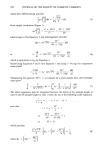
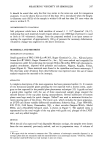
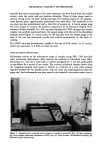
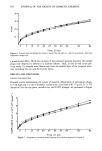
242 JOURNAL OF THE SOCIETY OF COSMETIC CHEMISTS number of pharmaceutical scientists (2,8) have in the recent past expressed concern for the lack of a suitable device for examining semisolids in their rheological "ground state," through the application of low shear largely avoiding significant changes in static structure. Low-shear methods previously available require rather complex equip- ment with elaborate procedures. A simple and readily accessible low-shear method would therefore be of distinct benefit to the investigator for fundamental studies, espe- cially for those related to material structure when the material can be examined closely under an approximately quiescent equilibrium state. This paper reports the theoretical development of an equation that describes a method shown to be useful for evaluating the viscoelastic properties of semisolid materials (1). It also presents experimental data characterizing the simple device for day-to-day viscosity determinations. The method involves two parallel plates between which the test mate- rial is pressed. Although, a similar parallel plate plastometer is already in existence (12,13), it was basically designed with high-load capacity for engineering materials such as resins. Our device, on the other hand, with low-load capacity, is designed for semisolid materials such as petrolatum. The mathematical treatment also employs a different approach. It will be seen in the Results and Discussion section that the actual experimental data are better explained by the presently derived equation rather than by the plastometer equation (13). GLOSSARY OF SYMBOLS t•ii = normal component of applied stress in S Sii v Ho H t F a K1 h J 0 'T' (2nd subscript) direction. (First subscript 'T' refers to surface.) (dynes/cm2). = shear component of applied stress in "Xl" direction on "•" surface (x I and • do not necessarily represent cartesian coordinates but are perpendicular to each other like x, y, or z coordinates) (dynes/cm2). = hydrostatic stress (dynes/cm2). = normal component of deviatoric stress with the same subscripts as for (dynes/ cm2). = shear strain. = rate of shear strain (shear rate) in "Xl" and "•" direction (sec-•). = volume of sample specimen (cm3). = initial height of sample specimen (cm). = height of sample at time t, = H o - h (cm). = time (sec). = applied force (applied weight X 981 g crn/sec2). = 4WX (cm3). = (Ho '/2 - Ho•/7a)(cm•/=). = viscosity (g/cm sec or poise). = height travelled by the top plate at time t (cm). = compliance = stress/strain (cm sec2/g or cm2/dynes). = a hypothetical angle such that its change (dO) = shear strain (no units), and its rate of change (dO/dO = shear rate (time-•). THEORY Viscosity is defined by Newton as the proportionality constant between shear stress and shear rate:
Purchased for the exclusive use of nofirst nolast (unknown)
From: SCC Media Library & Resource Center (library.scconline.org)