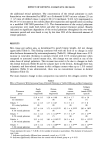
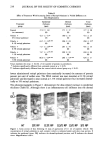
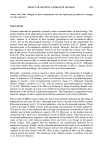
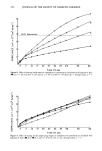
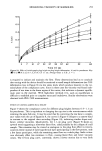
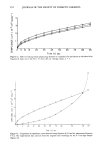
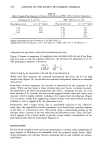
MEASURING VISCOSITY OF SEMISOLIDS 257 1. The method provides viscosity in absolute units unlike those obtained with the penetrometer, tube extrusion, and others (18). Although the Brookfield RVT vis- cometer with T-bar and helipath provides single viscosity values in absolute units (maximum range of 104 poise) (19), the mathematically undefined geometry of the T-bar renders it an empirical device. 2. Within limits, varying sample size does not affect the results with this device. The selection of sample height and diameter is equivalent to changing the cup and bob size of rotoviscometers, respectively, which in turn requires the application of dif- ferent instrument constants. 3. While in this study the viscosity values were found to be stress-dependent due to stress application in the non-linear viscoelastic range, stress-independent viscosities using stress in the linear viscoelastic range are also obtainable (1). Thus viscosities approaching 108-10 •ø poise range, usually associated with undisturbed structure or "ground-state," demonstrable by the rheogoniometer and creep test apparatus (7,20,21), can be measured with this simple device (1). In essence, absolute vis- cosity values independent of such variables as applied stress, time, sample size, unique only to the material and unaffected by the method of measurement, are obtainable with the device. 4. The device shows a sensitivity to non-homogeneity in a sample via its shape of deformation. ACXNOWLEDGMENTS Abstracted in part from a dissertation submitted by Shivaji Purwar to the graduate School of West Virginia University, in partial fulfillment of the Doctor of Philosophy • .......... ...... • ...... •'='• partly •' .... •.•lo• p grants c•,• •h,• qo,-i,•y •c •_ roetic Chemists to Mr. Purwar. The authors wish to thank Drs. William R. Powell and J. Krall, formerly of the Department of Mechanical En•ineerin• and the School of Medicine at West Virginia University, respectively, for their valuable assistance. REFERENCES (1) S. Purwar, A. R. Padhye, and J. K. Lim, A new method for measuring the viscoelastic parameters of pharmaceutical and cosmetic semisolids, J. Soc. Cosmet. Chem., 35, 115-129 (1984). (2) S.S. Davis, E. Shotton, and B. Warburton, Some limitations of continuous shear methods for the study of pharmaceutical semisolids, J. Pharm. Pharmac., 20, [Suppl.], 157S- 167S (1968). (3) B. W. Barry and E. Shotton, Performance of the Ferranti-Shirley viscometer with automatic flow curve recorder unit, 1bid., 20, 167-168 (1968). (4) G. B. Thurston and A. Martin, Rheology of pharmaceutical systems: Oscillatory and steady shear of non-Newtonian viscoelastic liquids, J. Pharm. Sci., 67, 1499-1506 (1978). (5) J. C. Boylan, Rheological estimation of the spreading characteristics of pharmaceutical semisolids, 1bid., 56, 1164-1169 (1967). (6) G. W. Radebaugh and A. P. SimoneIll, Phenomenological viscoelasticity of a heterogeneous phar- maceutical semisolid, 1bid., 72, 415-422 (1983). (7) B. W. Barry, Advances in Pharmaceutical Sciences, Vol. 4 (Academic Press, New York, 1974), pp. 1-72. (8) A. N. Martin, J. Swarbrick, A. Cammarata, and A. H. C. Chun, Physical Pharmacy (Lea & Febiger, Philadelphia, 1969), p. 500. (9) L. H. Block and P. P. Lamy, The rheological evaluation of semisolids, J. Soc. Cosmet. Chem., 21, 645-660 (1970).

258 JOURNAL OF THE SOCIETY OF COSMETIC CHEMISTS (lO) (11) (12) (13) (15) (16) (17) (18) (19) (20) (21) H. Umstiitter, Kolloid-Z., 70, p. 174 (1935) through Ref #9. A. N. Martin, G. S. Banker, and A. H. C. Chun, Advances in Pharmaceutical Sciences, Vol. 1 (Aca- demic Press, New York, 1964), pp. 19-47. R. Houwink and Ph. N. Heinze, Plastometry of synthetic resins, Inds. Enggo Chemistry, 10, 680-683 (1938). S. Oka, "Principles of Rheometry," in Rheology, Vol. 3 (Academic Press, New York, 1960), pp. 73 -75. C. O. Bennett and J. E. Myers, Momentum, Heat and Mass Transfer, 2nd ed. (McGraw-Hill, Inc., 1974), pp. 104-111. J. D. Ferry, Viscoelastic Properties of Polymers, 2nd ed. (,John Wiley and Sons, Inc., New York, 1970), pp. 6, 27, 51, 188. D. H. Kaelble, Physical Chemistry of Adhesion (,John Wiley and Sons, Inc., New York, 1971), p. 221. A. N. Martin, Physical Pharmacy (Lea & Febiger, Philadelphia, 1960), p. 632. Brookfield Table of Viscosity Ranges for Brookfield Model RVT Viscometer With T-Bar Spindles (Brookfield Engineering Lab., Inc., Stoughton, MA). J. H. Wood, G. Catacalos, and S. V. Liberman, Adaptation of commercial viscometers for special applications in pharmaceutical rheology. I. The Brookfield Viscometer, J. Pharm. Sci., 52, 296-298 (1963). B. W. Barry and A. J. Grace, Grade variation in the rheology of white soft paraffin B.P., J. Pharm. Pharmac., 22 [Suppl.], 147S-156S (1970).
Purchased for the exclusive use of nofirst nolast (unknown)
From: SCC Media Library & Resource Center (library.scconline.org)