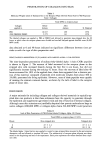
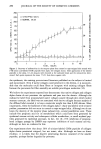
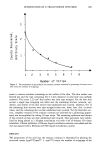
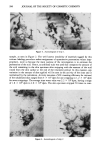
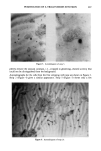
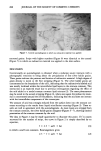
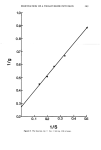
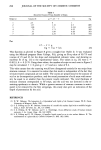
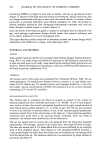
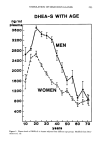
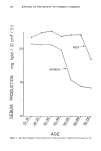
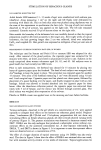
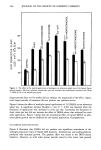
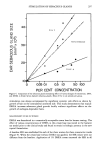
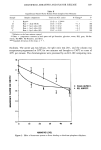
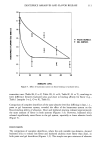
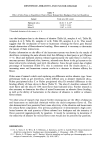
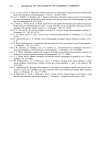
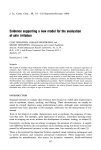
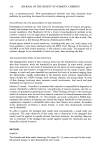
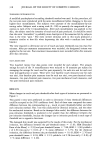
288 JOURNAL OF THE SOCIETY OF COSMETIC CHEMISTS ß •' • •-- -- • .": , •*.... ,• • ß - • : •i .• t '• =•{5 Figure 7. Control autoradiogram in which no radioactive material w• applied. scattered grains. Strips with higher numbers (Figure 6) were identical to the control (Figure 7) in which no radioactive material was applied to the skin surface. DISCUSSION Coventionally an autoradiogram is obtained when a radiation source interacts with a photographic emulsion to bring about the precipitation of fine silver halide grains. These grains indicate the presence and location of radioactive material. A high degree of grain density is noted in the first stripping (Figure 3). The silver halide grains are concentrated at the boundaries of the cells, indicating that the radioactively labeled acid was mostly localized within the intercellular lipid layers in the stratum comeurn. This interaction is an expected result due to previous investigations regarding the effect of the acid added to a model stratum corneum lipid mixture (2). The same phenomenon may be noted in the second stripping (Figure 4), where once again the radioactive mate- rial is concentrated around the cell boundaries, indicating that the acid does not interact with the intracellular components of the corneocytes. The amount of acid was strongly reduced from the surface down into the stratum cor- neum according to the results from liquid scintillation counting (Figure 2). These re- sults are well in agreement with the autoradiograms. As more layers are stripped from the stratum corneum, the silver halide grains disappear (Figures 5-7), showing limited penetration of the stratum comeurn by the acid. The data in Figure 2 may be made quantitative to illustrate this point. If f is counts recovered for the number of strips, the curve in Figure 2 is simply described by an equation, f= 2.5 - as/(1 + bs) [1] in which a and b are constants. Rearrangement gives 2.5 - f = as/(1 + bs) [2]

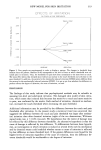
PENETRATION OF A TRIGLYCERIDE INTO SKIN 289 1.0 0.9 0.8 Q7 0.6 0.5 0.4 O. 3 O.2 O. 1 02. 0.3 0.4 Q5 1/s Figure 8. The function 1/g = I/as + b/a (eq. [3]) is linear.
Purchased for the exclusive use of nofirst nolast (unknown)
From: SCC Media Library & Resource Center (library.scconline.org)