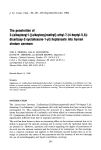
j. Soc. Cosmet. Chem., 39, 315-320 (September/October 1988) Evidence supporting a new model for the evaluation of skin irritation CURT WEINSTEIN, RONALD DROZDENKO, and SIDNEY WEINSTEIN, Pharmaceutical and Cosmetic Evaluations Division, NeuroCommunication Research Laboratories, Inc. (C. W. , R.D., S. Wo), and Western Connecticut State University (R. D.), Danbury, CT. Received June 8, 1988. Synopsis The results of standard visual evaluations of skin irritation may conflict with the consumer's experience of irritation. Such conflicts create challenges for those formulators of cosmetics, health-and-beauty aids, or pharmaceuticals who seek nonirritating products. New psychophysical procedures, however, may help minimize these problems by providing the means for accurately evaluating perceived irritation. The dam- aged skin model predicts that irritated skin becomes less sensitive to touch and more sensitive to pain. To verify the model's usefulness for evaluating induced, subclinical irritation, the Semmes-Weinstein Pressure Aesthesiometer was employed in a psychophysical procedure. Tactile thresholds of both touch and pain were rapidly determined before and after inducing irritation by mechanical and chemical means. Results on a small sample confirm the model's usefulness. In addition, the relative distance between touch and pain thresholds may reflect the degree or type of irritation induced. INTRODUCTION Standard methods to evaluate skin irritation have focused on visible skin characteristics such as erythema, edema, cracking, and flaking. These characteristics are usually as- sessed by trained observers using predetermined scales, although some instrumental methods have been described (1) (for example, reflectance for the measurement of ery- thema). Even in the absence of visible characteristics such as erythema, the sensation of irrita- tion may exist. For example, upon application of product, immediate burning sensa- tions or stinging can occur without the development of redness, scaling, or edema (2). Conversely, erythema may not always accompany the sensation of irritation. A signifi- cant difference between two test products on an erythema rating was found to be accom- panied by self-perceived irritancy in only some cases, but certainly not all cases (3). There is the potential for disparities between standard visual evaluation techniques used to screen products and consumer perceptual evaluations. These disparities create problems for manufacturers, who screen, for irritation, cosmetics, health-and-beauty 315

316 JOURNAL OF THE SOCIETY OF COSMETIC CHEMISTS aids, or pharmaceuticals. New psychophysical methods may help minimize these problems by providing the means for accurately evaluating perceived irritation. PSYCHOPHYSICS AND THE MEASUREMENT OF SKIN SENSATION Psychophysical methods are well suited for determining levels of sensory perception. Lawful relationships have been found between perceptions and physical stimuli for all sensory modalities. [See Moskowitz (4) for a review of psychophysical methods in the cosmetic industry.] In the application of psychophysical methods to skin sensation, an instrument which applies stimuli of known physical intensity to the skin is used. One such instrument is the Semmes-Weinstein Aesthesiometer (SWA). Several aspects related to tactile sensitivity, including body part, sex, brain injury, and local anesthetics, have been examined using the SWA (5,6). Because of the history of the SWA in the field of skin sensation, it was utilized in this study. The purpose was to evaluate changes in the thresholds of touch and pain, after irritating the skin. THE DAMAGED-SKIN MODEL OF SKIN IRRITATION The damaged-skin model of skin irritation states that the threshold for touch increases after skin irritation, while the threshold for pain decreases. In other words, irritated skin is less sensitive to low levels of stimulation (in the report of touch sensation), and at the same time more sensitive to high levels of stimulation (in the report of pain). These changes in touch and pain threshold are predicted for levels of irritation ranging from the subclinically, visually undetectable to the relatively severe irritation characterized as: deep or bright red, 100% coverage, with cracking, dryness, and strong edema. In cases of skin damage involving more extensive neural involvement, both touch and pain thresholds are expected to increase. Sinclair (7) stated, "clinically it is assumed that irritation is responsible for depression of sensory thresholds in affected territory, intensification of sensory response, and the oc- currence of spontaneous paraesthesia or pain." Other findings relevant to the touch-pain model of irritation were derived from research conducted at NeuroCommunication Re- search Laboratories (NCRL) (8-11). For example, one study conducted at NCRL dem- onstrated that subjects developing sore throats had higher thresholds (at their posterior oropharynx) compared to thresholds taken when their throats were normal. In another study, application of ethanol, a minor irritant, to intact skin momentarily increased tactile thresholds. In order to explore the damaged skin model more systematically, a small study was conducted. The main objective of this study was to determine if the damaged skin model could be applied to rapidly elicited, low-level irritation. An ancillary objective was to determine if the damaged skin model applied equally for chemically and me- chanically induced irritation. METHOD SUBJECTS Two females and three males (mean age 30 range 28-33 years) were used in this study. No general sensory or skin abnormalities were noted.
Purchased for the exclusive use of nofirst nolast (unknown)
From: SCC Media Library & Resource Center (library.scconline.org)