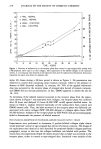
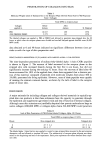
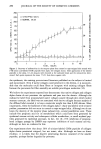
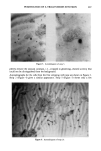
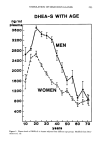
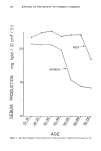
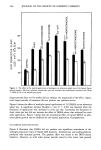
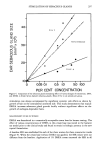
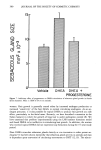
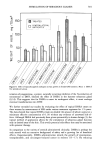
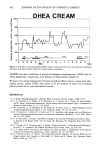
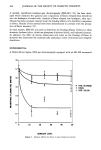
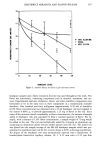
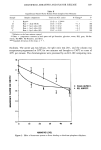
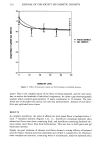
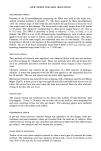
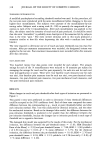
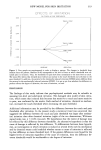
292 JOURNAL OF THE SOCIETY OF COSMETIC CHEMISTS Circulating DHEA-S is higher in men than in women, and has an age-related decline (Figure 1). Because of the high testicular output of testosterone, sebum production does not change substantially with age in men until the seventh decade. In women, sebum production is primarily dependent upon adrenal androgens (5). Thus the decline in adrenal androgen production after menopause (adrenopause) correlates well with the sharp decrease in sebum output in women (Figure 2). Since the ability of the sebaceous gland to respond to androgens does not diminish with age, local androgen replacement therapy should correct this systemic deficiency and return sebum production to its pre-menopausal level. This paper describes studies conducted on laboratory animals and human beings which demonstrate that DHEA has a unique, local sebotrophic effect. MATERIALS AND METHODS ANIMALS Syrian golden hamsters (SGH) were purchased from Harlan-Sprague Dawley (Farmers- burg, IN) at ten weeks of age and allowed to acclimate to the laboratory conditions for at least one week prior to the study. Long-haired Syrian hamsters (LHS) were bred at our facilities. Details of breeding and maintenance conditions of SGH and LHS hamsters can be found in previous publications (7,8). CHEMICALS All steroids used in this study were purchased from Steraloids (Wilton, NH). For an- imal experiments, the steroids were dissolved either in acetone or in a gel vehicle com- posed of 0.9% Abinco gel, 5% myristyl acetate, and isopropyl alcohol (q.s.). For clin- ical studies, various concentrations of DHEA were prepared in an oil-in-water emulsion comprising 22% oil and 5 % emulsifier. SGH EAR SEBACEOUS GLAND TEST The method used in evaluating the effects of steroids on growth of the ventral ear sebaceous glands has been described previously (7,9). Briefly, 50 I•l of each prepara- tion, with or without the steroid, was applied topically on the right ventral ear skin of adult female Syrian golden hamsters (11-12 weeks of age). The left ear was untreated to serve as an indicator of systemic effects, if any, of the topically applied preparation. Controls received 50 I•l of the vehicle alone to the right ear. Unless otherwise specified, treatments were given daily in the morning (except weekends). After two weeks of treatment, the animals were sacrificed by cervical dislocation. The ear was excised and the ventral skin was separated from the dorsal skin manually using forceps. The cartilage, attached to the ventral skin, was scraped off with a scalpel. The skin was stained with 0.1% Sudan Black B for two hours followed by an overnight wash in 85% propylene glycol. After fixation in 10% phosphate-buffered formalin, a 2-mm punch biopsy was taken from the medial zone and mounted on a microscope slide with the dermal side up. The sebaceous gland size was quantitated by image analysis as previously described (7).

STIMULATION OF SEBACEOUS GLANDS 293 ng/rnl plasma 3600 3200 2800 2400 2000 1600 1200 800 400 DHEA-S WITH AGE I - I MEN MEN ,•.& 10 20 30 40 50 60 70 yeare Figure 1. Plasma levels of DHEA-S in human subjects from different age groups. Modified from Oren- treich et al. (4).
Purchased for the exclusive use of nofirst nolast (unknown)
From: SCC Media Library & Resource Center (library.scconline.org)