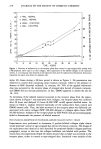
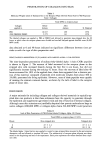
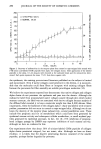
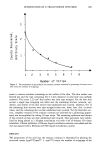
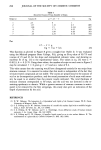
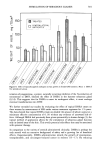
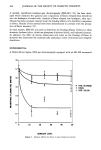
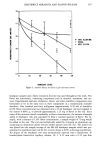
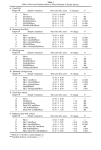
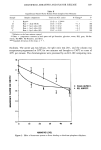
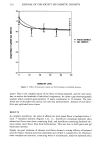
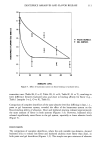
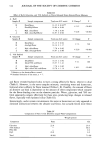
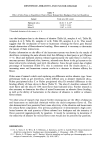
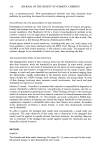
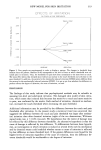
PENETRATION OF COLLAGEN INTO SKIN 279 Table I Molecular Weight Limit of Radioactivity in the Receptor Phase Derived From Native [3H]-Propionyl Type I Collagen Total DPM in receptor phase Collagen Before After applied in dialysis dialysis % Dialyzed PBS 10,917 299 97% 20% PBS/80% DMSO 5,575 141 97% The labeled collagen was applied in PBS or DMSO and allowed to penetrate tape-stripped skin for 48 hours, at which time the receptor phases were divided and one-half dialyzed against distilled water (8,000 MW cutoff). data obtained at 0 and 48 hours indicated no significant differences between time pe- riods or with the type of skin preparation used. PERCUTANEOUS ABSORPTION OF [3H]-AMINO ACID-LABELED ALPHA 1 CNBr PEPTIDES The time-dependent penetration of radioactively-labeled alpha I chain CNBr peptides is shown in Figure 2. The amount of label recovered in the receptor phase in the stripped skin cells increased linearly during the first five to six hours, but did not significantly increase during the ensuing 42 hours. Since the recovery of label after 48 hours accounted for 30% of the applied dose, these data suggested that a discrete por- tion of this material, composed of peptides with molecular weights from about 300 to 24,000, penetrated the living epidermis. However, none of these peptides were capable of crossing the stratum corneum barrier, as shown by the lack of label in the receptor phase of intact skin. DISCUSSION A major rationale for including collagen and collagen-derived materials in topically-ap- plied skin care products is that these substances have the capacity to penetrate through the epidermis and supplement age-related voids and loss of function of dermal collagen. Although most skin scientists are justifiably skeptical that protein molecules as large as native collagen (288,000 MW) or collagen alpha chains (96,000 MW) could penetrate Table II Lack of Skin Penetration of [3H]-Proline-Labeled Collagen Alpha 1(I) Chains Total DPM in receptor phase (-S.D.) Hours Non-stripped skin Stripped skin 0 67 - 2.4 67 - 2.4 48 83 ___ 17 83 --- 16 The labeled alpha 1 chain fraction was applied to control or tape-stripped skin mounted in the percutaneous absorption cell and allowed to incubate 48 hours. The radioactivity of receptor phase aliquots was deter- mined at the beginning and end of the experiment. Each point represents the values obtained from tripli- cate cells.

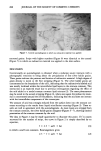
280 JOURNAL OF THE SOCIETY OF COSMETIC CHEMISTS o o 25O 225 A STRIPPED SKI N o NORMRL SKIN 200 o 1 E 3 4 5 8 48 TIME, HOURS 30 ¸ z0 .z ¸ 10 • 0 ¸ Figure 2. Recovery of radioactivity in the receptor phase from control or tape-stripped skin treated with [3H]-amino acid-labeled CNBr peptides from alpha 1(I) collagen chains. After application of the labeled peptides to the skins, 0.1-ml aliquots were removed at the indicated times and the radioactivity deter- mined. Each point represents the mean _+ S.D. from three separate cells. the epidermis, the existing peer-reviewed literature published on the subject is limited and inconclusive. Even if native collagen could penetrate to the dermis, it is inconceiv- able that the molecules could form fibers or integrate with existing collagen fibers because the precursors for fiber assembly are soluble procollagen molecules (14). We believe the experiments reported here demonstrate that native collagen and collagen alpha chains do not penetrate the epidermis and pass into the dermis. Although the radioactive label from propionylated native collagen passed through skin which lacked stratum corneum, the label was not associated with native collagen because analysis of the diffused label revealed it to have a molecular weight less than 8,000 daltons. More importantly, when the backbone of the collagen alpha 1 chain was labeled with tritiated proline, penetration did not occur in control or tape-stripped skin. Although we do not know the identity of the receptor phase radioactivity, several possibilities exist. These include free propionic acid (or its metabolites) which could have been generated by epidermal esterase activity and subsequent cellular metabolism, or small acylated pep- tides generated by epidermal proteases. In fact, the 10-15% inhibition of propiony- lated collagen passage by DMSO may represent inhibition of such enzyme activity, although we have no evidence for this. Our experiments show that about 30% of tritium-labeled CNBr peptides of collagen alpha chains penetrated stripped, but not intact, skin. Although we have no direct evidence, it is likely that the discrete penetrating fraction consisted of the smaller peptides, perhaps further degraded by proteases.
Purchased for the exclusive use of nofirst nolast (unknown)
From: SCC Media Library & Resource Center (library.scconline.org)