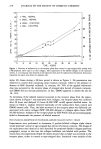
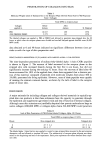
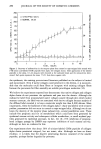
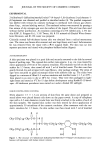
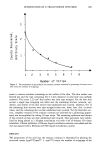
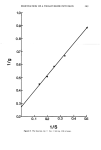
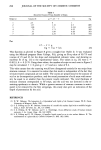
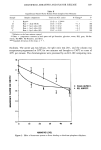
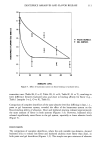
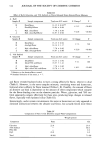
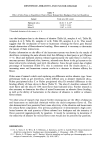
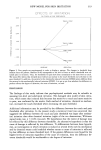
290 JOURNAL OF THE SOCIETY OF COSMETIC CHEMISTS Table I Recovered Counts Versus Number of Strips Strips (s) Counts (f) g = 2.5 - f 1/s 1/g 1 2.5 0 1 2 1.37 1.13 0.5 .885 3 1.00 1.5 0.333 .667 4 .79 1.71 0.25 .585 5 .51 1.99 0.20 .503 7 .25 2.25 0.14 .444 Put 2.5-f=g 1/g = 1/as q- b/a [3] This function as plotted in Figure 8 gives a straight line (Table I). It was evaluated using the Minitab program (State College, PA), giving an R-sq value of 99.7% and t-ratios of 23 and 33 for the slope and extrapolated ordinate value, and showing an excellent fit of eq. [1] to the experimental values. The values in eq. [3] were a = 0.8133, b = 0.2170. Using these values, the number of strips to reach zero in Figure 2 may be calculated. f = 0 gives g = 2.5 and an s value of 9.2. This value means that the counting would have disappeared entirely for ten strips from stratum corneum. It is essential to realize that this result is independent of the fact that tritium-treated compounds are not stable. The counts are proportional to the amount of acid or its decomposition products, and the actual penetration of acid must with neces- sity be equal to or smaller than the present results indicated. The total thickness of stratum corneum corresponded to 50 strips, and the acid was not detected in the re- maining epidermis or dermis. While a greater amount of stratum corneum is antici- pated to be removed by the first strippings, this study does give an indication of the depth of penetration by the acid. REFERENCES (1) D. W. Osborne, The Interaction of a Glyceridacid with Lipids of the Stratum Corneum, Ph.D. thesis, University of Missouri-Rolla, 1985. (2) S. E. Friberg and D. W. Osborne, Interaction of a model skin surface lipid with a modified triglyc- eride, J. Amer, Oil Chem. Soc., 63, 123 (1986). (3) S. E. Friberg, D. W. Osborne, and T. L. Tombridge, X-ray diffraction study of human stratum corneum,J. Soc. Cosmet. Chem., 36, 349 (1985). (4) S. E. Friberg and D. W. Osborne, A lamellar liquid crystal as an in situ surface balance. II. The conformation of a glyceridacid, Colloid & Polymer Sci. 264, 182 (1986).

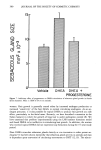
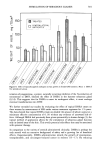
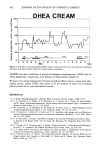
j. Soc. Cosmet. Chem., 39, 291-303 (September/October 1988) Local stimulation of sebaceous gland activity by the topical administration of dehydroepiandrosterone NORMAN ORENTREICH and JONATHAN R. MATIAS, Biomedical Research Station, Orentreich Foundation for the Advancement of Science, Inc., RD 2, Box 375, Cold Spring, NY 10516 (N.O., J.R.M.), Orentreich Medical Group, 909 Fifth Avenue, New York, NY 10021 (N. O. , J.R.M. ), and Department of Dermatology, NYU School of Medicine, 550 First Avenue, New York, NY 10016 (N.O.). Received January 25, 1988. Synopsis Topical preparations of an adrenal steroid, dehydroepiandrosterone (DHEA), were tested experimentally in laboratory animals and clinically in women. When applied topically at a concentration of 1%, DHEA stimulated growth of the ventral ear skin sebaceous glands of female Syrian hamsters by approximately 80% after two weeks of daily application without any evidence of systemic effects. Dose-response studies demon- strated that topical DHEA was effective at concentrations as low as 0.1%. Systemic side effects, as measured by gland size of the contralateral ear, were absent even with concentrations up to 5 % or with applications of 1% DHEA up to three times per day. Topical DHEA did not induce hirsutism since hair growth-pro- moting effects were not observed in the androgen-dependent hair of the long-haired Syrian hamster. Sebum excretion rate was also measured in women over a ! V2 year period on alternating treatments of placebo and DHEA creams. Topical DHEA doubled sebum production in women at a minimum effective dose of 0.1%, without any evidence of untoward side effects. These studies demonstrate that the topical application of DHEA is safe and effective in stimulating sebum production in women with reduced sebum output usually associated with menopause. INTRODUCTION Dehydroepiandrosterone (DHEA), first isolated 50 years ago by Butenandt, is secreted by the zona reticularis of the adrenal cortex and is rapidly conjugated by the liver to DHEA-sulfate (DHEA-S) (1,2). As a pro-hormone, DHEA and its sulfate can be enzy- matically converted to either androgens or estrogens, depending upon the tissue. Trans- formation of DHEA into 1713-estradiol and estrone is greatest, for example, in the corpus luteum or the placenta. In androgen target tissues, such as the prostate and the skin, DHEA is converted to androstenedione and from there to other androgens. In sebaceous glands, it has been shown that oral DHEA can stimulate sebum production, via conversion, to dihydrotestosterone (DHT), the active androgen required for seba- ceous gland growth (3). 291
Purchased for the exclusive use of nofirst nolast (unknown)
From: SCC Media Library & Resource Center (library.scconline.org)