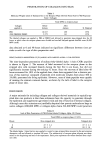
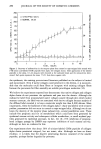
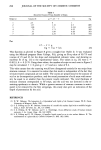
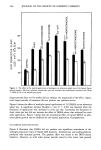
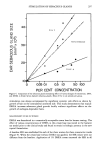
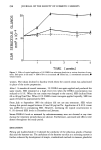
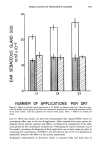
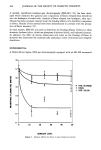
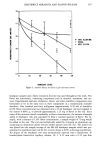
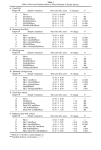
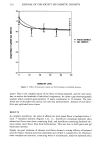
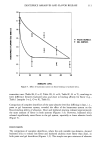
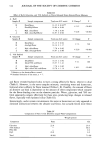
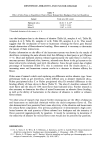
DENTIFRICE ABRASIVES AND FLAVOR RELEASE 313 Table V Effect of Silica Type on Equilibrium Passive Flavor Released Into Headspace From Gel Dentifrices Sample Total area (GC units) Hydrated silica 10.82 ñ 0.22* Silica C 11.20 ñ 0.42 Silica D 11.87 ñ 0.19 * Standard deviation of the mean n = 6. into the headspace than in the absence of abrasive (Table IA, samples A vs I Table IB, samples A vs J Table IC, samples A vs K Table ID, samples A vs L). This would suggest that the mechanism of water or humectant releasing the flavor goes beyond simple destruction of flavor-abrasive bonding. More research is necessary to determine the nature of these interactions. Further information on the effect of the humectant system was shown by the results of dentifrices containing the same abrasive level but differing in base (paste or gel) (Figures 3-5). Dical and hydrated alumina released approximately the same flavor in both hu- mectant systems. Hydrated silica, however, released more flavor in the gel system at the lower silica levels commonly used with this abrasive. Since the gel system has a higher percentage of humectant (Table IV), this is consistent with the results above i.e., increasing water and humectant content results in a decrease in abrasive affinity for flavor. Other areas of research which need exploring are differences within abrasive type. Some preliminary work on gel dentifrices, which differed only in abrasive (hydrated silica, Huber precipitated silica C or Huber precipitated silica D) revealed differences in the binding affinity of these silicas to flavor (Table V). The silica C dentifrice released 4% more flavor and the silica D 10% more flavor than hydrated silica. Further research is also necessary to determine the effect of mixed humectants on abrasive flavor binding, as well as the ability of humectants in the absence of abrasives to inhibit or enhance flavor release. Yet other areas of research that require further investigation are the effect of abrasives and humectants on individual chemicals within the multi-component flavor oil. The data demonstrated (not presented here) some selectivity of the abrasives and humectants for certain flavor components. Our previous publication (1) demonstrated a high corre- lation between the total quantity of flavor released into headspace and the intensity of flavor perceived organoleptically by panelists. It would be interesting to determine if the selectivity of abrasive for various flavor tones would also be perceived by panelists. REFERENCES (1) E. A. Tavss, S. G. Wiet, R. S. Robinson, J. Santalucia, and D. L. Carroll, Flavor characterization of dentifrices using kinetic headspace-gas chromatography, J. Chromatogr., 438, 273 (1988). (2) C. Bicchi, A. D'Amato, and C. Frattini, Selective sampling and capillary gas chromatography in the analysis of essential oils, Chromatographia, 23, 818 (1987).

314 JOURNAL OF THE SOCIETY OF COSMETIC CHEMISTS (3) O. J. Ferrer and R. F. Matthews, Terpene reduction in cold-pressed orange oil by frontal analysis-dis- placement adsorption chromatography, J. Food Sci., 52, 801 (1987). (4) J. J. C. Scheffer, A. Koedam, and A. Baerheim-Svendsen, Occurance and prevention of isomerization of some monoterpene hydrocarbons from essential oils during liquid-solid chromatography on silica gel, Chromatographia, 9, 425 (1976). (5) J. Drozd, J. Novak, and J. A. Rijks, Quantitative and qualitative headspace gas analysis of parts per billion amounts of hydrocarbons in water. A study of model systems by capillary-column gas chroma- tography with splitless sample injection, J. Chromatogr., 158, 471 (1978). (6) N. C. Jain and R. H. Cravey, Analysis of alcohol. II. A review of gas chromatographic methods, J. Chromatogr. Sci., 10, 263 (1972). (7) R. H. Cravey and N. C. Jain, Current status of blood alcohol methods, J. Chromatogr. Sci., 12, 209 (1974). (8) H. Hachenberg and A. P. Schmidt, Gas Chromatographic Headspace Analysis (Heyden, London, 1977), p. 81. (9) B. Kolb, Application of an automated head-space procedure for trace analysis by gas chromatography, J. Chromatogr., 122, 553 (1976). (10) J. M. Zechman, $. Aldinger, and J. N. Labows, Jr., Characterization of pathogenic bacteria by automated headspace concentration-gas chromatography, J. Chromatogr., 277, 49 (1986). (11) P. L. Wylie, Headspace analysis with cryogenic focusing: A procedure for increasing the sensitivity of automated capillary headspace analysis, Chromatographia, 21, 251 (1986). (12) A. J. Nunez and H. Maarse, Headspace methods for volatile components of grapefruit juice, Chroma- tographia, 21, 44 (1986). (13) W. Wellnitz-Ruen, G. A. Reineccius, and E. L. Thomas, Analysis of the fruity off-flavor in milk using headspace concentration capillary column gas chromatography, J. Agric. Food Chemistry, 30, 512 (1982). (14) G. Takeska and W. Jennings, Developments in the analysis of headspace volatiles: On-column injec- tions into fused silica capillaries and split injections with a low-temperature bonded PEG stationary phase, J. Chromatogr. Sd., 22, 177 (1984). (15) R. Robinson, E. Tavss, J. Santalucia, and D. Carroll, Flavor characterization of dentifrices using equilibrium headspace-gas chromatography, J. Chromatogr., accepted for publication, 1988.
Purchased for the exclusive use of nofirst nolast (unknown)
From: SCC Media Library & Resource Center (library.scconline.org)