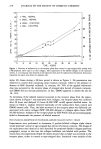
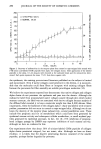
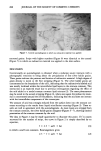
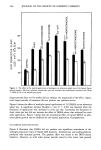
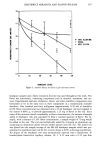
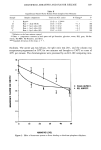
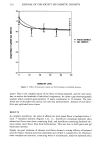
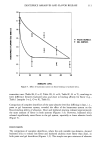
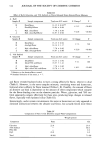
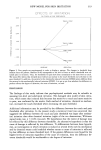
NEW MODEL FOR SKIN IRRITATION 319 4.00 EFFECTS OF IRRITATION ON TOUCH & PAIN THRESHOLDS 5.00 - 2.00 - 1.00 - 0.00 --1.00 - --2.00 TOUCH STRIP x? ?' //' // / / ,/ TOUCH OHEM BASELIN E I RRITATIO N Figure l. Four graphs are superimposed in order to display a pattern. The changes in threshold from baseline form the pattern. Baseline (0.00) corresponds to the level of force at which thresholds were ob- tained prior to irritation. Thus, the thresholds for pain have been normalized to the same level as touch. The main effect shows that irritated skin evidences an increase in the touch threshold and a decrease in the pain threshold. In addition, the pattern for the chemically induced irritation (CHEM) seems different from the pattern for the mechanically induced irritation (STRIP). It is not as yet clear whether this difference in pattern reflects the degree of irritation, the cause of irritation, or both. DISCUSSION The findings of this study indicate that psychophysical methods may be valuable in assessing low-level and subclinical irritation. The damaged skin model of skin irrita- tion, which states that irritated skin becomes less sensitive to touch and more sensitive to pain, was confirmed by the results. Each method of irritation, chemical or mechan- ical, increased the touch threshold while decreasing the pain threshold. Additional information may be provided by the difference between the touch and pain thresholds after irritation. In the present study a statistical trend was uncovered that suggested the difference between the touch and pain thresholds was larger after mechan- ical irritation than after chemical irritation (eight of the ten observations Wilcoxon signed ranks test, p 0.09 two-tail). We hypothesize that the extent of damage may be reflected by this difference between thresholds. An alternative hypothesis is that the cause of damage is reflected by this difference. To differentiate between these hypoth- eses, an investigation in which irritation is induced at several levels each by mechanical and by chemical means could establish whether extent or cause of irritation is reflected by that difference in mean threshold level. If the greater differences were found for the higher levels of irritation regardless of the cause of irritation, then the difference be- tween thresholds would be attributable to the degree of irritation.

320 JOURNAL OF THE SOCIETY OF COSMETIC CHEMISTS Finally, we note that for the chemically induced irritation, the pain threshold changed more than the touch threshold, a pattern which was reversed for the mechanically in- duced irritation. Perhaps the threshold which changes more reflects the extent of the irritation the alternative hypothesis is that the cause of irritation is reflected. In the investigation suggested above, if the pain thresholds changed more than the touch thresholds for the chemically induced irritation regardless of the level of irritation, then the cause of irritation would be attributable to a greater change in pain than touch thresholds. ACKNOWLEDGMENT The authors thank Jeffrey Naier for his assistance in data collection, data analysis, and preparation of this manuscript. REFERENCES (1) S. W. Babulak, L. D. Rhein, D. D. Scala, F. A. Simion, and G. L. Grove, Quantification of ery- thema in a soap chamber test using the Minolta Chroma (Reflectance) Meter: Comparison of instru- mental results with visual assessment. J. Soc. Cosmet. Chem., 37, 475-479 (1986). (2) P. B. Koehler, Clinical aspects of safety testing cosmetic products in the nineteen-eighties. J. Soc. Cosmet. Chem., 31, 213-218 (1980). (3) M. B. Finkey, Evaluation of subjective irritation induced by soap materials,J. Soc. Cosmet. Chem., 82, 153-162 (1987). (4) H. R. Moskowitz, Cosmetic Product Testing.' A Modern Psychophysical Approach (Marcel Dekker, New York, 1984). (5) S. Weinstein, Effects of local anesthetics on tactile sensitivity thresholds for cutaneous and mucous membranes, J. Invest. Dermatol. 69, 136-145 (1977). (6) S. Weinstein, "Intensive and Extensive Aspects of Tactile Sensitivity as a Function of Body Part, Sex and Laterality," in The Skin Senses, D. R. Kenshalo, Ed. (Thomas, Springfield, Illinois, 1968), pp. 195-218. (7) D. Sinclair, Mechanisms of Cutaneous Sensation (Oxford, New York, 1981), p. 236. (8) C. Weinstein and R. Drozdenko, On measuring skin irritation. Paper presented at a symposium: Skin Irritation: Definitions, Measurements, and Problems. NeuroCommunication Research Laboratories, Inc., Danbury, CT (1982). (9) S. Weinstein, C. Weinstein, and R. Drozdenko, Quantification of Damaged or Irritated Tissues Employing Somatosensation (NeuroCommunication Research Laboratories, Inc., Danbury, CT, 1984). (10) C. Weinstein, Memo to Our Clients.' If It's Subclinical, Then Why Investigate Subclinical Irritation? TR-1-85. (NeuroCommunication Research Laboratories, Inc, Danbury, CT, 1985). (11) S. Weinstein, R. Drozdenko, and C. Weinstein, Objective claims substantiation for cosmetic and pharmaceutical products, based upon measurement of sensory, perceptual, analgesic, pruritic, and irritative effects. Clinical Research Practices & Drug Regulatory Affairs, 4, 143-172 (1986).
Purchased for the exclusive use of nofirst nolast (unknown)
From: SCC Media Library & Resource Center (library.scconline.org)