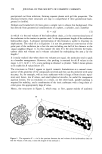
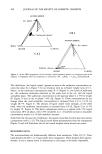
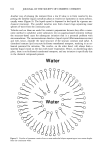
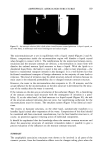
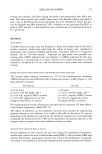
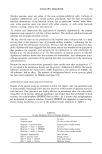
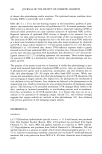
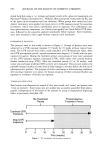
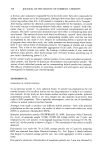
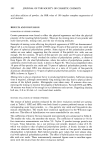
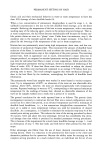
164 JOURNAL OF THE SOCIETY OF COSMETIC CHEMISTS Another way of relaxing the restraint from a low R value is to form vesicles by dis- persing the lamellar liquid crystalline phase as vesicles (or liposomes) in excess solvent, usually water (Figure 9). The liquid crystal is dispersed in the liquid by vigorous me- chanical treatment. The parallel lamellae now form closed rings separating inner spheres of water from the continuous part. Vehicles such as these are useful for cosmetic preparations because they offer a conve- nient method to solubilize active substances into an aqueous-based ointment without the structure-based cause for subsequent irritation that is a potential problem with microemulsions. The microemulsions dissolve a liquid crystal (Microemulsions section) and will, hence, disorder the lipid structure of the stratum corneum (vide infra). A disordered stratum lipid structure facilitates transdermal transport, resulting in an en- hanced potential for irritation. The vesicles, on the other hand, will always form a lamellar liquid crystal on the skin with water evaporation. Hence, no disordering takes place, there is no facilitated transdermal transport, and any irritation is specifically due to the chemical compounds present. Water o------ ------o Water Figure 9. Vesicles or liposomes consist of one or more molecular bilayers separating an inner water droplet from the continuous water.

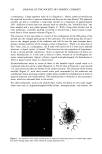
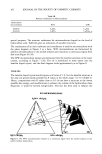
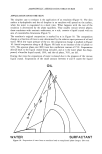
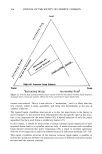
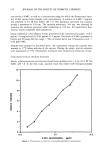
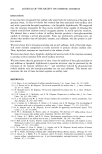
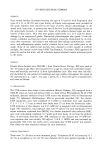
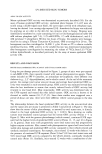
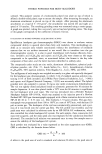
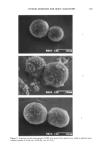
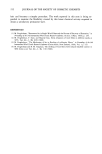
AMPHIPHILIC ASSOCIATION STRUCTURES 165 APPLICATION ONTO THE SKIN The simplest case to evaluate is the application of an emulsion (Figure 5). The skin surface is hydrophobic and the oil droplets in an emulsion will spread on the surface, while the water is evaporated in a short time. What happens with the rest of the emulsion is determined by the phase equilibria. They usually contain several phases those emulsions with nonionic surfactants, as a rule, contain a liquid crystal with an area of considerable dimensions (Figure 5). The emulsion's original composition is marked by ot in Figure 10. The composition change as a function of time is now determined by the relative vapor pressure of oil and water. With low vapor pressure of the oil, the composition change is marked in Figure 10. Initial evaporation along or-lB (Figure 10) leads to an increase of the oil phase to 52%. The aqueous phase one (48%) now has a surfactant content of 15%. Evaporation after {3 leads to the liquid crystal being included, and at •/the water phase has disap- peared a lamellar liquid crystal, 30%, and the oil phase, 70%, are left. During that time the evaporation of water is slowed due to the presence of the viscous liquid crystal. Evaporation of the small amount between •/ and $ causes the liquid OIL WATER SURFACTANT Figure 10. Evaporation of water from an emulsion leads to complicated phase changes. (See text).
Purchased for the exclusive use of nofirst nolast (unknown)
From: SCC Media Library & Resource Center (library.scconline.org)